brotherbobby
- 806
- 178
- Homework Statement
- A clever student has found that the density profile of the earth atmosphere is ##\rho=\rho_0 \exp(-z/z_0)##, where ##z## is the height above sea level and ##\rho_0## is the density at sea level (##1.28\; \text{kg/m}^3##). If ##z_0## is the ##\text{scale height}## of the atmosphere, determine its value.
- Relevant Equations
- The pressure at a point in a fluid ##P = \frac{dF}{dA}## where ##dF## is the infinitesimal force exerted by the fluid on an element of area ##dA##, irrespective on how it is aligned.
I want to begin by writing the problem and drawing its sketch to make things clearer on what is being asked for.
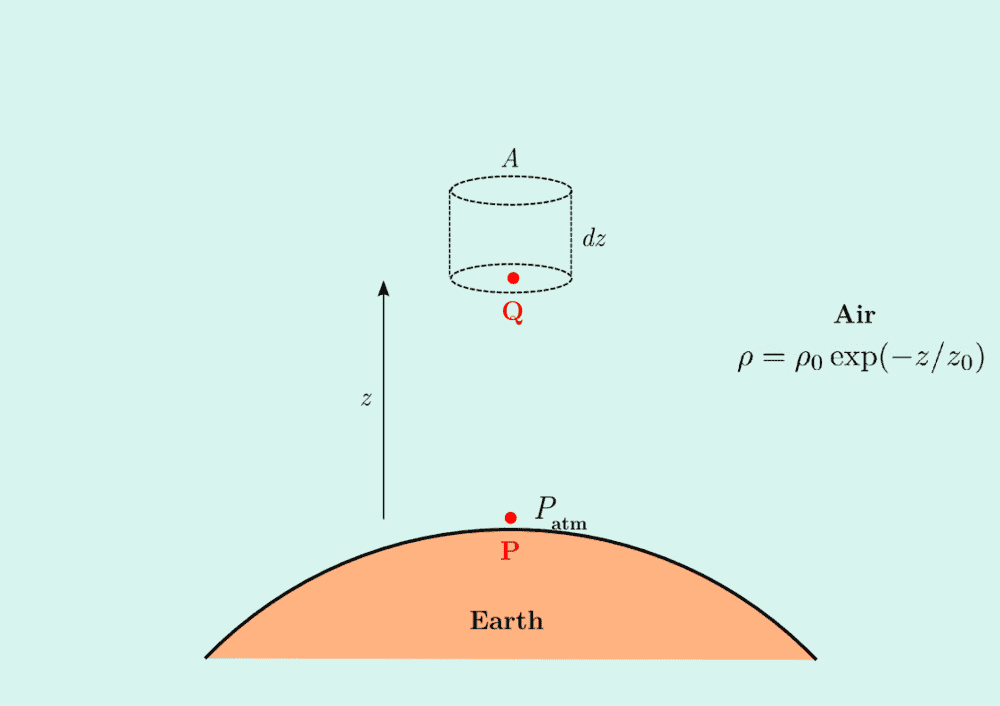 Given : In the sketch shown to the right, the density profile of air with increasing ##z## is given by ##\rho=\rho_0 \exp(-z/z_0)##. Since we know the value of atmospheric pressure at sea level (say at a point P) ##\left( P_{\text{atm}} = 1.013\times 10^5\; \text{Pascal}\right)##, we can use it to find the value of ##\mathbf{z_0}##, the scale height of the atmosphere.
Note : For decreasing air density with height, ##z_0 > 0##.
Attempt : Let us imagine a capsule of air of cross section area ##A## and thickness ##dz## located at a height ##z## above the Earth surface. The infinitesimal pressure at Q due to this ##dP = \frac{dF}{A} = \frac{dw}{A}= \frac{g dm}{A} = \frac{g \rho(z) d\tau}{A} = \rho(z) g dz## (well known!).
Integrating, remembering that ##P(z=\infty) = 0## and ##P(z=0) = P_{\text{atm}}##, we have : $$\int_0^{P_{\text{atm}}} dP = g \rho_0 \int_{\infty}^0 e^{-z/z_0} dz \Rightarrow P_{\text{atm}} = -\rho_0 g z_0\;\; \cancelto{1}{\left[e^{-z/z_0}\right]_{\infty}^0}$$
This leads to $$z_0 = \frac{P_{\text{atm}}}{-\rho_0 g} = \frac{-1.013\times 10^5}{1.28 \times 9.8} = \boxed{-8.07 \times 10^3\; \text{m}}$$.
Answer : The answer from the book is the same, but positive (as it should be!) ##\boxed{z_0 = 8.1\times 10^3\; \text{m} }##.
Where am I mistaken?
Note : For decreasing air density with height, ##z_0 > 0##.
Attempt : Let us imagine a capsule of air of cross section area ##A## and thickness ##dz## located at a height ##z## above the Earth surface. The infinitesimal pressure at Q due to this ##dP = \frac{dF}{A} = \frac{dw}{A}= \frac{g dm}{A} = \frac{g \rho(z) d\tau}{A} = \rho(z) g dz## (well known!).
Integrating, remembering that ##P(z=\infty) = 0## and ##P(z=0) = P_{\text{atm}}##, we have : $$\int_0^{P_{\text{atm}}} dP = g \rho_0 \int_{\infty}^0 e^{-z/z_0} dz \Rightarrow P_{\text{atm}} = -\rho_0 g z_0\;\; \cancelto{1}{\left[e^{-z/z_0}\right]_{\infty}^0}$$
This leads to $$z_0 = \frac{P_{\text{atm}}}{-\rho_0 g} = \frac{-1.013\times 10^5}{1.28 \times 9.8} = \boxed{-8.07 \times 10^3\; \text{m}}$$.
Answer : The answer from the book is the same, but positive (as it should be!) ##\boxed{z_0 = 8.1\times 10^3\; \text{m} }##.
Where am I mistaken?
Last edited: