Share Animal Pictures: For Animal Lovers
- Thread starter micromass
- Start date
-
- Tags
- Animal
Join the discussion
Registration is free. Ask a follow-up in this thread, or start your own.
3,073 replies · 328K views
Physics news on Phys.org
DennisN
Gold Member
- 2,197
- 10,329
What a monster!BillTre said:Here is a clip from Jeremy Wade in River Monsters (my daughter (field biologist) used to love this show) catching a Goliath Tigerfish. It is one of the scariest freshwater fish.
 I had never heard about it.
- 20,819
- 28,467
Science Advisor
Gold Member
- 2,856
- 12,707
These are baby caecillians. Limbless, tailless amphibians.
The picture is from this NY Times article on them.
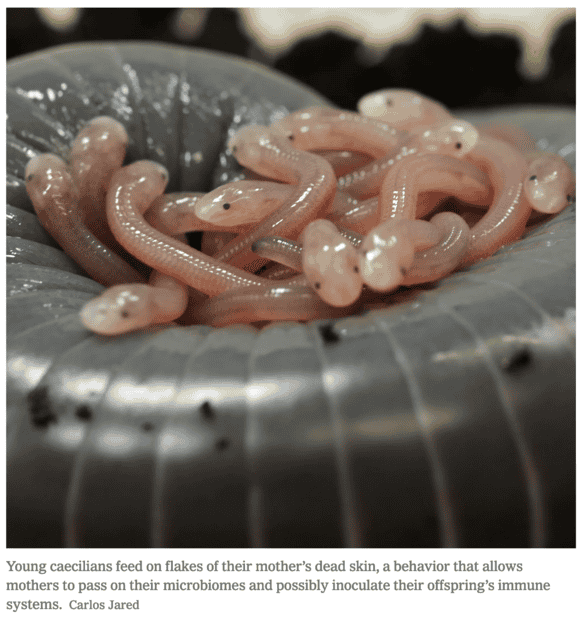
I used to keep some of these. I was trying to get them to breed.
They fertilize internally. Some species have a 21 month gestation period.
They are weird and interesting pets. They are strong worm-like things and great escape artists (making them a challenge to keep).
Some are terrestrial, but those available through the pet trade are usually aquatic species. Caecillians also shed their skin, somewhat like snakes (not related). They are now difficult to get because it has become a hassle to import them, especially since they are "weird" and a lot of people don't know what they are.
I had some that grew too about 2.5 feet.
They are excellent for sending to school with a kid for show and tell. Harmless, very active when picked up and have a slimy skin. (Beware, some teachers might freak out).
The picture is from this NY Times article on them.
I used to keep some of these. I was trying to get them to breed.
They fertilize internally. Some species have a 21 month gestation period.
They are weird and interesting pets. They are strong worm-like things and great escape artists (making them a challenge to keep).
Some are terrestrial, but those available through the pet trade are usually aquatic species. Caecillians also shed their skin, somewhat like snakes (not related). They are now difficult to get because it has become a hassle to import them, especially since they are "weird" and a lot of people don't know what they are.
I had some that grew too about 2.5 feet.
They are excellent for sending to school with a kid for show and tell. Harmless, very active when picked up and have a slimy skin. (Beware, some teachers might freak out).
Science Advisor
- 3,766
- 2,215
Aren't those a Klingon delicacy, seen occasionally on Star Trek?BillTre said:These are baby caecillians. [...]
DennisN
Gold Member
- 2,197
- 10,329
- 13,926
- 16,804
I've heard of bookworms. Bookdogs are new to me...

DennisN
Gold Member
- 2,197
- 10,329
Point Conception
Gold Member
- 1,185
- 1,959
My Thai girlfriend loves her cat

Point Conception
Gold Member
- 1,185
- 1,959
Science Advisor
- 3,766
- 2,215
The cat doesn't seem quite as keen...morrobay said:My Thai girlfriend loves her cat
Caption for the cat: "Oh dear lord! I know I have to put up with this, but... sheesh!"
- 20,819
- 28,467
Nature wins. Always!

Admin
- 69,782
- 25,630
- 13,926
- 16,804
Anybody else think the eagle on the right is saying "One more squawk out of you, young man..."?
- 20,819
- 28,467
Science Advisor
Homework Helper
Gold Member
- 5,629
- 1,778
Looks like he's going, "Oh s**t, forgot the 'turtle'."fresh_42 said:
OCR
- 996
- 936
Bystander said:Looks like he's going, "Oh s**t, forgot the 'turtle'."
I think it was an eagle. . .
.
Point Conception
Gold Member
- 1,185
- 1,959
You really are better off programing your self to hit the deer. https://www.thesilverlining.com/safety-tips/deer-vs.-car-collisions
Admin
- 69,782
- 25,630
Well, not necessarily hit the deerbie, but do your best to brake in a straight line to minimize any injuries or damage. And the corrollary is to always follow other vehicles at a safe distance so you can brake and avoid a collision if they slam on their brakes for a reason that you don't immediately see. Don't ask me how I know this...morrobay said:You really are better off programing your self to hit the deer. https://www.thesilverlining.com/safety-tips/deer-vs.-car-collisions

- 20,819
- 28,467
It also depends on the mass and shape. E.g. collision with a horse can be deadly, and a deer with big antlers crashing through your windshield? I don't know, doesn't sound like a good idea. The advice is because people crash with trees trying to escape the situation which is definitely worse than crashing with an animal.berkeman said:Well, not necessarily hit the deerbie, but do your best to brake in a straight line to minimize any injuries or damage. And the corrollary is to always follow other vehicles at a safe distance so you can brake and avoid a collision if they slam on their brakes for a reason that you don't immediately see. Don't ask me how I know this...
A pilot once said to me: Airplanes are actually very safe as long as you have sufficient altitude. And driving cars through their territory is safe as long as you are sufficiently slow.
DennisN
Gold Member
- 2,197
- 10,329
berkeman said:And the corrollary is to always follow other vehicles at a safe distance so you can brake and avoid a collision if they slam on their brakes for a reason that you don't immediately see.
In Sweden I've been taught a "three seconds" rule/guideline, which basically means you keep a minimum distance (to the car in front of you) which corresponds to three seconds, in order to give time for reaction and braking.
You measure the time by taking a mental note when the car in front of you passes a certain thing (e.g some line on the road, a sign, a tree or something). Then you count "1001, 1002, 1003" and note when you pass the same thing. If you pass the thing before "1003" you are too close to the car in front.
I don't know if this is a widespread guideline, but I thought I could share it.
Regarding close calls, I remember we once were very close to colliding with a moose who had decided to cross the road during twilight. Luckily my father had quick reactions and good control of the car. It was darn scary, the moose was BIG.
Science Advisor
- 3,766
- 2,215
On motorways (~110 kph) in my part of the world, some/many drivers instinctively use the rule "1, oh that'll do".DennisN said:You measure the time by taking a mental note when the car in front of you passes a certain thing (e.g some line on the road, a sign, a tree or something. Then you count "1001, 1002, 1003" and note when you pass the same thing. If you pass the thing before "1003" you are too close to the car in front

- 20,819
- 28,467
Our rule of thumb is "half the tacho", e.g. 60 meters at 120 km/h. Well, that was before ABS and alike. Now that I think of it, your 3 second rule wouldn't work on our highways. No chance.DennisN said:In Sweden I've been taught a "three seconds" rule/guideline, which basically means you keep a minimum distance (to the car in front of you) which corresponds to three seconds, in order to give time for reaction and braking.
You measure the time by taking a mental note when the car in front of you passes a certain thing (e.g some line on the road, a sign, a tree or something. Then you count "1001, 1002, 1003" and note when you pass the same thing. If you pass the thing before "1003" you are too close to the car in front.
I don't know if this is widespread guideline, but I thought I could share it.
I once had a colleague who regularly practiced a turn on the spot (with the help of the handbrake). This transforms the linear moment into a circular moment. But you have to learn it.DennisN said:Regarding close calls, I remember we once were very close to colliding with a moose who had decided to cross the road during twilight. Luckily my father had quick reactions and good control of the car. It was darn scary, the moose was BIG.

- 20,819
- 28,467
Come on over and practice! I have heard that there are travel agencies that offer visits to Germany only to drive on our highways.strangerep said:On motorways (~110 kph) in my part of the world, some/many drivers instinctively use the rule "1, oh that'll do".
I remember when I came back from the US, I tried to drive the same way and obeyed the rules - for two days. I was a moving obstacle. On day three I decided to become a comoving observer again.