Undergrad Sign mistake when computing integral with differential forms

Click For Summary
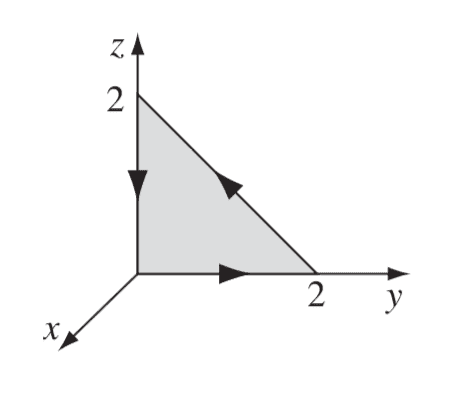
The discussion revolves around the application of Stokes' theorem using differential forms, specifically with the vector field (xy, 2yz, 3zx) and the form ω = xy dx + 2yz dy + 3zx dz. The user computes dω and finds it simplifies to 2y dz dy, but encounters a sign error when integrating, yielding 8/3 instead of the expected -8/3. They suspect the mistake lies in the ordering of the differentials, as the conventions for positive and negative orientations in differential forms may have been overlooked. The user seeks clarity on the intuitive understanding of these conventions and how to determine the correct ordering for integration. Overall, the conversation highlights the complexities of applying differential forms in vector calculus and the importance of adhering to established conventions.
beefbrisket
Messages
6
Reaction score
0
The question provides the vector field (xy, 2yz, 3zx) and asks me to confirm Stokes' theorem (the vector calc version) but I am trying to use the generalized differential forms version. So, I am trying to integrate \omega = xy\,dx + 2yz\,dy + 3zx\,dz along the following triangular boundary \partial \Sigma:
KNFOdZ9.png


First, I try to find \int_\Sigma d\omega. I computed d\omega = x\,dy\,dx + 2y\,dz\,dy + 3z\,dx\,dz which simplifies to 2y\,dz\,dy on \Sigma. However, integrating over the appropriate domain of y,z with that differential gives 8/3 when the answer should be -8/3. I suspect my mistake is in not first reordering 2y\,dz\,dy to -2y\,dy\,dz before integrating, but I'm not clear on the rational behind doing so. I am missing some intuition on what 2y\,dz\,dy and -2y\,dy\,dz "are." In any case, where have I gone wrong?
 

Attachments

  • KNFOdZ9.png
    KNFOdZ9.png
    2.8 KB · Views: 650
Physics news on Phys.org
Could be from differential forms convention ie ##dxdy## , ##dydz## , and ##dzdx## are in the positive direction but ##dydx## , ##dzdy## , and ##dxdz## are in the negative direction.

##dxdy = -dydx## , ##dydz = -dzdy## and ##dzdx = -dxdz##
 
jedishrfu said:
Could be from differential forms convention ie ##dxdy## , ##dydz## , and ##dzdx## are in the positive direction but ##dydx## , ##dzdy## , and ##dxdz## are in the negative direction.

##dxdy = -dydx## , ##dydz = -dzdy## and ##dzdx = -dxdz##

In one of Weintraub's intro texts on differential forms he introduces the "fundamental correspondence" between vectors and differential forms in R^3 (haven't been able to find any other sources using this name) and for the correspondence between vectors and 2-forms he indeed uses that ordering. Is there some intuitive explanation for why it is so? I imagine sometimes we would need to use the negative directions too, any idea how I would know which is the form I am after?
 
There's a vector convention for surfaces as shown in this wikipedia article:

https://en.wikipedia.org/wiki/Curl_(mathematics)

Counterclockwise ie righthand rule where fingers curl and point in the direction of integration and the thumb points in the direction of the normal to the surface considered the positive direction.

You can see it more clearly in the wedge product ie ##dx \wedge dy## which is anticommutative by definition.

Differential forms was a cleaner way of handling vector analysis. (my guess)
 
  • Like
Likes beefbrisket

Similar threads

  • · Replies 3 ·
Replies
3
Views
2K
  • · Replies 19 ·
Replies
19
Views
4K
  • · Replies 1 ·
Replies
1
Views
2K
Replies
6
Views
3K
  • · Replies 24 ·
Replies
24
Views
4K
  • · Replies 3 ·
Replies
3
Views
2K
  • · Replies 2 ·
Replies
2
Views
4K
  • · Replies 5 ·
Replies
5
Views
1K
  • · Replies 12 ·
Replies
12
Views
4K
  • · Replies 6 ·
Replies
6
Views
3K