Simple bending moment calculation

Click For Summary
SUMMARY

The discussion focuses on calculating the maximum bending moment for a beam under specific loading conditions. The user initially calculates reactions at supports using the formula m=wL, yielding values of 0.63 kN and 0.22 kN. However, another participant points out inaccuracies in these reactions and emphasizes the importance of understanding the loading system. They suggest using the equations ΣM = 0 and ΣF = 0 to derive correct reactions and recommend drawing shear and moment diagrams for accurate moment calculations.

PREREQUISITES
  • Understanding of static equilibrium principles, specifically ΣM and ΣF equations.
  • Familiarity with bending moment and shear force diagrams.
  • Basic knowledge of beam loading conditions and support reactions.
  • Proficiency in using mechanical assembly sketches for structural analysis.
NEXT STEPS
  • Learn how to construct shear and moment diagrams for various loading scenarios.
  • Study the principles of static equilibrium in mechanical systems.
  • Explore advanced bending moment calculation techniques for complex beam configurations.
  • Review case studies involving support reactions in structural engineering.
USEFUL FOR

Structural engineers, civil engineering students, and anyone involved in mechanical design and analysis of beams under load.

Wilson123
Messages
58
Reaction score
2
Hi,

Really need some help with figuring out the max bending moment in the diagram shown below (I'm aware this is extremely simple but time and stress appear to have the better of me, so any help is appreciated)
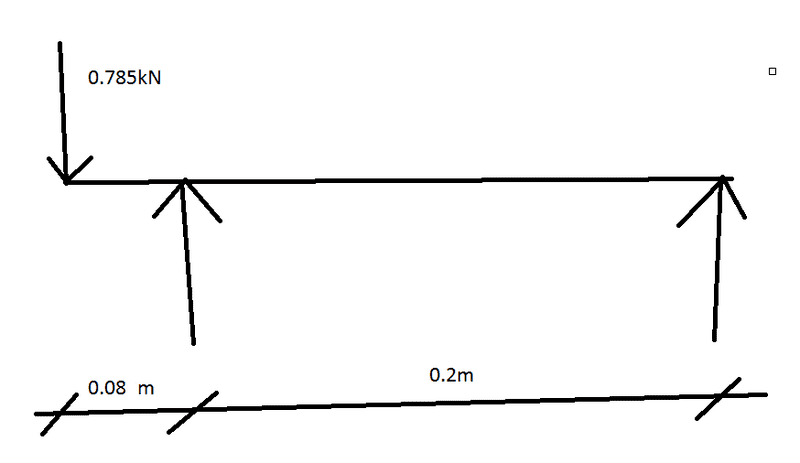
upload_2017-3-10_21-32-47.png


I think I've worked out the reactions at each support by doing m=wL as the following

0.785 x 0.08 = 0.63
0.785 x 0.28 = 0.22

I'm also aware that I could be completely wrong with what I've just put above.

SOS
 
Engineering news on Phys.org
The beam would probably just tip over with the forces acting in the directions shown .

We need to understand the actual loading system more clearly before calculating bending moments .

Can you post a sketch showing the actual mechanical assembly that your line drawing represents ?
 
I don't think the reactions are correct. As drawn, ΣM = 0 = 0.2R + 0.785(0.08) : R = - 0.314 kN : The "-" sign simply implies you have the right reaction, R, acting the opposite direction. ΣF = 0 = - 0.785 - 0.314 + L : The left reaction, L = 1.099 kN : Given the reactions you should be able to calculate the moment.
Draw shear and moment diagrams.
 
  • Like
Likes   Reactions: Wilson123
Vector1962 said:
I don't think the reactions are correct. As drawn, ΣM = 0 = 0.2R + 0.785(0.08) : R = - 0.314 kN : The "-" sign simply implies you have the right reaction, R, acting the opposite direction. ΣF = 0 = - 0.785 - 0.314 + L : The left reaction, L = 1.099 kN : Given the reactions you should be able to calculate the moment.
Draw shear and moment diagrams.

Thanks a lot for your help.
 
Draw a shear diagram first.
 

Similar threads

  • · Replies 2 ·
Replies
2
Views
2K
  • · Replies 2 ·
Replies
2
Views
2K
  • · Replies 1 ·
Replies
1
Views
2K
  • · Replies 6 ·
Replies
6
Views
4K
  • · Replies 4 ·
Replies
4
Views
2K
Replies
5
Views
4K
Replies
3
Views
1K
  • · Replies 1 ·
Replies
1
Views
2K
  • · Replies 5 ·
Replies
5
Views
6K
Replies
3
Views
13K