Simple derivation of the Equations of a Gyroscope

  • Context: High School 
  • Thread starter Thread starter alan123hk
  • Start date Start date
  • Tags Tags
    Derivation Gyroscope
Click For Summary
SUMMARY

The discussion centers on the derivation of mathematical equations that describe the motion behavior of gyroscopes. Participants highlight the complexities of understanding why gyroscopes spin in one direction while gravity attempts to rotate them in another, ultimately leading to precession rather than falling. Key concepts include torque, angular momentum, and the effects of linear momentum on gyroscopic motion. Resources such as HyperPhysics are recommended for further exploration of these principles.

PREREQUISITES
  • Understanding of basic physics concepts, particularly torque and angular momentum.
  • Familiarity with the principles of rotational motion.
  • Knowledge of linear momentum and its relation to angular momentum.
  • Basic mathematical skills for interpreting equations related to gyroscopic motion.
NEXT STEPS
  • Explore the derivation of gyroscopic equations through resources like HyperPhysics.
  • Watch educational videos that illustrate gyroscopic principles and precession.
  • Study the effects of torque on spinning objects in physics simulations.
  • Investigate the relationship between angular momentum and precession in gyroscopes.
USEFUL FOR

Students of physics, educators explaining gyroscopic motion, and anyone interested in the mechanics of rotational dynamics.

alan123hk
Messages
817
Reaction score
450
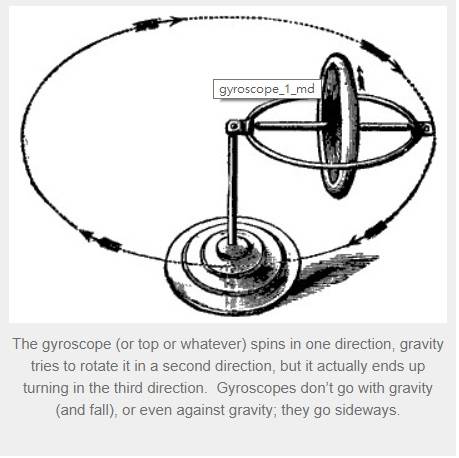
Frankly, it is difficult for me to understand the derivation of mathematical equations that describe and explain the motion behavior of a gyroscope, particularly the reason why it spins in one direction, gravity tries to rotate it in a second direction, but it actually ends up turning in the third direction and dose not fall down.

I'm looking for an as simple and easy to understand as possible way for deriving the equations of gyroscope to help me better understanding the basic principle of it.

Any help would be appreciated.
gyro.jpg
 

Attachments

  • gyro.jpg
    gyro.jpg
    27.6 KB · Views: 2,009
Physics news on Phys.org
alan123hk said:
Frankly, it is difficult for me to understand the derivation of mathematical equations that describe and explain the motion behavior of a gyroscope, particularly the reason why it spins in one direction, gravity tries to rotate it in a second direction, but it actually ends up turning in the third direction and dose not fall down.

I'm looking for an as simple and easy to understand as possible way for deriving the equations of gyroscope to help me better understanding the basic principle of it.

Any help would be appreciated.
View attachment 236714

That's an interesting way to look at it. The gyroscope is supported on its stand. If there were no stand it would fall down! The vertical forces are balanced: gravity down from the centre of mass and the normal force up through the stand. This, however, creates a "torque", which you would normally expect to rotate the object about the point of contact on the stand. Torque creates a change in angular momentum. As the gyroscope is spinning you have to take the change in that spin angular momentum into account, when you see that the torque is in the wrong direction to rotate a spinning gyroscope down.

The gyroscope is an example of the full vector nature of angular momentum. And that fact that you cannot ignore spin angular momentum in a rigid body.
 
  • Like
Likes   Reactions: nnunn and alan123hk
alan123hk said:
I'm looking for an as simple and easy to understand as possible way for deriving the equations of gyroscope to help me better understanding the basic principle of it.

If linear momentum is more intuitive than angular momentum to you, it might help to decompose the gyroscope into point masses, and consider their linear momentum:


The angular momentum explanation mentioned by @PeroK is a bit more abstract:
http://hyperphysics.phy-astr.gsu.edu/hbase/rotv2.html
 
  • Like
Likes   Reactions: PeroK
A.T. said:
If linear momentum is more intuitive than angular momentum to you, it might help to decompose the gyroscope into point masses, and consider their linear momentum:


The angular momentum explanation mentioned by @PeroK is a bit more abstract:
http://hyperphysics.phy-astr.gsu.edu/hbase/rotv2.html


There's a critical point at 2:25 where he equates the torque generated by the vertical forces to a torque generated by horizontal forces. That equivalence would appear to require that the wheel is supported by a rigid joint with the rope. In which case that equivalence would apply to a non-spinning wheel as well. Why can he equate the different torques for a spinning wheel but not for a non-spinning wheel? That would be my question.

Edit: to answer my own question, it doesn't require the rigid joint. In the case of the static wheel, the wheel rotates and falls; and, in the case of the spinning wheel, the wheek precesses. And the faster the wheel is spinning the more pronounced the precession and the less pronounced the falling.
 
Last edited:
Hi Perok, AT

Thanks for your valuable and informative replies.

I just found some very cool videos which explained the strange behavior of gyroscopes, and would like to share them to those who want to understand the basic physics of gyroscope. It should be useful for layman like me but certainly not for expert.
I think these videos are very cool because they clearly explained the principle of gyroscope in detail by means of simple and beautiful maths.


Last edited:
  • Like
Likes   Reactions: nnunn

Similar threads

  • · Replies 0 ·
Replies
0
Views
1K
  • · Replies 10 ·
Replies
10
Views
4K
  • · Replies 23 ·
Replies
23
Views
3K
  • · Replies 8 ·
Replies
8
Views
3K
  • · Replies 33 ·
2
Replies
33
Views
3K
  • · Replies 7 ·
Replies
7
Views
2K
  • · Replies 41 ·
2
Replies
41
Views
13K
  • · Replies 10 ·
Replies
10
Views
3K
  • · Replies 6 ·
Replies
6
Views
2K
  • · Replies 5 ·
Replies
5
Views
2K