Simple Harmonic Motion and equilibrium of springs

Click For Summary
SUMMARY

The discussion centers on the analysis of Simple Harmonic Motion (SHM) in a system involving a mass hanging from ideal springs with spring constants "k". The relevant equation for SHM is F = -kx, which describes the restoring force. Participants emphasize the importance of including a time dimension in the calculations to derive the period of oscillation. The conversation also touches on the concept of the combined spring constant and the restoring force when the mass is displaced from equilibrium.

PREREQUISITES
  • Understanding of Simple Harmonic Motion (SHM)
  • Knowledge of spring constants and their role in oscillatory systems
  • Familiarity with force diagrams and geometric relations in physics
  • Basic grasp of dimensional analysis in physics equations
NEXT STEPS
  • Research the derivation of the period of oscillation for a mass-spring system
  • Study the concept of combined spring constants in parallel and series arrangements
  • Explore the implications of restoring forces in oscillatory motion
  • Learn about dimensional analysis and its application in physics equations
USEFUL FOR

Students of physics, educators teaching mechanics, and anyone interested in understanding the principles of oscillatory motion and equilibrium in spring systems.

Mateus Buarque
Messages
6
Reaction score
0
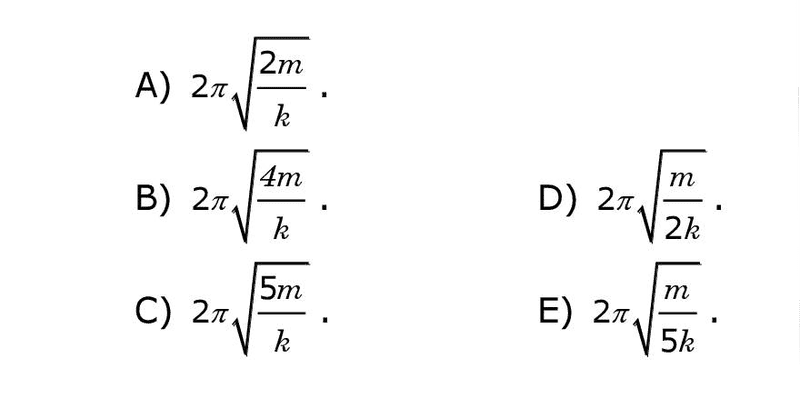
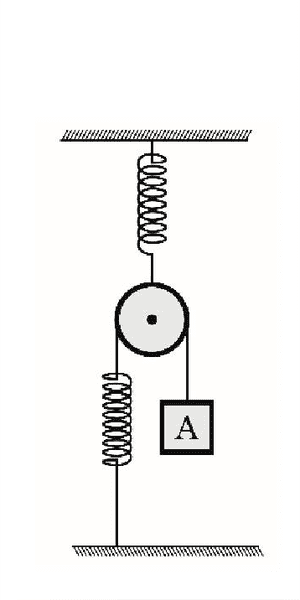
The figure below shows a system in equillibrium. The pulley and the springs (both with constants "k") are ideal. The period of oscillation of the mass A is given by:
h32wpSU.png

SE8FBui.png

ilh1Dkn

kaFjtJu

h3uoe

C8wMJ


Relevant equations:

F = -kx (SHM)

I tried to do a "force diagram" and set up some geometric relations but it´s not working.

 
Physics news on Phys.org
Hi,

You can start with discarding the answers that have the wrong dimension.
Your relevant equation needs a few colleagues: at least one with a dimension of time.
Would you know how the period for a simple mass hanging from a spring comes about ?
What is the restoring force for a disturbance from equilibrium in your system ?

Oh, and I notice you haven't been welcomed, so here goes:
Hello Mateus, :welcome: !
 
Mateus Buarque said:
I tried to do a "force diagram" and set up some geometric relations but it´s not working.
Please show the details of what you have tried.
 
BvU said:
Hi,

You can start with discarding the answers that have the wrong dimension.
Your relevant equation needs a few colleagues: at least one with a dimension of time.
Would you know how the period for a simple mass hanging from a spring comes about ?
What is the restoring force for a disturbance from equilibrium in your system ?

Oh, and I notice you haven't been welcomed, so here goes:
Hello Mateus, :welcome: !

Thank you but no answer has a wrong dimension, cause they are all in the form of a constant*root(m/k), which is correct!
 
Oops, so that doesn't help. Now how about the 'combined' spring constant ? What is the restoring force if I pull down the mass over a small distance ##x## ?
 

Similar threads

  • · Replies 51 ·
2
Replies
51
Views
4K
  • · Replies 11 ·
Replies
11
Views
2K
Replies
7
Views
1K
Replies
16
Views
2K
  • · Replies 10 ·
Replies
10
Views
1K
  • · Replies 14 ·
Replies
14
Views
2K
Replies
3
Views
850
  • · Replies 10 ·
Replies
10
Views
3K
  • · Replies 18 ·
Replies
18
Views
2K
Replies
20
Views
1K