Simulating deformation from impact with static load possible?

Click For Summary

Discussion Overview

The discussion revolves around the feasibility of simulating deformation in foam caused by an impact using a static load. Participants explore the relationship between dynamic and static forces, particularly focusing on how to achieve similar deformation in foam under static conditions as observed during an impact scenario.

Discussion Character

  • Exploratory
  • Technical explanation
  • Debate/contested

Main Points Raised

  • One participant presents a scenario involving a 0.5 kg ball impacting foam at 25 km/h and calculates the impact force as 343.35 N, questioning if the same deformation of 35 mm can be achieved with an equivalent static load.
  • Another participant clarifies that the force calculated is an average and that the actual force at maximum compression would be higher, suggesting that static and dynamic conditions may not yield the same deformation results.
  • A different viewpoint suggests that if the foam density is low, static and dynamic forces may be approximately equal, contingent on the speed of sound in the foam and the time for compression waves to travel through it.
  • One participant expresses uncertainty about how to determine the static load needed to achieve the same deformation, emphasizing that mass and force cannot be equated when acceleration is involved.
  • Another participant proposes modeling the foam as an elastic spring and discusses the complexities involved in accurately simulating the impact with static loads, suggesting a range of masses that might be needed to replicate the dynamic conditions.

Areas of Agreement / Disagreement

Participants do not reach a consensus on whether static and dynamic deformation can be equated, with multiple competing views on the relationship between static loads and the observed deformation from impacts. The discussion remains unresolved regarding the exact method to approximate the compensating mass for achieving similar deformation.

Contextual Notes

Participants note that the analysis is complex and involves many unknowns, including the properties of the foam and the dynamics of deformation under different conditions. There are also discussions about the limitations of using static loads to simulate dynamic impacts.

Kiru_Biru
Messages
3
Reaction score
0
Hi everyone,

For current project at work I am looking into possibility of simulating deformation from impact with static force.

Here is the input data:
A ball of 0.5 kg at speed of 25 km/h crashes into a damping foam which is placed on a rigid wall. Stopping (deformation) distance in the foam is 35 mm and deceleration is 70G (see picture)

I calculate impact force as F=m*a=0.5*70*G=343,35 N

The question is, if I put the same foam horizontally on a floor and will press in the ball (i.e. pressing area will be the same) with equal static force of 343,35 N (which will mean 35 kg load), will the deformation in the foam be the same 35 mm?
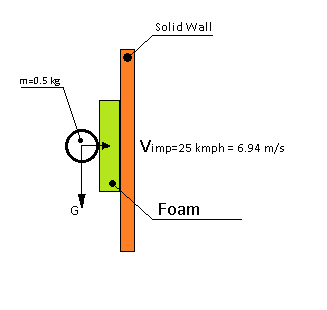
shema.png
 
Last edited:
Physics news on Phys.org
I added picture. The question is still open.
 
The net force of 340 N that you are calculating is an average force. The force on the ball at the moment of impact is about 0 since the foam has not yet compressed. At 0.035 m, it is fully compressed, so the force at that point is twice the average, or about 680 N.
So I am not sure what you want to do next...to determine what force must be applied, by say your hand, to compress the foam by .035 m? In which case no mass is involved. Or do you want to place a mass of a certain amount onto the foam, release it suddenly, and determine what mass gives an .035 m max compression of the foam?
You cannot equate force with an equivalent weight when there is acceleration...mass has inertia but force does not.
 
If the density of the foam is very low, then its static force and deformation will be approximately equal to the force and deformation at the same displacement under dynamic conditions. Check the speed of sound in the foam, and demonstrate that the time for a compression wave to travel through the foam is very short compared to the time the ball is in contact with the foam. If not, then the dynamics of the foam deformation need to be analyzed, and the deformation and force at a given displacement will not be the same as under static conditions.
 
PhanthomJay said:
So I am not sure what you want to do next...to determine what force must be applied, by say your hand, to compress the foam by .035 m? In which case no mass is involved. Or do you want to place a mass of a certain amount onto the foam, release it suddenly, and determine what mass gives an .035 m max compression of the foam?
You cannot equate force with an equivalent weight when there is acceleration...mass has inertia but force does not.

Hi PhanthomJay,

The idea is to select weight, which will be put on a contact body (the same body that was in the impact test so that contact surface is the same), and will create same deformation in foam of 35 mm.

In laboratory we will apply this static load to various foams and select ones where deformation distance is 35 mm or more. Later we will test these foams on impact.

Dynamic test is too long to set up for each foam, and static load test (if weight is calculated approximately right) could help us with initial foam selection!

I also see that if Force is 680 N, then the static mass would be around 70 kg, and that is too much! So, you are right, these forces can not be equated.

But do you think there is a way to approximately calculate this compensating mass to achieve the same deformation as in impact test? Or is it really realm of the unknown?

Untitled.png
Chestermiller said:
If the density of the foam is very low, then its static force and deformation will be approximately equal to the force and deformation at the same displacement under dynamic conditions. Check the speed of sound in the foam, and demonstrate that the time for a compression wave to travel through the foam is very short compared to the time the ball is in contact with the foam. If not, then the dynamics of the foam deformation need to be analyzed, and the deformation and force at a given displacement will not be the same as under static conditions.

This is an interesting approach albeit unfortunately still too complex for our task. I will add to my internal report though.
 
As chestermiller points out, actual analysis is complex with a lot of unknowns. IF the foam could be modeled as an elastic spring, mechanical energy would be conserved, the average force acting on the ball colliding horizontally with the foam would be about 350 N, the max force would be twice that or 700 N at the max deformation, all happening in about 0.01 second, and then the ball would rebound back and leave the foam with a speed of 25 km/hr. I am ignoring the downward 5 N gravity force. Then statically equivalent, you could apply a 700 N weight ( 70 kg mass) oh so slowly downward until it came to rest at its equilibrium position. the foam that displaces 35 mm under the 70 kg mass is the foam you want to use for your dynamic test. You say 70 kg is huge but don't forget the impact force is huge, so you need a lot of mass to statically simulate the dynamic impact load and 70g's deceleration!. Now in reality, your collision is not going to be elastic, nor plastic either where the ball would stop at 35 mm and not rebound at all. I would guess you are in between those extremes. My hunch is you need a mass of something between 35 and 70 kg lowered slowly to simulate the results. As I see it. No guarantees.
 

Similar threads

  • · Replies 3 ·
Replies
3
Views
7K
Replies
2
Views
5K
  • · Replies 9 ·
Replies
9
Views
43K
  • · Replies 45 ·
2
Replies
45
Views
7K
Replies
1
Views
4K
  • · Replies 75 ·
3
Replies
75
Views
7K
Replies
5
Views
3K
Replies
14
Views
12K