Single slit interference picture

Click For Summary

Discussion Overview

The discussion revolves around the illustrations of single slit interference and how different representations can depict the same phenomenon. Participants explore the implications of these illustrations in the context of wave optics and Huygens principle, questioning the accuracy and interpretation of various diagrams.

Discussion Character

  • Exploratory
  • Debate/contested
  • Technical explanation
  • Conceptual clarification

Main Points Raised

  • Some participants express confusion over how different illustrations of single slit interference can represent the same concept, particularly regarding the parallelism of light rays.
  • One participant suggests that the first illustration represents a general setup while the second is an approximation valid under certain conditions (D>>y), where angles for rays become nearly identical.
  • Another participant argues that the wave nature of light, as demonstrated by water waves, is essential to understanding the behavior of light in these diagrams.
  • Some participants assert that using multiple point sources at the slit is necessary to calculate the interference pattern, as a single point source would not yield interference.
  • Concerns are raised about the abrupt change in light direction in the illustrations, with one participant noting that Huygens principle explains this change.
  • One participant critiques the third illustration for not adequately representing the differences in path lengths that lead to destructive interference.
  • Another participant emphasizes that ray optics is insufficient for describing diffraction, advocating for wave optics as a more accurate framework.
  • Some participants discuss the limitations of classical physics and the importance of quantum mechanics in understanding light behavior, suggesting that historical principles may not fully explain modern phenomena.
  • There is a mention of the Schrödinger equation's relationship to wave behavior, indicating that diffraction is a manifestation of light's wave nature.

Areas of Agreement / Disagreement

Participants express a range of viewpoints, with no consensus on the adequacy of the illustrations or the principles involved. Disagreements persist regarding the interpretation of Huygens principle and the effectiveness of ray versus wave optics in explaining diffraction.

Contextual Notes

Limitations in the discussion include the lack of clarity on the conditions under which the approximations hold, the dependence on the definitions of terms like "ray" and "wave," and unresolved questions about the accuracy of the diagrams presented.

Maxo
Messages
160
Reaction score
1
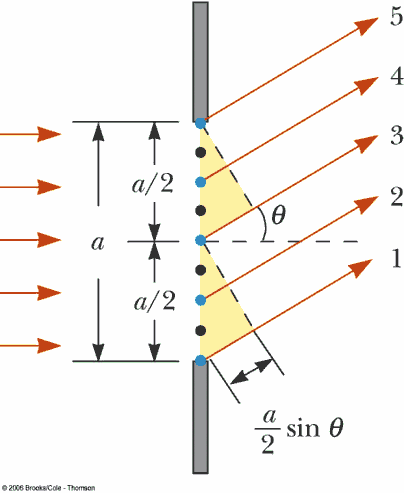
I'm wondering something about illustrations of single slit interference. I've seen them being illustrated in different ways. One way is this:
fraungeo.gif


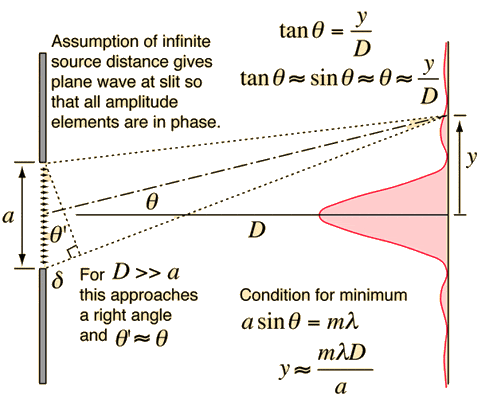
and another way is this:

pop4.27.f.15.gif


But I don't understand how these can show the same thing? In the first picture, we have light rays that are obviously NOT parallel, because they all point to a single point. But in the second picture, there are several rays that are all shown as parallel. How is that possible? The rays can't be both parallel and not parallel at the same time!

And another question. In the second picture, it is shown that light is coming in horizontally from the left. Why is it then suddenly tilted with angle θ? Why doesn't it just continue horizontally into the slit? This following picture makes much more sense to me:
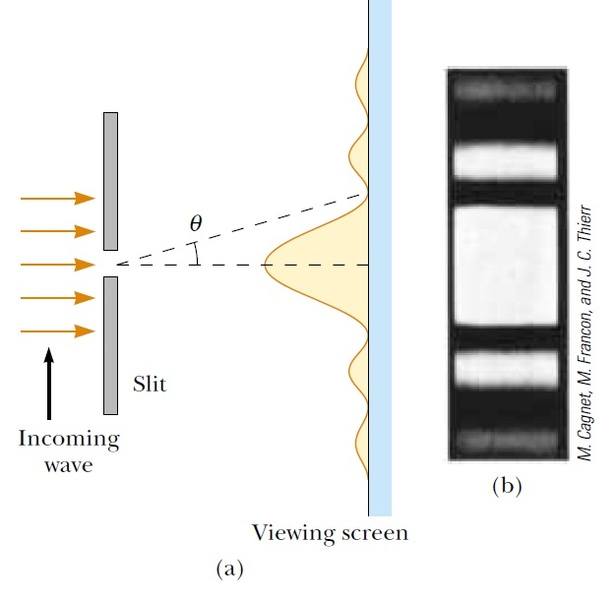
Figure+1.jpg

Because here at least we see that the light will continue horizontally and the angle θ is simply to show where destructive interference will take place. But this is again different from the two other pictures. Can someone please explain how all these pictures are related and how they are meant to show the same thing?

I mean none of the first two pictures make sense if we consider that the light will diffract like a point (omnidirectional) source at each point which it does according to Huygens principle, only the third picture shows that.
 
Science news on Phys.org
But I don't understand how these can show the same thing? In the first picture, we have light rays that are obviously NOT parallel, because they all point to a single point. But in the second picture, there are several rays that are all shown as parallel. How is that possible? The rays can't be both parallel and not parallel at the same time!
The first picture illustrates a general setup, the second is an approximation by taking the first pic and letting D>>y. This means that the actual angles for each numbered ray are very nearly the same.
This is actually written on the 1st diagram.

And another question. In the second picture, it is shown that light is coming in horizontally from the left. Why is it then suddenly tilted with angle θ? Why doesn't it just continue horizontally into the slit? This following picture makes much more sense to me:
This is the wave nature of light - have a look at water-waves traveling through a narrow opening ... the observation is that light appears to behave the same way.

Note: the angle shown is only one sample light-ray.
 
Maxo said:
I mean none of the first two pictures make sense if we consider that the light will diffract like a point (omnidirectional) source at each point which it does according to Huygens principle, only the third picture shows that.
it's the other way around. We need to use several point sources at the slit, to be able to calculate the interference pattern. If we just used one point source at the slit, then there is no interference pattern.
 
It's puzzling that you would complain about the abrupt change in the direction of propagation of light but go on to mention Huygens principle which is the explanation for how the ray can in fact change directions. Out of the three pictures, the one you liked the most - the 3rd one - is really the only one that isn't very good since it doesn't show that neighbor rays may have different path lengths allowing for destructive interference to happen explaining the dark bands of the interference pattern.
 
In the end, ray optics is quite poor for describing diffraction - quite simply because ray optics inherently ignores wave-like aspects of light propagation. Wave optics expresses a far field diffraction pattern as the Fourier transform of the spatial aperture transmission - much more accurate.

Claude.
 
Our best understanding is that the Laws of Classical Physics are approximations in the limits of 'large' sizes and numbers and that quantum mechanics is the correct description of the world. (of course, when we talk about even larger or faster things we need to consider Relativity). It can be a serious mistake to invoke a 'principle' from 1680 (or 1820) to 'explain' the world. Please take a look at this article:https://en.wikipedia.org/wiki/Huygens–Fresnel_principle. None of the diagrams you posted are correct, ALL 3 are great simplifications. The concept of light RAYS should only be used for every-day optical scenaroies, not for the very small (such as a slit experiment).
 
abitslow said:
Our best understanding is that the Laws of Classical Physics are approximations in the limits of 'large' sizes and numbers and that quantum mechanics is the correct description of the world. (of course, when we talk about even larger or faster things we need to consider Relativity). It can be a serious mistake to invoke a 'principle' from 1680 (or 1820) to 'explain' the world. Please take a look at this article:https://en.wikipedia.org/wiki/Huygens–Fresnel_principle. None of the diagrams you posted are correct, ALL 3 are great simplifications. The concept of light RAYS should only be used for every-day optical scenaroies, not for the very small (such as a slit experiment).

I was left unsure whether you're saying Huygens principle isn't very good or whether you're saying it's a really good principle. Can you make your point clearer?
 
The Huygen's principle is part of wave optics.
He is saying that wave optics produces results that are closer in detail than ray optics ... but the principle by itself may not be good enough for all situations. (Now we'll see if I'm right.)

The reason is that the Schrödinger equation (for QM) is a form of the helmholtz equation (for waves).
You are going to get very similar results, although the mechanisms may differ.

As the student advances, they will also meet Feynman's "sum over paths" treatment.
At this level, diffraction at slits is an example of the wave behavior of light for the very reason that ray optics is not so good at predicting the details. The usual next step is to point out that objects previously thought of as classical particles also have this behavior.

It's part of a journey - best not get too hung up on snags on the way.
 

Similar threads

  • · Replies 4 ·
Replies
4
Views
2K
  • · Replies 17 ·
Replies
17
Views
3K
  • · Replies 33 ·
2
Replies
33
Views
4K
  • · Replies 6 ·
Replies
6
Views
3K
  • · Replies 54 ·
2
Replies
54
Views
11K
  • · Replies 8 ·
Replies
8
Views
15K
  • · Replies 6 ·
Replies
6
Views
9K
  • · Replies 4 ·
Replies
4
Views
2K
  • · Replies 46 ·
2
Replies
46
Views
5K
  • · Replies 20 ·
Replies
20
Views
3K