Small signal analysis of a cascode amplifier

Click For Summary
SUMMARY

The voltage gain of a cascode amplifier can be determined through small signal analysis, yielding the expression Av = -gm1*Rds1*(1+gm2*Rds2). The analysis reveals that the small signal at the Vx node is equivalent to that at Vout when the load on Vout is infinite, due to the impedance of the current source feeding the drain of M2. Eliminating M2 from the circuit simplifies the analysis, allowing for the voltage gain to be expressed as Vout/Vin = -gm1*Rds1 under certain conditions.

PREREQUISITES
  • Understanding of small signal models in amplifier circuits
  • Familiarity with MOSFET parameters such as transconductance (gm) and drain-source resistance (Rds)
  • Knowledge of Kirchhoff's Current Law (KCL)
  • Basic concepts of cascode amplifier configurations
NEXT STEPS
  • Study the derivation of small signal models for cascode amplifiers
  • Learn about the impact of load impedance on voltage gain in amplifier circuits
  • Explore the role of current sources in enhancing amplifier performance
  • Review practical applications of cascode amplifiers in analog circuit design
USEFUL FOR

Electrical engineers, circuit designers, and students studying analog electronics who are looking to deepen their understanding of cascode amplifier performance and small signal analysis techniques.

mulothecook
Messages
6
Reaction score
0
Hello there.

I am stuck trying to figure out the voltage gain of a cascode amplifier from a small signal analysis. The circuit seems to be under-determined for reasons I do not understand or maybe I am missing the perfectly obvious.

Here's my small signal model:
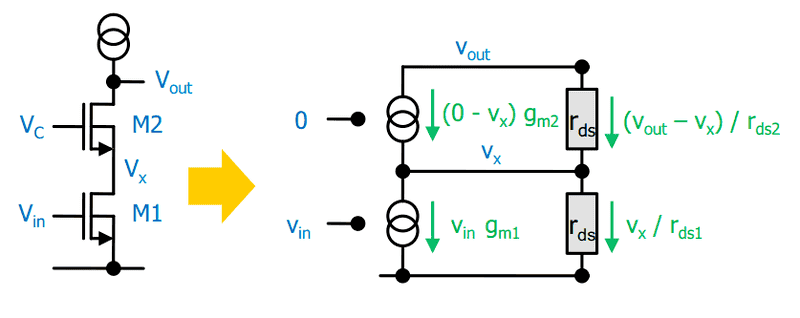
?temp_hash=c064e565f691e7abb408df22a4274b09.png

The only relation I can deduce without using further unknown quantities is the KCL for the vx node:

%7Bds2%7D%7D%20%3D%20v_%7Bin%7D%5Ccdot%20g_%7Bm1%7D%20+%20%5Cfrac%7Bv_x%7D%7Br_%7Bds1%7D%7D.gif

However, I need another relation to eliminate vx in order to solve for vout/vin. The small signal analysis without the cascode works just fine. May I kindly ask somebody to clarify this?M
 

Attachments

  • cascode_ssm.png
    cascode_ssm.png
    13.3 KB · Views: 1,079
Engineering news on Phys.org
Since you have a current source supplying the M2 FET, you can eliminate M2 and the voltage gain is the same as it would be without M2, namely Vout/Vin = -gm1*Rds1.

The small signal at Vx is the same as it is at Vout as long as the load on Vout is infinite, which is the impedance of the current source feeding the drain of M2. With a finite load on Vout, this will not be the result.
 
The Electrician said:
Since you have a current source supplying the M2 FET, you can eliminate M2 and the voltage gain is the same as it would be without M2, namely Vout/Vin = -gm1*Rds1.

Could you explain why this is the case?
 

Similar threads

  • · Replies 1 ·
Replies
1
Views
2K
Replies
9
Views
4K
  • · Replies 13 ·
Replies
13
Views
6K
  • · Replies 11 ·
Replies
11
Views
7K
  • · Replies 3 ·
Replies
3
Views
2K
Replies
11
Views
3K
  • · Replies 4 ·
Replies
4
Views
3K
  • · Replies 56 ·
2
Replies
56
Views
6K
  • · Replies 11 ·
Replies
11
Views
3K
Replies
104
Views
25K