Solar Activity and Space Weather Update thread

469 replies · 83K views · last reply
Stavros Kiri
Messages
1,150
Reaction score
1,020
I am picking this up as a continuation and extension of the idea laid out e.g. in @davenn 's thread
"The Sun today - 9 July 2017 - nice spot group"
https://www.physicsforums.com/threads/the-sun-today-9-july-2017-nice-spot-group.919696/

See also (for continuity purposes):
https://www.physicsforums.com/threa...17-nice-spot-group.919696/page-2#post-5825645

But the idea here is extended not to just one day or around that time, but to monitor the Sun's activity and Space Weather over time, beginning right after the Eclipse (in the US) of Aug. 21, 2017.
Everyone is welcome and encouraged to post valid updates for noticed significant solar activity and space weather facts and events, including personal or otherwise photos, videos etc., as long as they are valid. That also includes quoting appropriate [PF accepted] articles and sources, and other valid means of correct relevant imformation, or scientific news and updates on the field.

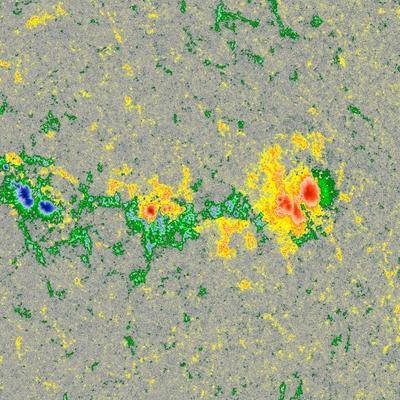
Currently there are still two significant Sun Spot groups, that acquire the names "group region 2671" and ".. region 2672". Here is a view of the Sun today 22 Aug. 2017, one day after the eclipse:
"

Banner logo for SpaceWeatherLive.com with the tagline Real-time auroral activity and solar activity, beside a globe showing an aurora oval and a small sun.

Sunspot regions

On this page you'll find an overview of all the visible sunspot regions on the Sun together with their properties, images and the chances on solar flares or proton events. This page is updated daily and the sunspot images every hour.
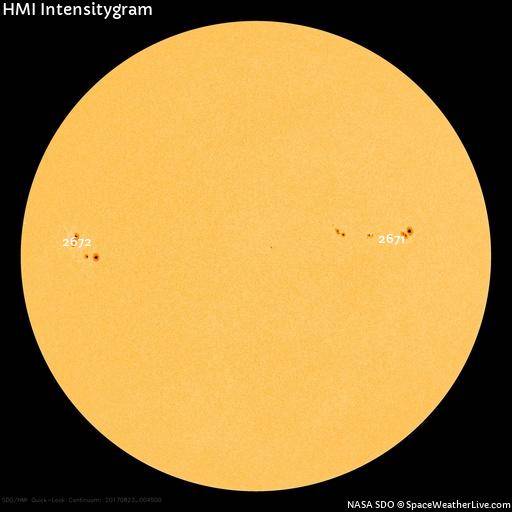
HMI Intensitygram of the Sun showing two labelled sunspot groups, 2672 on the left limb and 2671 on the right, with dark spots visible in each group.


Region 2671
Number of
sunspots Size Class Magn. Class Spot Location
18 250 -180 FSI N10W32
Orange-toned image of the Sun's photosphere showing several dark sunspot groups, with the largest cluster at upper right.
False-colour magnetogram of the Sun's surface showing active regions: blue and red patches of opposite magnetic polarity in green-outlined bands, with yellow and red areas on the right.

Flare probabilities
C M X Proton
55% 10% 1% 1%
Region 2672
Number of
sunspots Size Class Magn. Class Spot Location
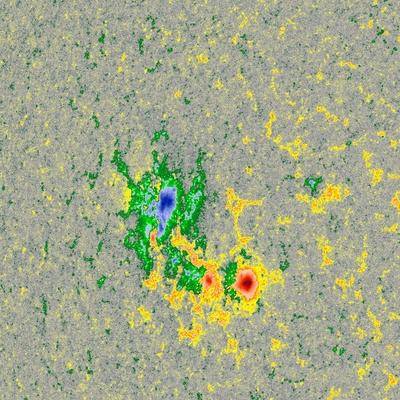
10 5 270 110 DAO N08E46
Hydrogen-alpha style image of the Sun's surface in orange, showing a small cluster of dark sunspots with reddish umbral cores, with the largest group near the lower right.
Magnetogram of the Sun's surface showing a sunspot region, with blue and red patches of opposite magnetic polarity surrounded by green and yellow areas on a gray background.

Flare probabilities
C M X Proton
45% 5% 1% 1%
Back to top
Current data suggest that it is not possible to see aurora now at middle latitudes
Active geomagnetic conditions expected
Latest news
False-colour image of the Sun in red, pink and blue tones, showing a bright glowing central region with streaks of light extending outward from it.

Sunday, 20 August 2017 - 07:31 UTC
M1.2 solar flare, C7.0 solar flare
More news
Today's space weather
Auroral activity Minor Severe
High latitude 25% 40%
Middle latitude 10% 1%
Predicted Kp max 4
Aurora forecast HelpMore data
Solar activity
M-class solar flare 15%
X-class solar flare 1%
Sunspot regionsMore data
Moon phase
New Moon
Moon Phases Calendar
"

Source: https://www.spaceweatherlive.com/en/solar-activity/sunspot-regions
 
Last edited:
Here is the view of the sun today, Aug. 25, 2017, after 3 days of rotation. Region 2671 is getting ready to leave us. Region 2672 still has some future ahead ...
SpaceWeatherLive.com logo: the site name in large grey letters with a yellow sun and a stylised Earth with a green-and-red aurora oval, above the tagline Real-time auroral activity and solar activity.
HMI Intensitygram of the full Sun in orange, with two sunspot regions labelled 2672 near the left-centre and 2671 near the right edge. Credit NASA SDO and SpaceWeatherLive.com.


Note that these are telescope views (inverted image).
With direct visual mode[/view] (upright image) we see in the afternoon and forth a picture oriantation similar to the above, while in the morning hours an upside down version of it.
 
Last edited:
Spot region 2671 just left us a few hours ago, today Sun 27 Aug., 2017. The remaining group 2672 is also winding down. Perhaps we are heading to a spotless day soon (last one was Aug 1).
Right now solar wind a bit high, with active geomagnetic conditions expected. Here is a full update:
"
SpaceWeatherLive.com logo with the tagline Real-time auroral activity and solar activity, and a small yellow sun and a stylised Earth with colourful auroral oval graphics.

Sunspot regions
On this page you'll find an overview of all the visible sunspot regions on the Sun together with their properties, images and the chances on solar flares or proton events. This page is updated daily and the sunspot images every hour.

HMI Intensitygram of the full solar disk showing a single small sunspot group labeled 2672 near the right-of-center; the rest of the disk is uniform orange.


Region 2672
Number of
sunspots
Size Class Magn. Class Spot Location
10 -2 130 -10 EAI N07W20
Orange solar disk image in hydrogen-alpha style showing two dark sunspot groups: a small cluster of spots at upper left and a larger dark spot with a dark core at right, plus a tiny spot below it.
False-colour image of the Sun's surface showing a small bright red-orange spot with yellow and green patches, surrounded by grey, with green and blue clusters on the left side.

Flare probabilities
C M X Proton
45% 10% 1% 1%
Solar flares from today
B1.6 B1.4
Back to top
Current data suggest that it is not possible to see aurora now at middle latitudes
Active geomagnetic conditions expected
The solar wind speed is currently moderately high (520.6 km/sec.)

Latest news
Blurred false-colour image of the Sun in extreme ultraviolet, showing a bright pinkish-white glow at centre with red and blue streaks extending outward.

Sunday, 20 August 2017 - 07:31 UTC
M1.2 solar flare, C7.0 solar flare
More news
Today's space weather
Auroral activity Minor Severe
High latitude 15% 15%
Middle latitude 1% 1%
Predicted Kp max 4
Aurora forecast HelpMore data
Solar activity
M-class solar flare 10%
X-class solar flare 1%
Sunspot regionsMore data
Moon phase
Waxing Crescent
Moon Phases Calendar
"
+ (some Almanac facts:)

"
Space weather facts
Last X-flare: 2015/05/05 X2.7
Last M-flare: 2017/08/20 M1.1
Last geomagnetic storm: 2017/08/23 Kp5 (G1)
Number of spotless days in 2017: 56
Current stretch spotless days: 2
This day in history*
Solar flares
1 1999 X1.1
2 2002 M4.6
3 1999 M2.8
4 2015 M2.2
5 2015 M2.1
Ap G
1 2015 40 G2
2 1998 30 G1
3 2000 27 G1
4 2014 19 G1
5 2003 18
*since 1994
"
 
Last edited:
"
HMI Intensitygram of the Sun from NASA SDO showing sunspot regions labelled 2672, 2673, 2674 and 2675, with the labels partly cut off at the right edge.


Region 2672
Number of
sunspots
Size Class Magn. Class Spot Location
4 -2 70 DAO N07W81
Close-up of the Sun in ultraviolet or extreme ultraviolet, orange disk on black background, with bright active-region plage and a faint limb on the right.
Close-up of the Sun's limb showing granulated surface texture with green and yellow patches of magnetic activity near the edge, against a black background.

Flare probabilities
C M X Proton
25% 1% 1% 1%
Region 2673
Number of
sunspots
Size Class Magn. Class Spot Location
1 80 10 HSX S08E25
Solar image in orange showing a single small dark sunspot with a surrounding penumbra near the center of the disk, against a granulated background.
False-colour image of a solar region with a blue and yellow spot at the centre, surrounded by green and yellow patches on a grey background.

Flare probabilities
C M X Proton
5% 1% 1% 1%
Region 2674
Number of
sunspots
Size Class Magn. Class Spot Location
10 5 770 280 EHO N13E42
Solar image in false-colour orange showing three sunspot groups on the solar disc: two larger dark spots at upper left and lower right, and a scattered trail of smaller spots between them.
Magnetogram of the Sun's surface showing an active region: a blue negative-polarity spot and a red positive-polarity spot, surrounded by green and yellow patches on a grey background.

Flare probabilities
C M X Proton
40% 10% 1% 1%
Solar flares from today
B4.9 B3.4 B4.6 B7.1 B3.7 C2.0
Region 2675 New
Number of
sunspots
Size Class Magn. Class Spot Location
4 30 DRO S07W35
Full-disc solar image in orange, showing two small dark sunspot groups on the photosphere, one left of centre and one to its right.
Solar magnetogram of the Sun's surface showing a sunspot region, with red and orange areas of positive polarity beside a blue spot of negative polarity, surrounded by green and yellow mottled texture on a grey background.

Flare probabilities
C M X Proton
10% 1% 1% 1%
Back to top
Current data suggest that it is not possible to see aurora now at middle latitudes
The solar wind speed is currently moderately high (623.6 km/sec.)

Latest news
Extreme ultraviolet image of the Sun showing bright active regions with loops of plasma arching above sunspot groups, rendered in yellow-green and blue false color.

Friday, 1 September 2017 - 18:03 UTC
Sunspot region 2674
More news
Today's space weather
Auroral activity Minor Severe
High latitude 20% 20%
Middle latitude 35% 10%
Predicted Kp max 5
Aurora forecast HelpMore data
Solar activity
M-class solar flare 10%
X-class solar flare 1%
B4.9 B3.4 B4.6 B7.1 B3.7 B4.8 B5.1 C2.0 C1.2
Sunspot regionsMore data
Moon phase
Waxing Gibbious
Moon Phases Calendar "
Group 2672 departing, while 2674 becomes a potential player! ...
https://www.spaceweatherlive.com/en/news/view/298/20170901-sunspot-region-2674
 
Total newb here, when it comes to observing sunspots, or even observing the sun at all...

I see that your images have a location listed for where the spots are. How do you record a location on a swirling ball of gases and plasma? Is the system set up to just locate on the disk, and each image records a new location with regards to the disk top/bottom, left/right, or do you have some magical fixed point of reference, that rotates with the sun? (The sun does rotate, right?)

Since I don't know if sunspots move, looking at the locations listed doesn't really get me to a definitive answer...

Sorry if it's a stupid question, but it begged asking.
 
Blank_Stare said:
Total newb here, when it comes to observing sunspots, or even observing the sun at all...

I see that your images have a location listed for where the spots are. How do you record a location on a swirling ball of gases and plasma? Is the system set up to just locate on the disk, and each image records a new location with regards to the disk top/bottom, left/right, or do you have some magical fixed point of reference, that rotates with the sun? (The sun does rotate, right?)

Since I don't know if sunspots move, looking at the locations listed doesn't really get me to a definitive answer...

Sorry if it's a stupid question, but it begged asking.

No stupid question at all. AR s (Active Regions) [of Sun spot groups] are dynamic and get a sequence number as they appear, where they appear. E.g. the next one will be 2676 (last one was 2675) etc.
The Sun does rotate of course, but the rotation period depends on the latitude, because the Sun is composed of a gaseous plasma (24.47 days at the equator versus 38 days at the poles) [differential rotation ...].

Regarding charting and orientation in the Sun, I am not an expert either, but I will try to learn some more and perhaps get back later.
 
HMI Intensitygram of the Sun showing sunspot groups labelled 2673, 2674, 2675, 2676 and 2677, with 2674 the largest, against an orange disc.

This is interesting. They just became 5 groups visible (one gone [2672], but two new came [2676 and, just fresh, 2677]).

2674 is the biggest (kind of huge) and 2673 seems to have just started growing.

Also time again for "eye tests". Group 2674 is also visible with unaided eye (wearing solar [eclipse] glasses of course)! You just need to know where to look, and a good vision. I saw it clearly yesterday and today (Sept. 3). By tomorrow perhaps group 2673 will also be similarly visible. We'll see.
But CAUTION: never look at the sun with naked eye, or not even with just sun glasses
(even if the sun is behind clouds). Use solar [eclipse] glasses, or other appropriate filter, with your eyes, cameras, telescopes and other instruments ...
 
Still 5 groups visible right now (but not for long). 2 major huge ones (2673, 2674).

Stavros Kiri said:
By tomorrow perhaps group 2673 will also be similarly visible.
Yep!
Stavros Kiri said:
But CAUTION: never look at the sun with naked eye, or not even with just sun glasses
(even if the sun is behind clouds). Use solar [eclipse] glasses, or other appropriate filter, with your eyes, cameras, telescopes and other instruments ...
Also CAUTION: and in any case do not look at the Sun for long, even if you have protection (I usually observe at max 30 sec intervals, spaced out in between ...). Non visible consequences may be in effect ...

Today's update: a few M-class strong flares from group 2673. Latest one M4.21, advised about an hour ago.

Summary of current space weather facts:

Current data suggest that it is not possible to see aurora now at middle latitudes

G1 - Minor geomagnetic storm expected
The observed Kp index is 4+ but the predicted K-indice of 5- indicates that stronger geomagnetic conditions might occur at this moment.

The solar wind speed is currently moderately high (594.9 km/sec.)

The maximum X-ray flux of the past two hours is:
M4.21

S1 Space Radiation Storm
At the moment there is a minor S1 class space radiation storm active. This happens about 50 times in one solar cycle.

Latest news
False-colour extreme ultraviolet image of the Sun showing a bright, loop-like coronal structure of glowing plasma arcing above the solar surface against a red and green background.

Monday, 4 September 2017 - 16:35 UTC
M-class solar flares, Sunspot region 2673

Note: group region 2673 has grown rapidly into a "player" the past 48 hours. 2674 is still big and important though. The rest ones seem to be winding down, two setting soon.
So ... a lot going on in the Sun, that we usually ignore! It's not just a bright fire ball in our day sky! ...
 
Last edited:
Just for a very short time 6 groups now visible (new one appeared, 2678). The biggest one now is 2673, which grew very rapidly the last few days. It also gave rise to significant class M- flares, which will be affecting Earth shortly (Geomagnetic storm, predicted Kp index 7, possibly even radio blackout and significant aurora activity expected). Here is some more details from SpaceWeatherLive.com:
"
HMI intensitygram of the Sun showing active regions labelled 2677, 2678, 2674 and 2673, with dark sunspot groups visible; the largest group is at the lower right.


Region 2673
Number of
sunspots
Size Class Magn. Class Spot Location
33 5 880 200 DKC S09W35
Solar image in false-color orange showing a cluster of dark sunspots, mainly a large dark spot group in the centre with smaller spots scattered around it.
Magnetogram of the Sun's surface showing an active region with strong opposite-polarity patches, red and blue, surrounded by green and yellow areas on a grey background.

Flare probabilities
C M X Proton
95% 55% 25% 95%
Region 2674
Number of
sunspots
Size Class Magn. Class Spot Location
23 -11 680 -60 FHI N14W19
Orange-toned image of the Sun's photosphere showing several dark sunspot groups, with the largest group at the lower right and smaller groups scattered toward the upper left.
False-colour magnetogram of the Sun's surface showing a large active region: red and yellow patches of positive polarity on the right, blue patches of negative polarity on the left, and green mixed-polarity areas between them, over a grey background.

Flare probabilities
C M X Proton
75% 20% 1% 1%
Region 2675
Number of
sunspots
Size Class Magn. Class Spot Location
1 -3 10 BXO S07W87
Solar disk in ultraviolet or hydrogen-alpha style imaging, orange-yellow, with a small bright active region visible on the limb at the lower left.
Solar disk image in false colour showing a sunspot group on the solar limb, with yellow and green patches against a grey granulated background, black space beyond the edge.

Flare probabilities
C M X Proton
5% 1% 1% 1%
Region 2676
Number of
sunspots
Size Class Magn. Class Spot Location
2 -2 30 BXO S09W81
Solar disk in orange light against black space, showing a bright active region with small bright features near the limb on the right edge of the sun.
Solar disk photographed in false color, with yellow and green speckled granulation on gray, and a bright yellow-green active region near the limb on the right edge; the rest of the frame is black.

Flare probabilities
C M X Proton
5% 1% 1% 1%
Region 2677
Number of
sunspots
Size Class Magn. Class Spot Location
1 -1 20 10 AXX N18E34
Solar photosphere in yellow-orange hydrogen-alpha style view with a larger dark sunspot group at lower left and a few small spots near center right.
Solar magnetogram in false colour, with grey quiet-Sun background and patches of green, yellow and red marking magnetic regions, with blue-and-green sunspot cores visible at left and centre.

Flare probabilities
C M X Proton
5% 1% 1% 1%
Region 2678 New
Number of
sunspots
Size Class Magn. Class Spot Location
2 10 BXO N11E40
Solar photosphere in orange-yellow with a cluster of dark sunspots: a larger spot with a dark core near the centre-left, and several smaller spots to its lower right, plus one tiny spot at upper right.
Solar magnetogram in false colour on a grey background, with green and yellow patches and two stronger blue-and-red spots, likely sunspot regions, near the centre and upper right.

Flare probabilities
C M X Proton
5% 1% 1% 1%
Back to top
Current data suggest that it is not possible to see aurora now at middle latitudes
The maximum X-ray flux of the past two hours is:
M7.7
S1 Space Radiation Storm
At the moment there is a minor S1 class space radiation storm active. This happens about 50 times in one solar cycle.
Latest news
False-colour extreme ultraviolet image of the Sun showing a bright, looping coronal structure of hot plasma arching above the solar surface against a green and red background.

Monday, 4 September 2017 - 16:35 UTC
M-class solar flares, Sunspot region 2673
More news
Today's space weather
Auroral activity Minor Severe
High latitude 10% 90%
Middle latitude 40% 45%
Predicted Kp max 7
Aurora forecast HelpMore data
Solar activity
M-class solar flare 75%
X-class solar flare 25%
Sunspot regionsMore data
Moon phase
Full Moon
Moon Phases Calendar

Space weather facts
Last X-flare: 2015/05/05 X2.7
Last M-flare: 2017/09/05 M2.3
Last geomagnetic storm: 2017/09/04 Kp5 (G1)
Number of spotless days in 2017: 56
Last spotless day: 2017/08/01
This day in history*
Solar flares
1 2011 X2.1
2 2011 M5.3
3 2012 M1.6
4 2005 M1.4
5 2014 M1.1
Ap G
1 1995 23 G2
2 2004 14
3 1994 14 G1
4 2016 13
5 2015 13
*since 1994 "
 
Stavros Kiri said:
Space weather facts
Last X-flare: 2015/05/05 X2.7
Last M-flare: 2017/09/05 M2.3
Last geomagnetic storm: 2017/09/04 Kp5 (G1)
Number of spotless days in 2017: 56
Last spotless day: 2017/08/01
update ... there's been a M7.7 flare in the last 2 hrs :smile:
 
  • Like
Likes   Reactions: Stavros Kiri
another update ... a X9.3 monster ... largest flare in a decade
 
  • Like
Likes   Reactions: stoomart and Stavros Kiri
Stavros Kiri said:
Thanks davenn!
please call me Dave :smile:
the nn are the first and last letters of my surname

I have used davenn on the internet since the early - mid 1990's

Dave
 
davenn said:
please call me Dave :smile:
the nn are the first and last letters of my surname

I have used davenn on the internet since the early - mid 1990's

Dave

Ok Dave :smile:
 
New type IV moderate radio blackout effective (from a previous class M-flare, a couple of hours ago) and a new strong M7.36 flare the last hour ...
 
Also, latest type II radio emission and another X-class flare (X1.39), from group 2673. Also more activity in between, since the last update. Looks like the Sun is having a party! ...
 
A portion of AR2674 has now completely separated and became AR2679 (again 5 groups visible now, 2 major). Also the large CME arrival:
"Latest news
Artist's rendering of Earth's magnetosphere with blue glowing magnetic field lines curving around the planet, facing a glowing orange solar wind on the left.

Friday, 8 September 2017 - 03:37 UTC
X9.3 CME impact, Severe G4 storm
More news"

Max predicted Kp index 8 (G4)! [The highest is 9 (G5).] Aurora time!

Also new strong M8.12 solar flare from group 2673, the past hour or so.
 
Last edited:
Currently from SpaceWeatherLive.com:

"Current data suggest that there is a decent possibility that aurora can be seen now at middle latitudes

G4 - Severe geomagnetic storm
Observed Kp: 9-


The solar wind speed is currently high (742.6 km/sec.)

The direction of the interplanetary magnetic field is slightly South (-6.69nT).

The Disturbance Storm Time index predicts strong storm conditions right now (-118nT)

The maximum X-ray flux of the past two hours is:
M3

S1 Space Radiation Storm
At the moment there is a minor S1 class space radiation storm active. This happens about 50 times in one solar cycle."
 
Another strong M3.79 flare, just a few minutes ago, from sunspot region 2673. So hopes for more aurora in a couple of days (max 3) !
 
Stavros Kiri said:
Another strong M3.79 flare, just a few minutes ago, from sunspot region 2673. So hopes for more aurora in a couple of days (max 3) !

it's not Earth bound as the spot group is about to disappear around the limb of the sun :smile:
 
  • Like
Likes   Reactions: Stavros Kiri
davenn said:
it's not Earth bound as the spot group is about to disappear around the limb of the sun :smile:
I was afraid of that :sorry: ... . Is that always the case when close to limb, no matter how strong is the flare? Or it depends on the angular distribution of the CME?

Yesterday (other issue), a few hours after my last post above, I witnessed myself a short-wave band Radio Blackout, which was also announced (by SpaceWeather...) at the time, but I am not sure what the origin was. The whole short-wave band was totally wiped out (for an hour or so, if I am not mistaken).
 
Stavros Kiri said:
Is that always the case when close to limb, no matter how strong is the flare? Or it depends on the angular distribution of the CME?

the size and the way/direction(s) the flare erupts has a direct effect on the CME produced. That said, it isn't totally black and white.
Flares may or may not produce significant CME's and sometimes a smaller flare say a M2.2 can produce a bigger CME than a M6.1.

When it comes to flares that are pointing at an angle significantly away from the earth, they tend to have little effect umless they
produce a "full halo " CME ... You will see the term "full halo" used periodically when describing CME's

Dave
 
  • Like
Likes   Reactions: Stavros Kiri
Just before the culprit 2673 rotated out of view:
"Latest news
Extreme ultraviolet image of the Sun in orange tones showing a bright flare erupting at the right limb, with a dark filament and mottled active regions across the disk.

Sunday, 10 September 2017 - 16:18 UTC
X8.2 solar flare"

Currently no named sunspot regions! (may be tomorrow one ...)
HMI Intensitygram of the Sun showing a full disk in yellow-orange with a small dark sunspot near the left limb and a bright active region near the right limb.


But: (active as we speak)
"S3 Space Radiation Storm
At the moment there is a strong S3 class space radiation storm active. This happens about 10 times in one solar cycle.
"
(From SpaceWeatherLive.com)
 
davenn said:
the size and the way/direction(s) the flare erupts has a direct effect on the CME produced. That said, it isn't totally black and white.
Flares may or may not produce significant CME's and sometimes a smaller flare say a M2.2 can produce a bigger CME than a M6.1.
Reading about the monster X9.3 event on Sept. 6 got me onto the near hit of the massive CME in 2012. As an IT professional, I'm curious about how much warning we would get if one of these Carrington events was headed straight for us, which apparently has a 12% chance of happening between 2012-2022.

Edit: Looks like DSCOVR can provide a 15-60 minute early warning from the L1 Lagrangian point.
 
Last edited:
  • Like
Likes   Reactions: Stavros Kiri and davenn
stoomart said:
Edit: Looks like DSCOVR can provide a 15-60 minute early warning from the L1 Lagrangian point.

the time difference is related to the speed of the CME and these can vary significantly ... 400 to 1500+ km/sec
over 1000 km/sec is reasonably rare but 700 - 1000 km / sec is quite common for the avg to large CME

that first link you gave about the CME in 2012 was mostly good, tho there are some total inaccuracies
like this comment

All this activity would have been missed if STEREO A — the STEREO spacecraft ahead of us in Earth’s orbit and the twin to STEREO B, which trails in our orbit — had not been there to record the blast.

this is total garbage ... we have had other spacecraft orbiting at the L1 Lagrangian point for years
namely SOHO and more recently the SDO ( Solar Dynamics Observatory)
they would not have missed the eventDave
 
  • Like
Likes   Reactions: Stavros Kiri and stoomart