Lambda96
- 233
- 77
- Homework Statement
- Find the difference in kinetic energy when the velocities of the object and planet are antiparallel
- Relevant Equations
- none
Hi,
the task is as follows
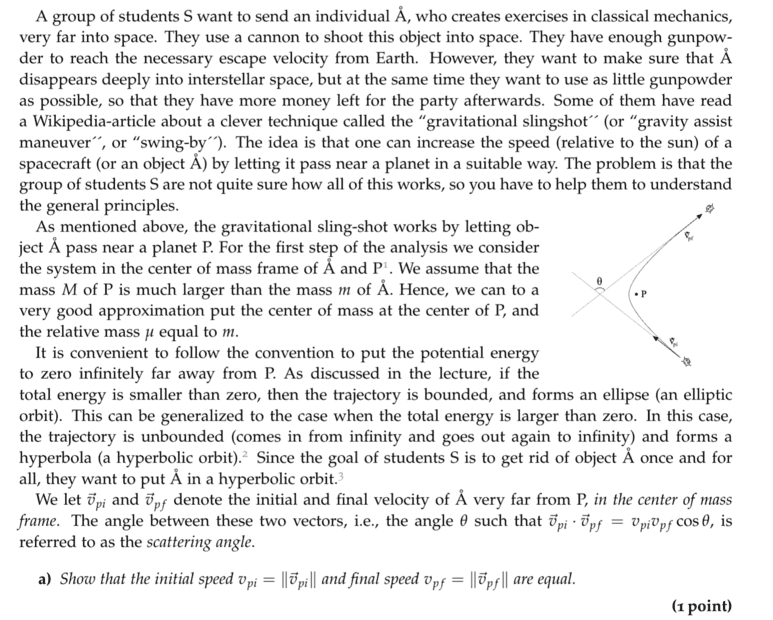
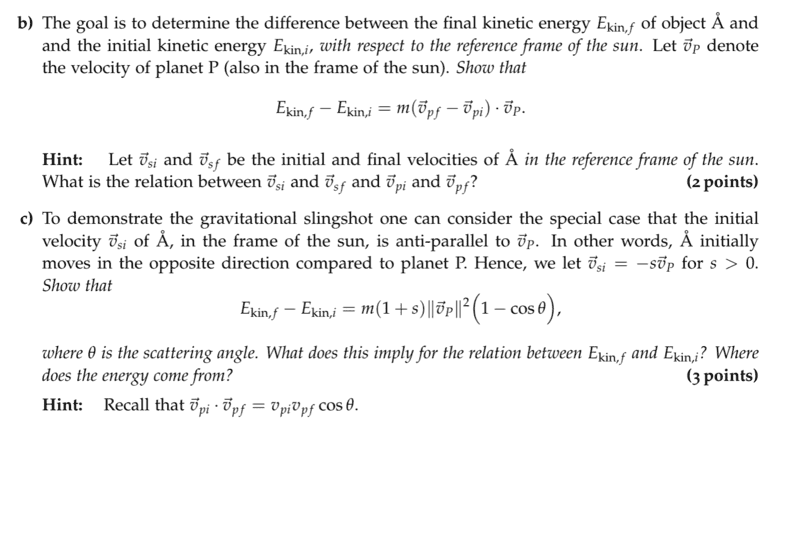 Unfortunately, I am not getting anywhere at all with task c. I have now proceeded as follows:
I assume that the calculation takes place in the reference system of the sun. In the task the following is valid, $$\vec{v}_{si}=-s\vec{v}_p$$ I have now simply assumed that the planet is scattered the velocity vector by the angle $$\theta$$ so the following is valid for the final velocity
$$\vec{v}_{sf}=-s\vec{v}_p*cos(\theta)$$
After that I simply made the difference in the kinetic energy, i.e.$$E_{kin,f}-E_{kin,i}=\frac{1}{2}m\vec{v}_{sf}^2 - \frac{1}{2}m\vec{v}_{si}^2$$If I now insert $$\vec{v}_{sf}=-s\vec{v}_p*cos(\theta)$$ and $$\vec{v}_{si}=-s\vec{v}_p$$, I immediately see that I do not get the required equation, since I have terms like $$s^2$$ and $$cos(\theta)^2$$. But I also don't understand how to get this equation where $$s$$ and $$cos(\theta)$$ occur, you have to square the velocity for the kinetic energy.
the task is as follows
I assume that the calculation takes place in the reference system of the sun. In the task the following is valid, $$\vec{v}_{si}=-s\vec{v}_p$$ I have now simply assumed that the planet is scattered the velocity vector by the angle $$\theta$$ so the following is valid for the final velocity
$$\vec{v}_{sf}=-s\vec{v}_p*cos(\theta)$$
After that I simply made the difference in the kinetic energy, i.e.$$E_{kin,f}-E_{kin,i}=\frac{1}{2}m\vec{v}_{sf}^2 - \frac{1}{2}m\vec{v}_{si}^2$$If I now insert $$\vec{v}_{sf}=-s\vec{v}_p*cos(\theta)$$ and $$\vec{v}_{si}=-s\vec{v}_p$$, I immediately see that I do not get the required equation, since I have terms like $$s^2$$ and $$cos(\theta)^2$$. But I also don't understand how to get this equation where $$s$$ and $$cos(\theta)$$ occur, you have to square the velocity for the kinetic energy.
 , with your help I was able to solve the task of
