Solving Advanced SHM Problem: Tips & Guidance

  • Context: Undergrad 
  • Thread starter Thread starter PhysicsKid0123
  • Start date Start date
  • Tags Tags
    advanced Shm
Click For Summary

Discussion Overview

The discussion revolves around a homework problem related to advanced simple harmonic motion (SHM). Participants seek guidance on how to approach the problem without receiving direct answers, focusing on the methodology and reasoning involved in solving it.

Discussion Character

  • Homework-related
  • Exploratory

Main Points Raised

  • One participant expresses a desire for guidance on how to approach the SHM problem, indicating they have some initial thoughts but are unsure if they are on the right track.
  • Another participant requests the original poster to rotate and repost images for better readability, suggesting a technical issue with the provided materials.
  • A participant presents a mathematical formulation of SHM, including the equations for position and velocity, and poses a question about whether their explanation is sufficient or if further elaboration is needed.
  • There is a repetition of the mathematical formulation, with a participant indicating they will further analyze the information provided.
  • One participant acknowledges the request to move the thread to the homework section and indicates they will take a better picture of the problem.

Areas of Agreement / Disagreement

The discussion does not appear to reach a consensus, as participants are still exploring the problem and seeking clarification. Multiple viewpoints and requests for assistance are present.

Contextual Notes

There are limitations regarding the clarity of the images shared, which may affect the understanding of the problem. Additionally, the mathematical steps presented are not fully resolved or elaborated upon.

PhysicsKid0123
Messages
95
Reaction score
1
I have a homework problem I need help with. I don't want the answer given to me since I know I can answer it with the proper guidance.
How should I approach this problem?
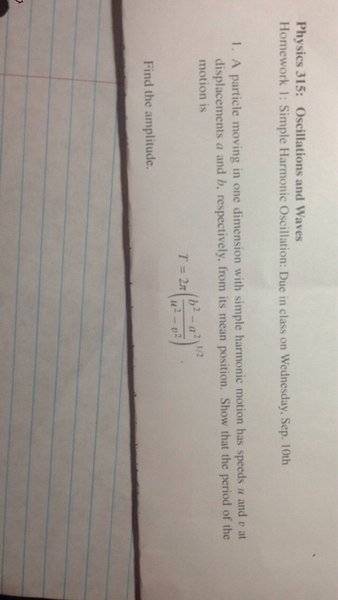
ImageUploadedByPhysics Forums1409893185.944767.jpg


This is what I have so far. How should I approach this? Did I start off right?
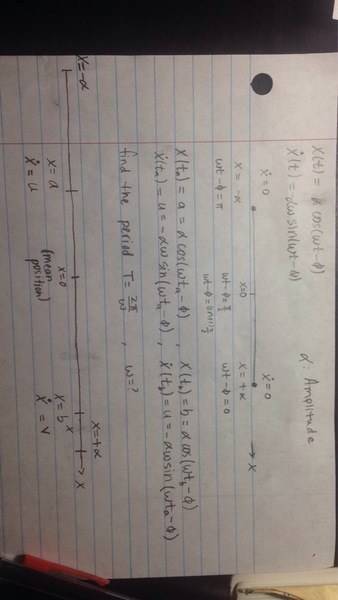
ImageUploadedByPhysics Forums1409893621.787673.jpg

Thanks in advanced!
 
Physics news on Phys.org
Sorry thought this was the homework section
 
hi there

can you please rotate and repost your images so I don't have to lie down to try and read them :)

cheers
Dave

PS have asked for it to be moved to homework section
 
We have:
x=\alpha \cos{(\omega t-\phi)} \Rightarrow \dot x=-\alpha \omega \sin{(\omega t-\phi)}
Let's take \delta=\omega t-\phi, then we can write:
\sin^2 \delta+\cos^2 \delta=1 \Rightarrow (\frac{\dot x}{\alpha \omega})^2+(\frac{x}{\alpha})^2=1.
Is it enough or I should explain further?
 
Shyan said:
We have:
x=\alpha \cos{(\omega t-\phi)} \Rightarrow \dot x=-\alpha \omega \sin{(\omega t-\phi)}
Let's take \delta=\omega t-\phi, then we can write:
\sin^2 \delta+\cos^2 \delta=1 \Rightarrow (\frac{\dot x}{\alpha \omega})^2+(\frac{x}{\alpha})^2=1.
Is it enough or I should explain further?
Mhmm let me see what I can extrapolate from this. Give me a moment... Thanks btw.
 
davenn said:
hi there

can you please rotate and repost your images so I don't have to lie down to try and read them :)

cheers
Dave

PS have asked for it to be moved to homework section
Okay! I will take a better picture!
 
Since this has been reposted in the HW section, I will close this thread.
 

Similar threads

  • · Replies 21 ·
Replies
21
Views
4K
  • · Replies 1 ·
Replies
1
Views
2K
  • · Replies 3 ·
Replies
3
Views
8K
  • · Replies 3 ·
Replies
3
Views
2K
  • · Replies 4 ·
Replies
4
Views
5K
  • · Replies 7 ·
Replies
7
Views
3K
  • · Replies 35 ·
2
Replies
35
Views
4K
  • · Replies 26 ·
Replies
26
Views
2K
  • · Replies 19 ·
Replies
19
Views
2K
  • · Replies 13 ·
Replies
13
Views
1K