Solving Circuit for v1, v2, and v3

  • Context: Engineering 
  • Thread starter Thread starter VinnyCee
  • Start date Start date
  • Tags Tags
    Circuit
Click For Summary

Discussion Overview

The discussion revolves around solving a circuit to find the voltages v1, v2, and v3. Participants explore different methods of analysis, including Kirchhoff's Voltage Law (KVL) and Kirchhoff's Current Law (KCL), while addressing the challenges posed by the circuit configuration.

Discussion Character

  • Technical explanation
  • Debate/contested
  • Mathematical reasoning

Main Points Raised

  • One participant presents a circuit schematic and initial equations derived from KVL but notes that they yield infinite solutions.
  • Another participant suggests that an additional equation is needed, questioning the validity of the initial four equations.
  • Some participants propose using KCL instead of KVL, arguing that it may simplify the analysis and reduce the number of required equations.
  • There is a discussion about the correct application of KCL at different nodes, with participants attempting to derive equations for v1, v2, and v3.
  • One participant points out a potential error in the formulation of a KCL equation and suggests corrections to ensure proper current summation.
  • Several participants engage in verifying the correctness of derived equations and the results of reduced row echelon form (RREF) calculations for the voltages.

Areas of Agreement / Disagreement

Participants express differing opinions on the best approach to solve the circuit, with some favoring KVL and others advocating for KCL. There is no consensus on the correctness of the initial equations or the final voltage values, as participants continue to verify and challenge each other's calculations.

Contextual Notes

Some equations presented may depend on assumptions about the circuit elements and configurations, and there are unresolved questions regarding the accuracy of the derived equations and the application of KCL and KVL.

VinnyCee
Messages
486
Reaction score
0
Here is the circuit:

http://img208.imageshack.us/img208/6185/ch3prob26mn0.jpg

We are supposed to find v1, v2 and v3.

My work so far:

i_1\,=\,\frac{v_3\,-\,v_2}{5\,\Omega}\,,\,i_2\,=\,\frac{v_3\,+\,10\,V}{15\,\Omega}\,,\,i_3\,=\,\frac{v_2\,-\,4\,i_0}{20\,\Omega}\,,\,i_4\,=\,\frac{v_1\,-\,15\,V}{20\,\Omega}

(KVL 1): 10\,i_3\,+\,4\,i_0\,=\,5\,i_1\,+\,20\,i_4\,+\,15V

(KVL 2): 15\,i_2\,-\,10\,V\,-\,4\,i_0\,-\,5\,i_3\,-\,5\,i_1\,=\,0

(KVL 3): 5\,i_1\,+\,5\,(i_1\,-\,i_3)\,+\,10\,i_o\,=\,0

(KVL 4 - Loops 1 and 2): 15\,i_2\,-\,10\,V\,-\,15\,V\,-\,20\,i_4\,-\,5\,(i_1\,-\,i_3)\,-\,5\,i_1\,=\,0

Using these equations, I get infinite answers. I did not list KVL 5, which is the whole outer loop, but I think that it is incorrect anyways because I am getting 0 = 0 for the last two rows in the matrix. Can someone please help?

EDIT: :eek: The 3V source at the top of the schematic should actually be a 3A independent current source.
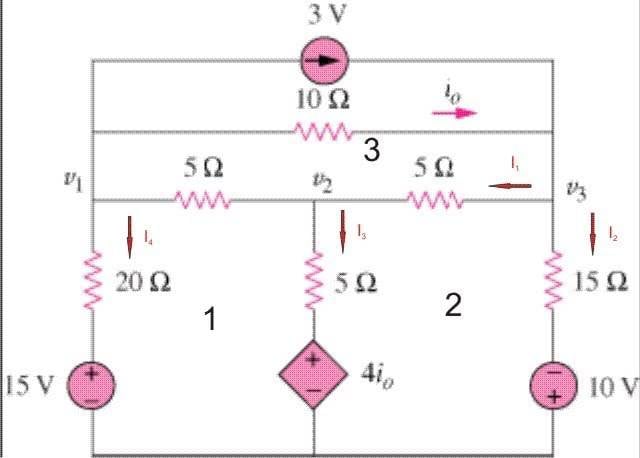
ch3prob26.jpg
 
Last edited by a moderator:
Physics news on Phys.org
Just checking, but can everyone see the picture with the circuit schematic?
 
I can't see the schematic. You're trying calculate what the i_n are in terms of the constants 10V, 15V etc?

--I can see it nowYou need one more equation to solve this set, you have 5 unknowns and only 4 equations (unless i_0 is given?)
 
Last edited:
i_0 is not given. What would you suggest as the 5th equation? A supernode, but where?

Do the first four equations look right?
 
Do you see that i_0 = \frac {v_1-v_3}{10}

BTW I think solving this using KCL is much easier than what you are trying. You only need 3 equations.
 
Last edited:
I agree with Corneo. Since you wanted to solve for the nodal voltages, then nodal analysis (which is KCL) should be more accomodating than mesh analysis (or KVL, which is what you are using now). And like Corneo says, nodal analysis would only give you three equations which appears more reasonable for a exercise of this kind.

But if you should insist on using KVLs, then please check that I3 = (V2 - 4*I0)/20 is incorrect.
 
Where would the three KCL's be applied at? Can you show please?
 
I'll show you one and you try to obtain the rest.

The KCL on node 1 (which has the nodal voltage V1) gives
(V1 - 15)/20 + (V1 - V2)/5 + (V1 - V3)/10 + 3 = 0
or
(7/20) V1 - (1/5) V2 - (1/10) V3 = -9/4
and this becomes Equation #1.

Try to generate the other two KCLs with respect to nodes 2 and 3.
 
Last edited:
Yes, I see that when KCL is applied to a v_n node, that the terms that are not constant in the resulting equation all begin with v_n.

KCL @ v_2:

\frac{v_2\,-\,v_1}{5}\,+\,\frac{v_2\,-\,4\,i_o}{5}\,+\frac{v_2\,-\,v_3}{5}\,=\,0

KCL @ v_3:

\frac{v_3\,-\,v_1}{10}\,+\,\frac{v_3\,-\,v_2}{5}\,+\,\frac{v_3\,+\,10}{15}\,+\,3\,=\,0

Is that correct?
 
  • #10
VinnyCee said:
KCL @ v_3:

\frac{v_3\,-\,v_1}{10}\,+\,\frac{v_3\,-\,v_2}{5}\,+\,\frac{v_3\,+\,10}{15}\,+\,3\,=\,0

The last equation should read...
\frac{v_3\,-\,v_1}{10}\,+\,\frac{v_3\,-\,v_2}{5}\,+\,\frac{v_3\,+\,10}{15}\,-\,3\,=\,0
since we are summing up the currents leaving the node.

Noting next that I0 = (V1 - V3)/10, the KCL for node 2 can then be written in terms of the nodal voltages only. You will then have 3 unknowns and 3 equations which then becomes a mathematical exercise.
 
  • #11
RREF\,\left( \begin{array}{cccc}<br /> \frac{7}{20} &amp; -\,\frac{1}{5} &amp; -\,\frac{1}{10} &amp; -\,\frac{9}{4} \\<br /> -\,\frac{11}{20} &amp; \frac{3}{5} &amp; -\,\frac{9}{50} &amp; 0 \\<br /> -\,\frac{1}{10} &amp; -\,\frac{1}{5} &amp; \frac{11}{30} &amp; \frac{7}{3}<br /> \end{array} \right)\,=\,\left( \begin{array}{cccc}<br /> 1 &amp; 0 &amp; 0 &amp; -5.544 \\<br /> 0 &amp; 1 &amp; 0 &amp; -0.691 \\<br /> 0 &amp; 0 &amp; 1 &amp; 4.475<br /> \end{array} \right)

v_1\,=\,-5.544\,V
v_2\,=\,-0.691\,V
v_3\,=\,4.475

Does it look right?
 
  • #12
VinnyCee said:
\left( \begin{array}{cccc}<br /> \frac{7}{20} &amp; -\,\frac{1}{5} &amp; -\,\frac{1}{10} &amp; -\,\frac{9}{4} \\<br /> -\,\frac{11}{20} &amp; \frac{3}{5} &amp; -\,\frac{9}{50} &amp; 0 \\<br /> -\,\frac{1}{10} &amp; -\,\frac{1}{5} &amp; \frac{11}{30} &amp; \frac{7}{3}<br /> \end{array} \right)\end{array} \right)
I am not sure if the second row is correct. You might want to check.
 
  • #13
Double checking KCL @ v_2:

\frac{3}{5}\,v_2\,-\,\frac{1}{5}\,v_1\,-\,\frac{4}{5}\,\left(\frac{v_1\,-\,v_3}{10}\right)\,-\,\frac{1}{5}\,v_3\,=\,0

RREF\,<br /> \left(<br /> \begin{array}{cccc} <br /> 0.35 &amp; -0.2 &amp; -0.1 &amp; -2.25 \\<br /> -0.28 &amp; 0.6 &amp; -0.12 &amp; 0 \\<br /> -0.1 &amp; -0.2 &amp; 0.367 &amp; 2.34<br /> \end{array} \right)\,=\,\left( \begin{array}{cccc} 1 &amp; 0 &amp; 0 &amp; -7.178 \\0 &amp; 1 &amp; 0 &amp; -2.767 \\0 &amp; 0 &amp; 1 &amp; 2.912\end{array} \right)

Does this mean that v_1\,=\,-7.18\,V,\,v_2\,=\,-2.77\,V,\,v_3\,=\,2.91\,V?
 
  • #14
Yup, that looks good to me.
 

Similar threads

  • · Replies 6 ·
Replies
6
Views
3K
  • · Replies 5 ·
Replies
5
Views
2K
  • · Replies 15 ·
Replies
15
Views
2K
  • · Replies 1 ·
Replies
1
Views
2K
Replies
7
Views
1K
  • · Replies 13 ·
Replies
13
Views
1K
  • · Replies 7 ·
Replies
7
Views
4K
  • · Replies 9 ·
Replies
9
Views
2K
  • · Replies 2 ·
Replies
2
Views
2K
  • · Replies 19 ·
Replies
19
Views
13K