Some questions about toppling of a set of two cylinders

Click For Summary
SUMMARY

The discussion focuses on calculating the toppling angle of a composite system consisting of two glued cylinders with different densities (ρ1=2650 kg/m³ for the top cylinder and ρ2=7000 kg/m³ for the bottom cylinder). The top cylinder has a length of 100 mm and the bottom cylinder has a length of 250 mm, both with a radius of 27 mm. The challenge lies in analyzing the torques created by the offset center of gravity and the weight of the system as it tilts, requiring a detailed understanding of momentum in two dimensions.

PREREQUISITES
  • Understanding of center of gravity (COG) calculations
  • Knowledge of torque and its components in physics
  • Familiarity with static friction and its role in preventing slipping
  • Ability to work with vectors in physics
NEXT STEPS
  • Learn how to calculate the center of gravity for composite objects
  • Study the principles of torque and its application in rotational dynamics
  • Explore static friction coefficients and their impact on stability
  • Investigate vector analysis techniques for resolving forces and torques
USEFUL FOR

Physics students, mechanical engineers, and anyone interested in understanding the mechanics of toppling objects and rotational dynamics.

IgnacioPR
Messages
5
Reaction score
1
Dear colleagues of Physics Forum:

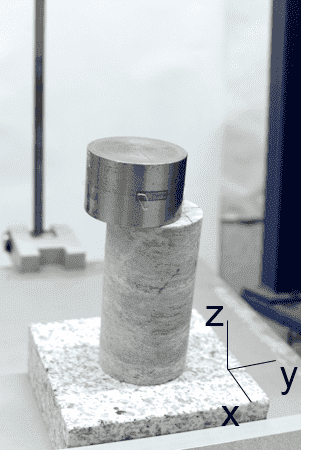
I am trying to estimate the inclination (angle) at which the figure presented with the enclosed photo, composed by two cylinders of different densities (ρ1=2650 kg/m3 and ρ2=7000 kg/m3), will topple, when progressively inclined from a horizontal position. Let's assume that both cylinders are glued, that is, they cannot displace between them. Let's also assume that the set will not slide and only "fail" through toppling.

Length of the cylinder 1 is l1=100 mm and length of the cylinder 2 is l2=250 mm. Both pieces have a radius, r = 27 mm. The top one (c2) is displaced r/2 from the centre, in the way shown in the figure below.

Could you help me on calculating the point of toppling (angle)? I tried to estimate it, but I think I should consider momentums in two different axes...and I do not know how to proceed. Also of interest is to calculate the point (location) at which this set will topple around...

[I hope the photo be easy to understand. The set is rotating around the y-axis]
7UXhvI.png
Ignacio
 

Attachments

  • 7UXhvI.png
    7UXhvI.png
    30.7 KB · Views: 630
Last edited by a moderator:
Physics news on Phys.org
Dear anorlunda:

Thanks for your response. It's right, but I have already estimated the centre of gravity. The problem I found is that this centre of gravity of the complete body (composed by the other two), falls out of a vertical symmetry plane, so I don't know how to calculate momentum from the rotation pivot.

Thanks,
Ignacio
 
I missed the part about glued in the OP. If they are glued together, then you have a single object. Are you asking how to find the C.O.G. for that object?
 
You're rotating around the y-axis, and from that point of view (looking towards the Z-X plane) the disks are aligned, not offset. So their centers of mass will fall along a straight line that is coincident with the axes of the cylinders.

Here are some sketches of various views of your setup:
upload_2018-12-4_12-32-55.png


The red dots represent the center of mass of the combined object.
 

Attachments

  • upload_2018-12-4_12-32-55.png
    upload_2018-12-4_12-32-55.png
    1.8 KB · Views: 627
  • Like
Likes   Reactions: IgnacioPR
Yes, you have a single object but with a different density distribution, since one is a steel cylinder and the other one is a rock cylinder. I have found the COG easily, but I am struggling to find a way for estimating the point of toppling of the entire set. You have momentums created in two dimensions, so I don't know how to estimate the angle of toppling by the composition of two momentums.Thanks for your help.
Ignacio
 
Are you saying that the offset cylinder will create a torque about the pivot point so that the combined object will turn/roll as the platform tilts?
 
Hi!

Thanks for your response.

I am saying that two momentums or torques will co-exist: one created by the offset cylinder in an axis and other one created by the normal and shear forces, corresponding to the weight of the set. What I don't know is how to analyse these two torques acting in different axes.

Thanks,
Ignacio
 
gneill said:
Are you saying that the offset cylinder will create a torque about the pivot point so that the combined object will turn/roll as the platform tilts?

Hi! Thanks for your response. I am saying that two momentums or torques will co-exist: one created by the offset cylinder in an axis and other one created by the normal and shear forces, corresponding to the weight of the set. What I don't know is how to analyse these two torques acting in different axes. Thanks, Ignacio

Reference https://www.physicsforums.com/threa...ut-toppling-of-a-set-of-two-cylinders.961575/
 
  • #10
I'm not sure I can be of much help here. Perhaps if you work with vectors you would be able to find a net torque vector at a point, then find its components projected on to different axes. ##\tau = r\times F_g## where ##r## is the vector from the point of interest to the center of mass, and ##F_g## the vector force of gravity working on the center of mass. A point of interest, for example, might be the center of the base of the bottom cylinder.

You haven't described what forces are keeping the object from slipping or turning on the tilting platform.Is it just static friction? Do you a value for that?
 
  • #11
Make a drawing like the rectangles in gniell's drawing. Make the left hand side of the bottom rectangle (tilting point) at x=0. Draw a line from the center of mass of the composite system to x=0, z=0. Now draw a line from the center of mass to x= diameter of lower cylinder, z=0. The angle at the vertex of this triangle is the critical angle.
 

Similar threads

  • · Replies 1 ·
Replies
1
Views
4K
  • · Replies 1 ·
Replies
1
Views
2K
  • · Replies 7 ·
Replies
7
Views
3K
  • · Replies 47 ·
2
Replies
47
Views
9K
  • · Replies 2 ·
Replies
2
Views
1K
  • · Replies 3 ·
Replies
3
Views
4K
  • · Replies 1 ·
Replies
1
Views
3K
  • · Replies 3 ·
Replies
3
Views
4K
  • · Replies 8 ·
Replies
8
Views
13K
Replies
16
Views
2K