SUMMARY
Sound waves travel faster in solids than in air due to the higher elasticity of solids, despite their greater density. The relationship between sound speed and air density is inversely proportional; as air density decreases, sound speed increases. Additionally, temperature plays a crucial role: higher temperatures reduce air density, resulting in faster sound propagation. The formula for sound velocity, V = √(E/d), illustrates that lower density leads to higher velocity when elasticity remains constant.
PREREQUISITES
- Understanding of basic physics concepts, particularly sound waves
- Familiarity with the formula for sound velocity, V = √(E/d)
- Knowledge of elasticity and its impact on wave propagation
- Basic grasp of how temperature affects gas density
NEXT STEPS
- Research the relationship between elasticity and sound speed in different media
- Explore the effects of temperature on sound propagation in gases
- Learn about the properties of solids that contribute to sound transmission
- Investigate the physics of sound waves in various states of matter
USEFUL FOR
Students studying physics, educators teaching sound wave properties, and anyone interested in the mechanics of sound propagation in different media.
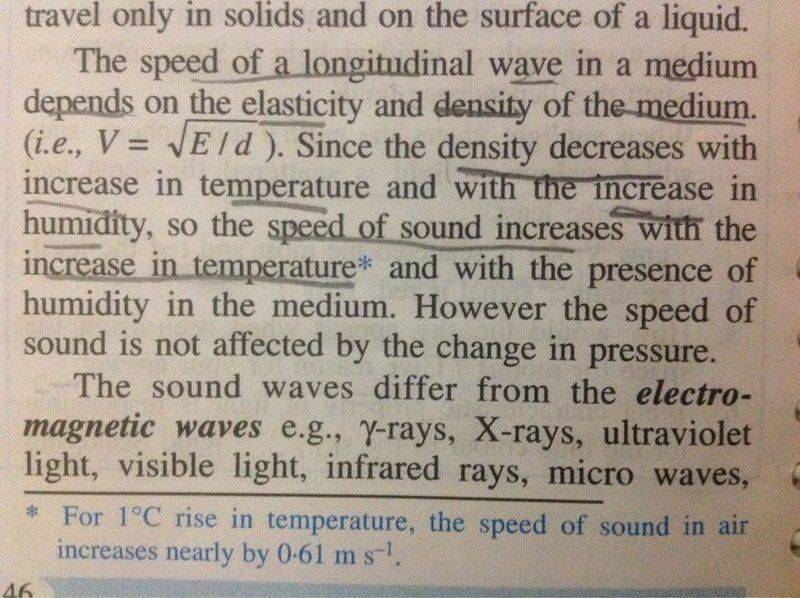 = root of elasticity divided by root of density of medium.