Spring-mass system with a pendulum using Lagrangian dynamics

Click For Summary
SUMMARY

The discussion focuses on deriving the movement equation for a spring-mass system with an attached pendulum using Lagrangian dynamics. Participants emphasize the importance of correctly identifying the potential energy contributions from both the spring and gravitational forces. The potential energy of the spring is expressed as $$\frac{1}{2}k((r(t)-r(0))^2$$, while the gravitational potential energy includes a term of $$mg(r(t)-r(0))$$. The conversation also highlights the distinction between time-dependent quantities and abstract variables in the Lagrangian formalism.

PREREQUISITES
  • Lagrangian mechanics fundamentals
  • Understanding of potential and kinetic energy in mechanical systems
  • Knowledge of spring dynamics and Hooke's Law
  • Familiarity with the principle of stationary action
NEXT STEPS
  • Study the derivation of Lagrange's equations in classical mechanics
  • Explore the concept of configuration space and its significance in Lagrangian dynamics
  • Learn about the role of kinetic energy terms in Lagrangian formulations
  • Investigate the implications of time independence in Lagrangian systems
USEFUL FOR

Students and practitioners in physics, particularly those studying classical mechanics, as well as engineers and researchers working on dynamic systems involving springs and pendulums.

MarkTheQuark
Messages
5
Reaction score
2
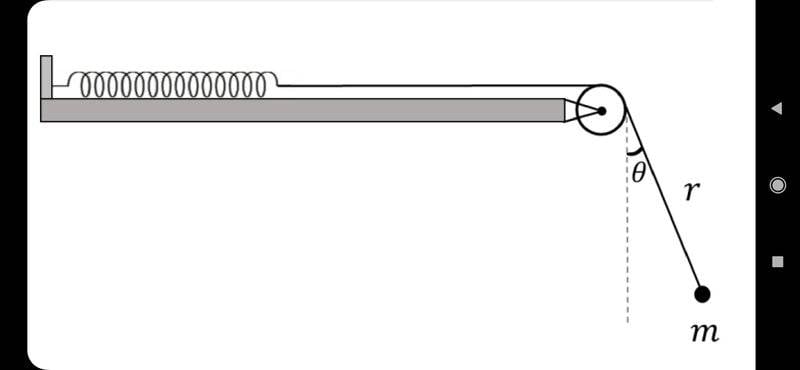
I'm stuck in a problem of a spring mass system with a pendulum attached to it as showed in the figure below:

My goal is to find the movement equation for the mass, using Lagrangian dynamics.

If the spring moves, the wire will move the same amount. Therefore, we can write the x and y position of the mass in terms of this displacement, the length of the wire, and the theta angle.

The problem I'm having is getting to identify the potential energy of the spring, using these terms so that when solving the LaGrange equation it gives a restoring force term of the spring.

Can anyone help me identifying this?
Screenshot_2022-05-20-02-36-19-986_com.google.android.apps.docs.jpg
 
  • Like
Likes   Reactions: Delta2
Physics news on Phys.org
I am not very good in Lagrangian mechanics but if we use $$r(t),\theta(t)$$ for the position of the mass, then the contribution to Lagrangian from the potential energy of the spring should be $$\frac{1}{2}k((r(t)-r(0))^2$$ assuming that at t=0 the spring is at its natural length.

I believe there is more to the Lagrangian from the gravitational potential energy of the mass.
 
  • Like
Likes   Reactions: MarkTheQuark and PhDeezNutz
MarkTheQuark said:
I'm stuck in a problem of a spring mass system with a pendulum attached to it as showed in the figure below:

My goal is to find the movement equation for the mass, using Lagrangian dynamics.

If the spring moves, the wire will move the same amount. Therefore, we can write the x and y position of the mass in terms of this displacement, the length of the wire, and the theta angle.

The problem I'm having is getting to identify the potential energy of the spring, using these terms so that when solving the LaGrange equation it gives a restoring force term of the spring.

Can anyone help me identifying this?View attachment 301707
This looks like homework. You need to show us your best effort. See the guidelines:

https://www.physicsforums.com/help/homeworkhelp/
 
  • Like
Likes   Reactions: MarkTheQuark
I like @Delta2 ‘s suggestion. Treat ##r(0)## as the natural spring/wire length and ##r(t)## as the new length. Then the spring potential energy is exactly what he mentioned. Just add a gravitational term ##mg(r(t)-r(0))## and you've fully formed your Lagrangian.

Edit: You still have to form your kinetic terms.
 
  • Like
Likes   Reactions: Delta2 and MarkTheQuark
I think the gravitational potential energy depends on ##\theta## too.
 
  • Like
Likes   Reactions: MarkTheQuark and PhDeezNutz
Delta2 said:
I think the gravitational potential energy depends on ##\theta## too.
I really ought to start thinking before I start posting. Of course you are right. Tack on a ##\cos \theta##.
 
  • Like
Likes   Reactions: Delta2
PhDeezNutz said:
I like @Delta2 ‘s suggestion. Treat ##r(0)## as the natural spring/wire length and ##r(t)## as the new length. Then the spring potential energy is exactly what he mentioned. Just add a gravitational term ##mg(r(t)-r(0))## and you've fully formed your Lagrangian.
It's not usual to express the quantities in a Lagrangian as a function of time, as these are quantities associated with a configuration space. In fact, in the Lagrangian formalism it's important that they are not the time dependent quantities associated with the system's evolution, but abstract quantities in configuration space.

The gravitational term depends on ##r## and ##\theta##.
 
  • Like
  • Informative
Likes   Reactions: MarkTheQuark, Delta2 and PhDeezNutz
@PeroK I definitely agree. IIRC the EL equation (at least the one I know) was derived without an explicit dependence on ##t##.
 
  • Like
Likes   Reactions: MarkTheQuark
PeroK said:
It's not usual to express the quantities in a Lagrangian as a function of time, as these are quantities associated with a configuration space. In fact, in the Lagrangian formalism it's important that they are not the time dependent quantities associated with the system's evolution, but abstract quantities in configuration space.

The gravitational term depends on ##r## and ##\theta##.
I don't fully understand this comment, when we going to add the kinetic energy term of Lagrangian we going to use some ##\dot r## and ##\dot \theta## terms with the dot denoting the derivative with respect to time...
 
  • Like
Likes   Reactions: MarkTheQuark
  • #10
Delta2 said:
I don't fully understand this comment, when we going to add the kinetic energy term of Lagrangian we going to use some ##\dot r## and ##\dot \theta## terms with the dot denoting the derivative with respect to time...
In the Lagrangian formalism ##r##, ##\dot r## and ##t## are independent abstract variables.

In particular, ##\dot r \not \equiv \frac{ dr} {dt} ##.

PS This particular Lagrangian is time-independent.
 
  • Like
Likes   Reactions: MarkTheQuark
  • #11
when we write ##\frac{\partial L}{\partial \dot x}## we consider ##\dot x## as an independent variable;
when we write ##\frac{d}{dt}\frac{\partial L}{\partial \dot x}## we consider both ##\dot x,x## as functions of time
 
  • Like
Likes   Reactions: Delta2 and MarkTheQuark
  • #12
Yes ok I think I get it now, it is like when we have the function## f(x,y) ##and we form the function ##g(t)=f(x(t),y(t)) ##then according to the chain rule it will be $$\frac{dg}{dt}=\frac{\partial f}{\partial x}\frac{dx}{dt}+\frac{\partial f}{\partial y}\frac{dy}{dt}$$ so though x and y are both functions of time so they can't be independent, we treat them as independent variables when taking the partial derivatives of f with respect to x and y.
 
  • #13
wrobel said:
when we write ##\frac{\partial L}{\partial \dot x}## we consider ##\dot x## as an independent variable;
when we write ##\frac{d}{dt}\frac{\partial L}{\partial \dot x}## we consider both ##\dot x,x## as functions of time
To add to this, once we have the abstract quantities ##\frac{\partial L}{\partial x}## and ##\frac{\partial L}{\partial \dot x}##, we then transform them to time-dependent dynamic quantities and assert that when we evaluate these quantities along a trajectory that represents a valid solution of the system, then the following equation holds:
$$\frac{d}{dt}\frac{\partial L}{\partial \dot x} = \frac{\partial L}{\partial x}$$Which we should all agree is the product of inspirational human thought!
 
  • Like
  • Informative
Likes   Reactions: Delta2 and MarkTheQuark
  • #14
PeroK said:
In the Lagrangian formalism ##r##, ##\dot r## and ##t## are independent abstract variables.

In particular, ##\dot r \not \equiv \frac{ dr} {dt} ##.

PS This particular Lagrangian is time-independent.
More specifically, the Lagrangian is a (possibly also time dependent - although not in this case) function on the tangent bundle of configuration space. The action along a curve ##\gamma## in configuration space is then defined as the time integral of the Lagrangian evaluated along the corresponding curve ##(\gamma,\dot\gamma)## in the tangent bundle, where ##\dot\gamma## is the tangent vector of ##\gamma##. The equations if motion that single out a particular time evolution are then given by the principle of stationary action.
 
  • #15
Orodruin said:
More specifically, the Lagrangian is a (possibly also time dependent - although not in this case) function on the tangent bundle of configuration space. The action along a curve ##\gamma## in configuration space is then defined as the time integral of the Lagrangian evaluated along the corresponding curve ##(\gamma,\dot\gamma)## in the tangent bundle, where ##\dot\gamma## is the tangent vector of ##\gamma##. The equations if motion that single out a particular time evolution are then given by the principle of stationary action.
Sorry for this as I haven't read any good textbook on Lagrangian Mechanics, if we want to calculate the action for some path in the configuration space, we 'll replace in the Lagrangian ##q=q(t)## and ##\dot q=\frac{dq}{dt}## or we can take ##q,\dot q## as independent and replace them with whatever functions of t we like, I mean not necessarily the one being the derivative/integral of the other?
 
  • #16
Although you could technically compute the action for any path in the tangent bundle, the principle of least action works with paths on configuration space and their corresponding path in the tangent bundle.

If you would try arbitrary paths in the tangent bundle you would just end up with having all partial derivatives of the Lagrangian equal to zero because ##\delta q## and ##\delta \dot q## would be independent variations.
 
  • Like
Likes   Reactions: MarkTheQuark and Delta2

Similar threads

Replies
9
Views
4K
  • · Replies 3 ·
Replies
3
Views
3K
  • · Replies 11 ·
Replies
11
Views
2K
Replies
9
Views
2K
Replies
1
Views
1K
  • · Replies 9 ·
Replies
9
Views
3K
  • · Replies 2 ·
Replies
2
Views
5K
  • · Replies 2 ·
Replies
2
Views
4K
Replies
7
Views
5K
Replies
6
Views
3K