What is the Lagrangian, equations of motion for this system?

Click For Summary

Homework Help Overview

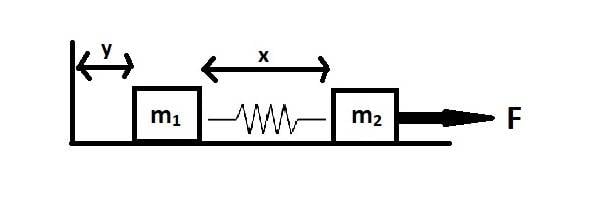
The discussion revolves around a system of two masses, m1 and m2, connected by a spring on a smooth surface, with a constant force applied to m2. Participants are analyzing the Lagrangian formulation of the system, including kinetic and potential energy expressions, and the resulting equations of motion.

Discussion Character

  • Mixed

Approaches and Questions Raised

  • The original poster attempts to derive the Lagrangian and equations of motion based on the kinetic and potential energy of the system.
  • Some participants question the setup of coordinates and the dependence of displacements on both x and y.
  • There is discussion about the generalized force and its application to both coordinates.
  • Participants explore the implications of including an external force in the Lagrangian.

Discussion Status

Participants are actively engaging with each other's contributions, questioning assumptions, and clarifying the formulation of the equations of motion. Some guidance has been provided regarding the treatment of the generalized force and potential energy, but there is no explicit consensus on the final equations.

Contextual Notes

There is an ongoing examination of the assumptions regarding the coordinates and the effects of the applied force on both masses. The discussion reflects a need for clarity on how to incorporate the external force into the Lagrangian formulation.

Amitayas Banerjee
Messages
31
Reaction score
2
<<Moderator's note: Moved from a technical forum, no template.>>
FiQkC.jpg

Description of the system:
The masses m1 and m2 lie on a smooth surface. The masses are attached with a spring of non stretched length l0 and spring constant k. A constant force F is being applied to m2.

My coordinates:
Left of m1 there is a stationary wall. The distance between m1's left surface and the wall is represented as y and the distance between the right and left surfaces of m1 and m2, respectively, is represented as x.

What my brain says:
The kinetic energy of this system is equal to the sum of kinetic energies of the two masses, i.e,
$$\frac{1}{2}m_1 \dot{y}^2 + \frac{1}{2}m_2 (\dot{x}+\dot{y})^2$$
and the potential energy is just the spring potential, i.e,
$$\frac{1}{2} k (x-l_0)^2$$
Therefore, the Lagrangian seems to be,
$$L=\frac{1}{2}m_1 \dot{y}^2 + \frac{1}{2}m_2 (\dot{x}+\dot{y})^2 - \frac{1}{2} k (x-l_0)^2$$

Now, the generalized force is
$$F\cdot \frac{\partial {(x+y)}}{\partial x}$$
So, the equations of motion seem to be,
$$\frac{d}{dt}(\frac{\partial L}{\partial {\dot x}}) - \frac{\partial L}{\partial { x}}=F$$
and
$$\frac{d}{dt}(\frac{\partial L}{\partial {\dot y}}) - \frac{\partial L}{\partial { y}}=0$$Is this correct? Or am I missing something? Please help me figure out the mistakes.
 

Attachments

  • FiQkC.jpg
    FiQkC.jpg
    7.5 KB · Views: 959
Last edited by a moderator:
Physics news on Phys.org
Your coordinates are set up in such a manner that the displacement depends on both x and y.

Also note that you perfectly well can treat the force using a potential, since it is conservative.
 
Orodruin said:
Your coordinates are set up in such a manner that the displacement depends on both x and y.
Sir, What is the problem if the displacement of m2 depends on both x and y? How can I modify my equations for that? Is there any problem with my generalized force calculation?
 
Last edited:
  • Like
Likes   Reactions: Delta2
The generalised force for any coordinate is given by ##F(\partial \ell/dq^i)##, where ##\ell## is the displacement and ##F## the force. You have ignored the effect of the generalised force on the ##y## coordinate.
 
Orodruin said:
You have ignored the effect of the generalised force on the yyy coordinate.
Is it not $$F\cdot \frac{\partial {(x+y)}}{\partial x}$$
The factor of F becomes 1. Does it not?
 
Amitayas Banerjee said:
Is it not $$F\cdot \frac{\partial {(x+y)}}{\partial x}$$
The factor of F becomes 1. Does it not?
That is just the effect on the ##x## coordinate, but you are ignoring the fact that ##x + y## also depends on ##y##.
 
Orodruin said:
That is just the effect on the xxx coordinate, but you are ignoring the fact that x+yx+yx + y also depends on yyy.
Then my second equation of motion is $$
\frac{d}{dt}(\frac{\partial L}{\partial {\dot y}}) - \frac{\partial L}{\partial { y}}=F\cdot \frac{\partial {(x+y)}}{\partial y}$$? Is it correct now?
 
Yes. However, as I said, it is easier to do this by including a potential in the Lagrangian.
 
Sir, what are the finally correct equations? Are they
$$\frac{d}{dt}(\frac{\partial L}{\partial {\dot x}}) - \frac{\partial L}{\partial { x}}=F$$

and

$$\frac{d}{dt}(\frac{\partial L}{\partial {\dot y}}) - \frac{\partial L}{\partial { y}}=F$$
? Please clarify this
 
Last edited:
  • Like
Likes   Reactions: Delta2
  • #10
I think they are correct now, probably Orodruin wants to incorporate the external force into the Lagrangian by adding a term -F(x+y) as extra potential energy to the lagrangian, so it will be ##L'=L-F(x+y)## and the equations of motion with ##L'## will be homogeneous.
 

Similar threads

  • · Replies 11 ·
Replies
11
Views
3K
  • · Replies 6 ·
Replies
6
Views
3K
  • · Replies 1 ·
Replies
1
Views
3K
Replies
7
Views
3K
  • · Replies 2 ·
Replies
2
Views
2K
Replies
6
Views
2K
  • · Replies 16 ·
Replies
16
Views
2K
  • · Replies 26 ·
Replies
26
Views
4K
Replies
6
Views
4K
Replies
5
Views
2K