Statics problem: A ramp is supported by two cables

Click For Summary

Discussion Overview

The discussion revolves around a statics problem involving a ramp supported by two cables, specifically focusing on the calculation of moments about different points (A and C). Participants explore the correct application of formulas and the implications of using different points of reference in their calculations.

Discussion Character

  • Homework-related
  • Technical explanation
  • Debate/contested

Main Points Raised

  • One participant expresses confusion regarding the notation used for moments, questioning why the problem refers to moment at C when it is asking for the moment at A.
  • Another participant points out a mistake in the application of the moment formula, emphasizing that the distance from point A to the force at point C should be used instead of the distance from point A to point G.
  • A participant acknowledges the helpfulness of the previous response and reflects on their initial approach, which did not yield an answer listed among the possible options.
  • There is a discussion about the equivalence of using either distance in the moment calculation, noting that the relationship between the distances simplifies the problem, leading to the same moment value.
  • Concerns are raised about the possible answers provided in the problem, suggesting that they may incorrectly refer to the moment at C rather than A.

Areas of Agreement / Disagreement

Participants express differing views on the correct approach to calculating moments, with some agreeing on the equivalence of the distances used while others maintain that the problem's phrasing may lead to confusion regarding the correct moment to calculate. The discussion remains unresolved regarding the correctness of the provided answers.

Contextual Notes

There are limitations regarding the assumptions made about the relationships between the distances and the forces, as well as the clarity of the problem statement itself. The discussion highlights potential ambiguities in the problem setup.

Camailee
Messages
2
Reaction score
0
Homework Statement
The ramp ABCD is supported by cables at corners C and D. The tensile force in both cables is 420N. Determine the moment about point A produced by the force exerted at point C.
Relevant Equations
Moment at A (MA) = rGA x TCG.
Where rGA = GA/|GA|
TCG = 420N
Problem illustration:
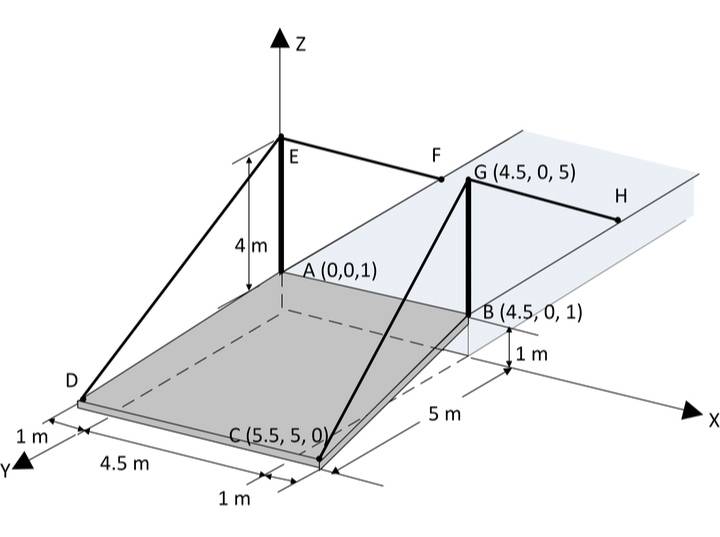
IMG_20210107_212412.jpg


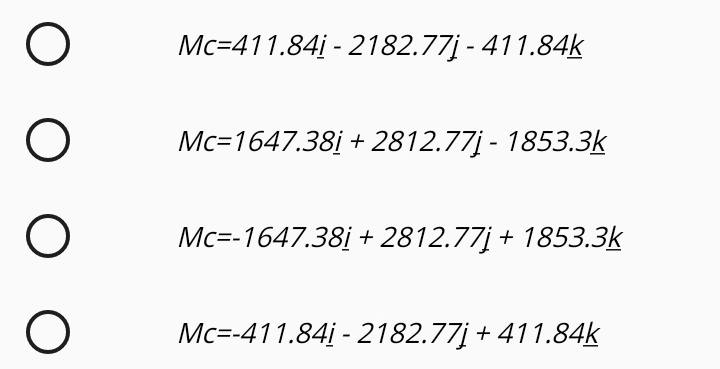
The possible answers are:
IMG_20210107_210036.jpg

I don't understand why it says Mc if it is asking for the moment at A, not C. But maybe I am getting something wrong.

So with the formulas I posted above, I have this:
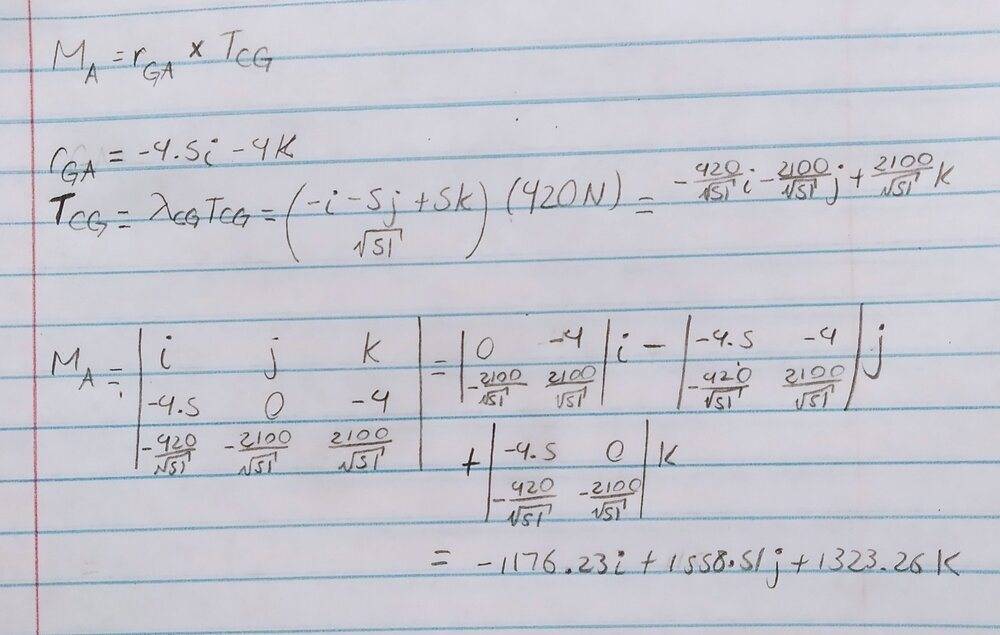
IMG_20210107_212105.jpg
 
Last edited by a moderator:
Physics news on Phys.org
Your mistake is that you insert ##r_{GA}## in the formula for the moment while you should insert ##r_{CA}##. It is the moment about point A, of the force that is applied at point C not at point G.

What you did is calculate the moment about A, of the force that is applied at point G which is not what is asked for. The forces at G and C might be equal in magnitude , but the point of application differs (and the direction reverses).
 
Delta2 said:
Your mistake is that you insert ##r_{GA}## in the formula for the moment while you should insert ##r_{CA}##. It is the moment about point A, of the force that is applied at point C not at point G.

What you did is calculate the moment about A, of the force that is applied at point G which is not what is asked for. The forces at G and C might be equal in magnitude , but the point of application differs (and the direction reverses).

Thank you for your answer Delta2. Was really helpful!

I understand what you mean. In fact the approach you mentioned is the one I thought first. I did it and the answer I got wasn't included on all the possible answers.

IMG_20210108_122416.jpg


The other approach I posted above, with the ##r_{GA}## was based on an example I found, asking the same thing of the same structure, but with different distance units. Why does ##r_{GA}## is used, instead of ##r_{CA}## ?

IMG_20210108_122913.jpg


Update: As I suspected and mentioned before, the possible answers are wrong because they are referring to the moment ##M_C## and not ##M_A## .
 

Attachments

  • Screenshot_2021-01-08-10-38-03-711_com.google.android.apps.docs.jpg
    Screenshot_2021-01-08-10-38-03-711_com.google.android.apps.docs.jpg
    30.1 KB · Views: 310
  • Screenshot_2021-01-08-10-38-03-711_com.google.android.apps.docs.jpg
    Screenshot_2021-01-08-10-38-03-711_com.google.android.apps.docs.jpg
    30.1 KB · Views: 300
Last edited:
Well sorry , I now see that it is the same thing whether you take the arm to be ##r_{CA}## or ##r_{GA}## because it is ##r_{CA}=r_{GA}+r_{CG}## and when we take the cross product with ##T_{CG}## the term ##r_{CG}\times T_{CG}=0## vanishes. You indeed calculated both to be equal which verifies it.

I don't know why the answer doesn't match one of the options. It might be because they are referring to the moment ##M_C## as you say, i.e moment about point C.
 
  • Like
Likes   Reactions: Camailee

Similar threads

  • · Replies 1 ·
Replies
1
Views
3K
  • · Replies 1 ·
Replies
1
Views
2K
  • · Replies 2 ·
Replies
2
Views
2K
  • · Replies 27 ·
Replies
27
Views
4K
  • · Replies 4 ·
Replies
4
Views
3K
  • · Replies 5 ·
Replies
5
Views
2K
Replies
6
Views
2K
  • · Replies 4 ·
Replies
4
Views
2K
Replies
3
Views
3K
  • · Replies 2 ·
Replies
2
Views
2K