SUMMARY
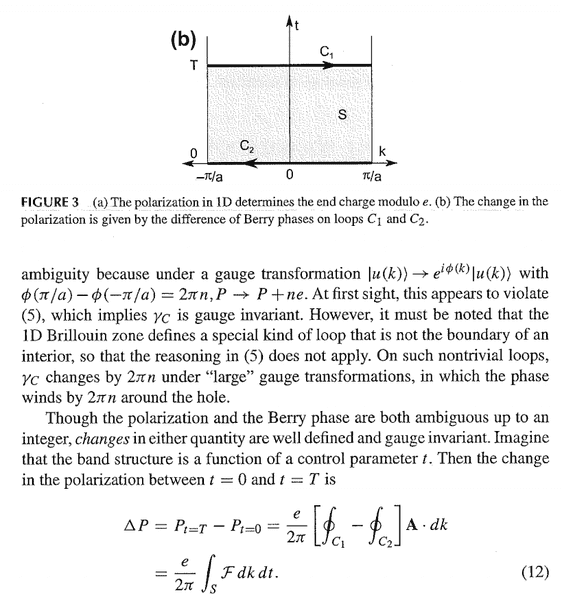
The discussion centers on the application of Stokes' Theorem in the context of a torus and its curvature. Participants clarify that the object in question is not a torus but rather a cylinder, as the top and bottom edges are not identified, which affects the application of Stokes' Theorem. The integral of the 1-form ##A## along the closed loops ##C_1## and ##C_2## would yield a non-zero result if the top and bottom were not identified. Thus, the boundary of the cylinder is defined by the difference between the two loops, leading to a conclusion that the integral of ##dA## would be zero if it were a torus.
PREREQUISITES
- Understanding of Stokes' Theorem
- Familiarity with differential forms and their integrals
- Knowledge of toroidal and cylindrical geometries
- Basic concepts of curvature in differential geometry
NEXT STEPS
- Study the implications of Stokes' Theorem on different geometrical shapes
- Explore the properties of differential forms in topology
- Learn about the identification of edges in manifolds
- Investigate the relationship between curvature and topology in higher dimensions
USEFUL FOR
Mathematicians, physicists, and students studying differential geometry, particularly those interested in the applications of Stokes' Theorem and the topology of surfaces.