Which Stress vs Strain Curve Has a Larger Slope?

  • Context: Undergrad 
  • Thread starter Thread starter gracy
  • Start date Start date
  • Tags Tags
    Curve Strain Stress
Click For Summary
SUMMARY

This discussion focuses on determining the slope of stress vs. strain curves, specifically how to visually assess which curve is steeper. Participants emphasize the importance of having scaled axes for accurate slope comparison, noting that without them, conclusions are unreliable. The concept of "set strain," which refers to permanent deformation, is clarified, alongside the phenomenon of "necking," where a material's cross-sectional area reduces under stress, leading to decreased tensile strength. The conversation concludes with a deeper understanding of how stress is calculated in relation to necking and the original cross-sectional area.

PREREQUISITES
  • Understanding of stress vs. strain concepts
  • Familiarity with the terms "necking" and "set strain"
  • Basic knowledge of calculus, particularly slope calculations
  • Experience with material deformation and tensile testing
NEXT STEPS
  • Research "stress-strain curve analysis" for deeper insights
  • Study "necking in materials" to understand its implications on tensile strength
  • Explore "engineering stress vs. true stress" for clarity on stress calculations
  • Learn about "Hooke's Law" and its application in material science
USEFUL FOR

Material scientists, mechanical engineers, and students studying material mechanics will benefit from this discussion, particularly those interested in the behavior of materials under stress and strain.
gracy
Messages
2,486
Reaction score
83
How can we determine which curve has larger slope just by looking at curves.
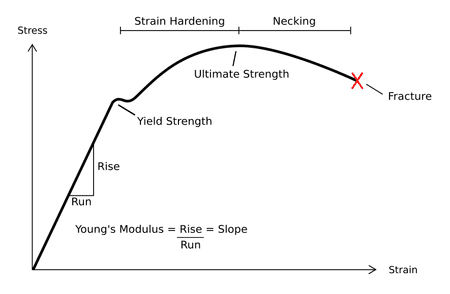
450px-Stress_Strain_Ductile_Material.png

http://www.meritnation.com/img/shared/userimages/mn_images/image/a_2_12_2.png
Which curve has larger slope?
 
Last edited by a moderator:
Physics news on Phys.org
First, check to see that the axes are scaled the same, then look for which one is steeper.
 
gracy said:
Which curve has larger slope?
At what point?
 
RUber said:
which one is steeper.
That's what I wanted to ask how to determine which one is steeper?
 
gracy said:
how to determine which one is steeper
Without scales on the x and y axes, there is no way to determine slopes.
 
  • Like
Likes   Reactions: gracy
Bystander said:
Without scales on the x and y axes, there is no way to determine slopes.
I just have to tell which curve has larger slope,i.e I don't want to determine absolute or exact slope .I just want to compare slopes of the two curves which I have posted.Is it also not possible?
 
You can ASSUME both are scaled identically and pick which has the steeper initial slope (closer to vertical) --- but it's very poor form to make that sort of assumption, particularly between two entirely different graphic styles. It's likewise very poor graphic style to omit any suggestions of scale, but that takes ink, and ink costs publishers money.
 
  • Like
Likes   Reactions: gracy
Bystander said:
and pick which has the steeper initial slope
Curve 2 in my post,right?
 
gracy said:
Curve 2 in my post,right?
That's the one my eye tells me is steeper. I would still hate to wager large sums of money on what either of the plots actually represent numerically.
 
  • #10
So steepness is determined by looking at how straight curve is?Or by how much closer the curve is with y axis?
 
  • #11
I think the second one is correct.As this image depicts.
gradsteep.gif
 
  • #12
Yes. You've taken calculus?
 
  • #13
What is meant by set strain in stress vs strain curve?
 
  • #14
Bystander said:
You've taken calculus?
No.
 
  • #15
gracy said:
set strain
"Set strain" is permanent deformation of an object. Under stress objects deform. Up to a certain limit, they deform elastically; that is, the deformation is NOT permanent, and if the stress is removed/relaxed, they will return to their original dimensions and shape. If stress is increased beyond that limit, when it is again relaxed or removed, the object will not return to its original shape and/or dimensions. Take a spring from a "dead" ball point pen refill, and stretch or compress it one cm. When you release it, it flies across the table/room, and when you finally find where it landed, it will be the original length. Stretch it to the length of your hand and release it, and you will notice that it's unable to recover it's original length of 3 to 4 cm.

As far as the calculus question, you will eventually be presented with the concept of "slope" which in x-y, or Cartesian, coordinates is defined as the limit as delta x goes to zero of delta y divided by delta x. It can be approximated by looking at a non-zero change in x and seeing how much y changes, and that's probably a more convenient way of looking at it for you for the moment.
 
  • Like
Likes   Reactions: gracy
  • #16
I understood what set strain is.It is strain which remains permanently .Last thing about strain vs stress I want to ask.What is neck in this type of curve?
 
  • #17
Why stress decreases after point D in the curve below?

mage=http%3A%2F%2Fwww.meritnation.com%2Fimg%2Fshared%2Fuserimages%2Fmn_images%2Fimage%2Fa_2_12_2.png
 
  • #18
When materials are actually pulled (just like taffy) apart to generate these curves, at some value of applied stress, the sample specimen (sometimes a square cross-section, sometimes a rectangular cross-section, sometimes round cross-section, and other cross section shapes) will stop "drawing" (elongating) uniformly over the length of the specimen, and at its weakest point will begin "necking," a local reduction of cross-sectional area that then has lower tensile strength than the rest of the specimen (lower area times tensile strength equals lower force it can resist) and this effect then leads to the final tensile failure.
 
  • Like
Likes   Reactions: gracy
  • #19
Bystander said:
and at its weakest point will begin "necking,"
Can you please explain this further,Sir.
 
  • #20
If you have a "fat" rubber band handy, look at its cross-section, or bungee cord for holding books together, and look at the "relaxed" cross-section. It's uniform over the length of whatever is (rubber band, bungee cord,...) As you stretch it, the cross-section decreases, again, uniformly over the length (for a given force, the cross-section is constant over the length) up to the point where it breaks. Trying to think of a material that will show "necking." Cheese on a pizza --- you pick up a slice, and the cheese sticks to the next slice, or the tray, and pulls ("draws") out into long thin strings? Occasionally you'll have a really thick blob of cheese that starts to draw, then just seems to "pull back into itself" at either end and leave the thin string connecting the two blobs? That's necking.
 
  • Like
Likes   Reactions: gracy
  • #21
upload_2015-2-8_14-42-15.png

Have I interpreted correctly?
 
  • Like
Likes   Reactions: Bystander
  • #22
Yes.
 
  • #23
But I am not getting one thing.Stress=force/area
If there is reduction in cross sectional area stress should increase than why stress decreases after point D (before breaking point)in my curve of post 17.
 
  • Like
Likes   Reactions: Bystander
  • #24
gracy said:
why stress decreases after point D
What's plotted is the total stress. It's not actually divided by the actual cross-sectional area of the "necked-down" section of the test specimen. This link
http://en.wikipedia.org/wiki/Ultimate_tensile_strength may be some help for you. Particularly the section showing the "red" vs. "blue" stress-strain curves, and the explanation that accompanies it describing the two cross-sectional areas used in plotting both of these curves, "A" and "A0."
 
  • #25
Bystander said:
This link
http://en.wikipedia.org/wiki/Ultimate_tensile_strength may be some help for you.
Yes.It helped.Particularly this line
"when necking becomes substantial, it causes a reversal of the engineering stress–strain curve as the engineering stress is calculated assuming the original cross-sectional area before necking."
I have interpreted it (the curve of 17 post)in this way.Curve A to B obeys hooks law.Than B to C denotes plastic flow i.e strain increases without increase in stress as in your pizza analogy cheese starts to flow /pull then curve C to D depicts necking as cross sectional area decreases stress increases,lastly curve D to E indicates substantial increase in necking that's why we will consider original cross sectional area so stress will come down to original value|(less than necking region)that's why stress appears to decrease after point D in curve.
Correct?
 
  • #26
You have got it.
 
  • Like
Likes   Reactions: gracy
  • #27
Thanks.You are such a nice teacher.God bless you.
 
  • #28
Sir @Bystander I again want to start conversation with you,can I?
 
  • #29
Sir @Bystander have you left the conversation with option ignore future messages?
 
  • #30
gracy said:
But I am not getting one thing.Stress=force/area
If there is reduction in cross sectional area stress should increase than why stress decreases after point D (before breaking point)in my curve of post 17.

I also had problems wit this until I realized that the curves are obtained by forcing the extension of the sample with a very strong frame (i.e. Not by hanging a load on it). The force needed for that extension is then measured. If you try it the other way, the sample will just give way and break before reaching the interesting time.
 

Similar threads

  • · Replies 4 ·
Replies
4
Views
2K
  • · Replies 1 ·
Replies
1
Views
3K
  • · Replies 5 ·
Replies
5
Views
2K
  • · Replies 13 ·
Replies
13
Views
5K
  • · Replies 2 ·
Replies
2
Views
3K
Replies
19
Views
2K
  • · Replies 1 ·
Replies
1
Views
2K
  • · Replies 2 ·
Replies
2
Views
6K
  • · Replies 4 ·
Replies
4
Views
6K
  • · Replies 9 ·
Replies
9
Views
7K