Superpostion circuit analysis question

Click For Summary

Discussion Overview

The discussion focuses on analyzing a superposition circuit, specifically determining the configuration of resistors in series and parallel. Participants are exploring the implications of replacing current and voltage sources with open and short circuits, respectively, and how this affects the circuit's components.

Discussion Character

  • Technical explanation
  • Debate/contested
  • Homework-related

Main Points Raised

  • One participant expresses confusion about identifying which resistors are in series or parallel after applying the superposition principle, specifically questioning if r2 and r4 are in parallel.
  • Another participant suggests drawing the circuit diagram with the specified modifications to clarify the configuration and indicates that some components can be removed due to lack of current.
  • A participant acknowledges the suggestion to redraw the circuit but remains confused about the components that can be removed, particularly mentioning R6's position.
  • Further clarification is provided, indicating that R1 and R6 may be in series with the equivalent resistance after the modifications.
  • Another participant emphasizes the importance of understanding current flow in the modified circuit and questions how the current behaves at a specific node near R2.

Areas of Agreement / Disagreement

Participants do not reach a consensus on the configuration of the circuit components, and there are multiple viewpoints regarding the identification of series and parallel relationships among the resistors.

Contextual Notes

There are unresolved assumptions regarding the behavior of current in the circuit and the specific configuration of components that can be combined or removed.

fatmoe
Messages
6
Reaction score
0
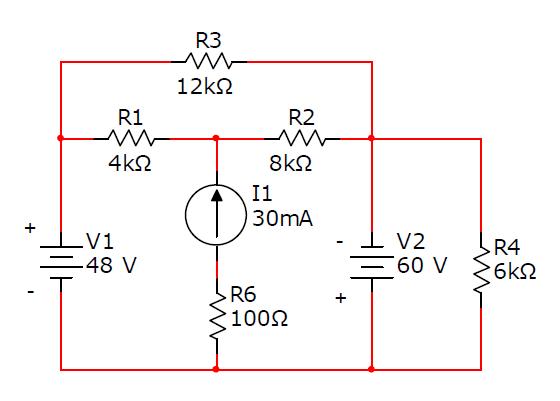
The problem I am having is determining what is in series and what is in parallel.

Now I am working with v1, so I1 has been removed and replaced with an open circuit and v2 has been replaced with a short.

So does that mean that r2 || r4? and if so, does that also mean that r2 || r4 which would then be in series with r3?


nqVKsGY.jpg
 

Attachments

  • Untitled.jpg
    Untitled.jpg
    17 KB · Views: 412
Physics news on Phys.org
I think you should actually draw the circuit diagram replacing I1 with an open circuit and V2 with a short circuit.

Then, you should see there are two more components you can remove, because they don't have any current flowing through them. That should answer your question

does that mean that r2 || r4? and if so, does that also mean that r2 || r4 which would then be in series with r3?
 
AlephZero said:
I think you should actually draw the circuit diagram replacing I1 with an open circuit and V2 with a short circuit.

Then, you should see there are two more components you can remove, because they don't have any current flowing through them. That should answer your question

Well I have redraw it but I don't see two other components that I can remove.. R6 is in the middle so I can't combine it with anything.. I'm confused.. Already spent 4 hours on this questions..
 
AlephZero said:
I think you should actually draw the circuit diagram replacing I1 with an open circuit and V2 with a short circuit.
K
Then, you should see there are two more components you can remove, because they don't have any current flowing through them. That should answer your question

I think I see now.. You mean r1 and r6? Then that would in series with the equivalent.
 
You have an open circuit for I1 and a short circuit for V2. The current will always flow the easiest route from + to -.

As Aleph said, draw your new circuit and look at how the current would flow through it. In your above post, R6 is correct, however, there will flow current through R1. What happens with the current on the node to the right of R2? Where will it flow from there?
 

Similar threads

  • · Replies 1 ·
Replies
1
Views
2K
  • · Replies 15 ·
Replies
15
Views
3K
  • · Replies 5 ·
Replies
5
Views
2K
  • · Replies 5 ·
Replies
5
Views
3K
  • · Replies 12 ·
Replies
12
Views
2K
  • · Replies 7 ·
Replies
7
Views
2K
  • · Replies 6 ·
Replies
6
Views
2K
  • · Replies 2 ·
Replies
2
Views
2K
  • · Replies 7 ·
Replies
7
Views
2K
  • · Replies 3 ·
Replies
3
Views
2K