Surprise? Entropy changes for systems in a canonical state

Click For Summary
SUMMARY

The discussion centers on the derivation of the second law of thermodynamics from Gibbs entropy, highlighting its simplicity and the clarity it brings to the concepts of heat and work from a statistical perspective. Participants express surprise at this derivation, indicating a gap in common knowledge among those studying statistical physics. The reference to Jaynes' 1957 work is noted as a significant resource for further exploration of this topic. The conversation invites insights on the historical context and additional references related to this argument.

PREREQUISITES
  • Understanding of Gibbs entropy and its implications in statistical mechanics
  • Familiarity with the second law of thermodynamics
  • Basic knowledge of heat transfer and internal energy concepts
  • Awareness of historical context in thermodynamics, particularly Jaynes' contributions
NEXT STEPS
  • Study the derivation of the second law from Gibbs entropy in detail
  • Explore Jaynes' 1957 paper on statistical mechanics for deeper insights
  • Research the historical development of thermodynamic principles
  • Investigate other statistical interpretations of heat and work in physics literature
USEFUL FOR

Students and professionals in physics, particularly those focused on statistical mechanics and thermodynamics, as well as educators seeking to enhance their understanding of entropy and its implications.

maajdl
Gold Member
Messages
391
Reaction score
29
Every year since the 90's I come back to some of my pet topics in physics, like statistical physics.
This time it was the reading of a Wikipedia article on entropy that surprised me.
The derivation of the second law from the Gibbs entropy was unknown to me.
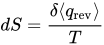
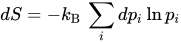
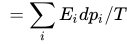
I didn't know how heat, how change of internal energy, and how work can be identified from the equations below:
6e42d8b7fd3830084141f9d0cb4f3d9715881171
edbcfce7e6e6c915bc211eb40239d5cefa9ce6e3
f69390136af8271cf1b44410b38ae32308b00e6b

or

df63971dc42a5cfffe90afe9a0d043f63fd59fa8


Not only is this derivation very simple but it also clarifies the meaning of heat and work from a statistical point of view.

I would like to know:

- if you were aware of this argument
- when/how you learned it
- how far it could be traced back in time (Gibbs maybe)
- if you know other references that mention this argument and discuss it further

Thanks to share
 
Science news on Phys.org

Similar threads

  • · Replies 15 ·
Replies
15
Views
3K
  • · Replies 13 ·
Replies
13
Views
4K
  • · Replies 17 ·
Replies
17
Views
3K
Replies
10
Views
3K
  • · Replies 60 ·
3
Replies
60
Views
10K
  • · Replies 15 ·
Replies
15
Views
3K
  • · Replies 1 ·
Replies
1
Views
3K
  • · Replies 22 ·
Replies
22
Views
6K
  • · Replies 3 ·
Replies
3
Views
2K
  • · Replies 2 ·
Replies
2
Views
2K