Taking classical limit question (statistical mechanics )

Click For Summary

Homework Help Overview

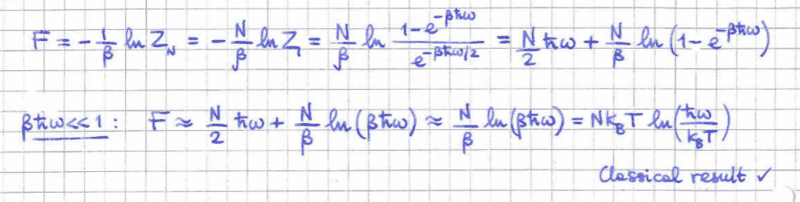
The discussion revolves around the classical limit in statistical mechanics, specifically focusing on the limit condition ##\beta (h/2\pi) \omega << 1##. Participants are examining the implications of this limit on exponential and logarithmic expansions.

Discussion Character

  • Conceptual clarification, Mathematical reasoning

Approaches and Questions Raised

  • Participants explore the reasoning behind expanding exponential functions in the context of small variables, questioning the validity of neglecting terms in the expansion of ##e^{-x}## compared to ##e^{x}##. There is also a discussion about the behavior of logarithmic functions near zero and the implications of these expansions on the overall approximation.

Discussion Status

Some participants have offered insights into the nature of exponential functions and Taylor expansions, while others express confusion regarding the significance of terms being neglected in the context of negative exponents. The conversation reflects a mix of interpretations and clarifications without reaching a consensus.

Contextual Notes

Participants are grappling with the nuances of Taylor series expansions and the behavior of functions as they approach limits, particularly in the context of statistical mechanics. There is an underlying concern about the implications of these expansions on the accuracy of approximations.

binbagsss
Messages
1,291
Reaction score
12
1. Homework Statement

Question attached.
freee.png


I am looking at the second line limit ##\beta (h/2\pi) \omega << 1 ##

2. Homework Equations

above

3. The Attempt at a Solution

Q1)In general in an expansion we neglect terms when we expand about some the variable taking small values of the function because the other terms are so small and so we get a good approximation from e.g first order terms. so in this case i see in the exponential expansion we have gone up to ##O(x=\beta (h/2\pi) \omega )## and the '1s' have cancelled. However, to me this makes sense if we were looking at ##\exp^{x}## but instead we are looking at ##e^{-x}## and when we raise to a negative exponent between ##0 < x <1 ## this is large, so why do we expand out?

for e.g i the log term in the 2nd term must be tending ##\to -\infty ## and I thought this is the reason we don't expand it out? or why do we not expand it out, I know in general you can't expand out ## \log (0) ## and it seems like we have a limiting case of this, but..thanks
 

Attachments

  • freee.png
    freee.png
    42.4 KB · Views: 922
Physics news on Phys.org
binbagsss said:
1. Homework Statement

Question attached.

View attachment 222448

I am looking at the second line limit ##\beta (h/2\pi) \omega << 1 ##

2. Homework Equations

above

3. The Attempt at a Solution

Q1)In general in an expansion we neglect terms when we expand about some the variable taking small values of the function because the other terms are so small and so we get a good approximation from e.g first order terms. so in this case i see in the exponential expansion we have gone up to ##O(x=\beta (h/2\pi) \omega )## and the '1s' have cancelled. However, to me this makes sense if we were looking at ##\exp^{x}## but instead we are looking at ##e^{-x}## and when we raise to a negative exponent between ##0 < x <1 ## this is large, so why do we expand out?

for e.g i the log term in the 2nd term must be tending ##\to -\infty ## and I thought this is the reason we don't expand it out? or why do we not expand it out, I know in general you can't expand out ## \log (0) ## and it seems like we have a limiting case of this, but..thanks

I don't see what you are worried about. If ##|x| << 1## then ##e^x \approx 1+x##. It doesn't matter whether ##x## is positive or negative. And, of course, you can't Taylor expand ##\log## around ##0##.
 
Dick said:
I don't see what you are worried about. If ##|x| << 1## then ##e^x \approx 1+x##. It doesn't matter whether ##x## is positive or negative. And, of course, you can't Taylor expand ##\log## around ##0##.

No I don't understand because ##e^{-x} ## for ##x<<1## is large, and so by neglecting any term you are neglecting a significant contribution? (whereas for ##e^x## ofc you are not neglecting a significant contribution but smaller terms which makes complete sense)..
 
No, for x << 1 , e-x ≈ 1-x
Do you really think e0.001 and e-0.001 are very different?
 

Similar threads

  • · Replies 4 ·
Replies
4
Views
2K
  • · Replies 2 ·
Replies
2
Views
2K
  • · Replies 3 ·
Replies
3
Views
2K
  • · Replies 7 ·
Replies
7
Views
2K
  • · Replies 3 ·
Replies
3
Views
2K
  • · Replies 10 ·
Replies
10
Views
2K
  • · Replies 12 ·
Replies
12
Views
2K
Replies
4
Views
1K
Replies
6
Views
1K
  • · Replies 1 ·
Replies
1
Views
2K