The Electric Field of a Continuous Distribution of Charge

Click For Summary

Homework Help Overview

The discussion revolves around finding the electric potential at a specific point due to a continuous distribution of charge, particularly focusing on the mathematical formulation and integration involved in the problem.

Discussion Character

  • Mathematical reasoning, Problem interpretation, Assumption checking

Approaches and Questions Raised

  • The original poster attempts to derive the electric potential using integration and expresses uncertainty about the correctness of their solution. Some participants suggest combining logarithmic terms for clarity and explore the implications of varying distances in relation to the charge distribution.

Discussion Status

Participants are actively engaging with the mathematical expressions presented, with some providing feedback on the original poster's approach. There is an exploration of the behavior of the potential as certain parameters change, but no consensus has been reached regarding the correctness of the solution.

Contextual Notes

There is a mention of different scenarios involving charge distributions, including an infinitely long wire and a point charge, which may influence the interpretation of the results. The discussion also touches on the limits of the potential as the distance becomes significantly larger than the length of the charge distribution.

seto6
Messages
248
Reaction score
0
part 2 The Electric Field of a Continuous Distribution of Charge

Homework Statement


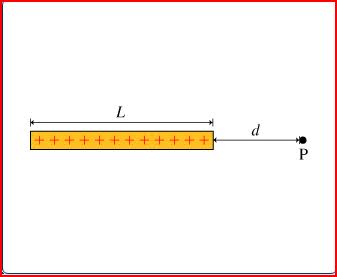
find the electric potential at point p
29619jm.jpg

Homework Equations


v=Kq/r...v=Er.

The Attempt at a Solution


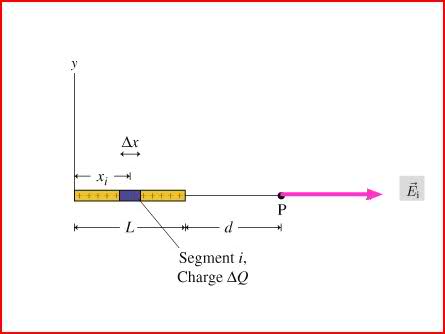
2m3gt1d.jpg

using this pic above and dQ=(Q/L)(dX)
v=(K)(dQ)/(L-(X_i)+d) then sub dq=dX(Q/L)

we get...
(KQ/(L))(dX/(L+d-(X_i)) then integrating

V=(KQ/L)((-ln(d))+(ln(L+d)))

is this correct? if not could some one tell me where i went wrong.
thanks in advance.
 
Last edited:
Physics news on Phys.org
That looks about right except that I would combine the logarithm arguments and write it as

[tex]V=\frac{kQ}{L}ln \left(1+\frac{L}{d}\right)[/tex]

Then you can see more clearly what happens when d is much larger than L.
 
i see what you are doing but as d>>L it goes to zero..

but does not tell anything about what's below.

a) an infinitely long wire with total charge Q
b) an infinitely long wire with total charge Qd/L
c) a point charge of magnitude Q
d) an electric dipole with moment QL
 
seto6 said:
i see what you are doing but as d>>L it goes to zero..

Not quite, as [itex]d\to\infty[/itex] [itex]V[/itex] will go to zero. For [itex]d\gg L[/itex] you'll want to use the Taylor series expansion of [itex]\ln(1+x)[/itex] with [itex]x=\frac{L}{d}[/itex] to get an idea of how the potential behaves.
 

Similar threads

  • · Replies 5 ·
Replies
5
Views
2K
  • · Replies 17 ·
Replies
17
Views
3K
Replies
1
Views
2K
  • · Replies 7 ·
Replies
7
Views
3K
Replies
5
Views
1K
  • · Replies 5 ·
Replies
5
Views
3K
  • · Replies 1 ·
Replies
1
Views
1K
  • · Replies 1 ·
Replies
1
Views
2K
  • · Replies 2 ·
Replies
2
Views
1K
  • · Replies 1 ·
Replies
1
Views
6K