The Well-Ordering Principle for the Natural Numbers ....

Click For Summary
SUMMARY

The discussion centers on Theorem 1.2.10 from Ethan D. Bloch's book, "The Real Numbers and Real Analysis," specifically addressing the confusion surrounding the statement regarding the existence of an element such as ##a + 1## in set ##G##. Participants clarify that the original phrasing is misleading and suggest a more precise interpretation, emphasizing the contradiction arising from the assumption that ##G## has no minimum element. The conversation highlights the importance of clear definitions and assumptions in mathematical proofs, particularly in the context of the principle of complete induction.

PREREQUISITES
  • Understanding of basic set theory and notation
  • Familiarity with mathematical proofs and theorems
  • Knowledge of the principle of complete induction
  • Experience with real analysis concepts
NEXT STEPS
  • Study the principle of complete induction in detail
  • Explore alternative texts on real analysis for clearer explanations
  • Practice constructing proofs involving minimum elements in sets
  • Review the definitions and properties of ordered sets and their implications
USEFUL FOR

Students of real analysis, mathematicians seeking clarity in proofs, and educators looking for effective teaching resources in mathematical concepts.

Math Amateur
Gold Member
MHB
Messages
3,920
Reaction score
48
I am reading Ethan D. Bloch's book: The Real Numbers and Real Analysis ...

I am currently focused on Chapter 1: Construction of the Real Numbers ...

I need help/clarification with an aspect of Theorem 1.2.10 ...

Theorem 1.2.10 reads as follows:
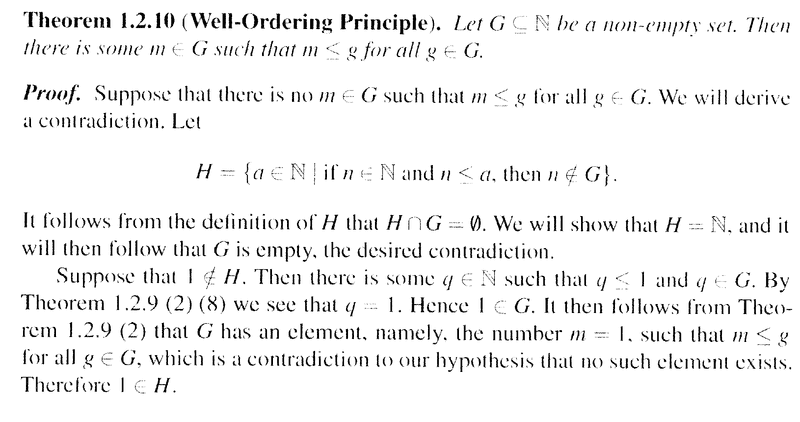
?temp_hash=caa4fb240ef7ae4b420c257b6a236690.png

?temp_hash=caa4fb240ef7ae4b420c257b6a236690.png

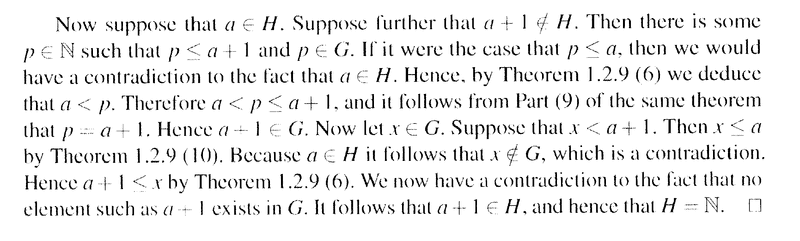
Towards the end (second last line) of the above proof by Bloch, we read the following:

" ... ... We now have a contradiction to the fact that no element such as ##a + 1## exists in ##G##. ... ... "
I do not understand this remark ... as above ##a + 1## has earlier been proved to belong to ##G## ..

Can someone explain the remark "We now have a contradiction to the fact that no element such as ##a + 1## exists in ##G##" in the context of the proof and explain just what is going on ... ...

Help will be much appreciated ...

Peter
 

Attachments

  • Bloch - 1 - Theorem 1.2.10 - PART 1 ... ....png
    Bloch - 1 - Theorem 1.2.10 - PART 1 ... ....png
    32 KB · Views: 2,778
  • Bloch - 2 - Theorem 1.2.10 - PART 2 ... ....png
    Bloch - 2 - Theorem 1.2.10 - PART 2 ... ....png
    25.8 KB · Views: 867
Physics news on Phys.org
It is written in a very confusing way. Much too condensed, and no labelling of assumptions to allow justifications to be made clear.

The phrase 'no element such as ##a+1## exists in ##G##' is particularly obscure, because we have no idea what the 'such as' means. It looks like it was intended to mean 'a minimum element', but it did not say that. Also, it should have not referred to the assumption that ##G## has no minimum as a 'fact'. It is an assumption, not a fact.

The statement about the contradiction would be much more clearly written as follows:

'Since ##x## was chosen as an arbitrary element of ##G##, we conclude that every element of ##G## is greater than or equal to ##a+1##, yet ##a+1\in G##. That is, ##a+1## is a minimum element of ##G##. That contradicts our assumption in the first line of our proof that ##G## has no minimum element. Hence we must reject the assumption that there is no minimum element.'
 
Last edited:
  • Like
Likes   Reactions: Math Amateur
Just a thought. Ugh -- More than 50 years ago I took an upper level analysis class. The students and the prof all agreed that the text was impenetrable, with lots of unnecessary impediments for students. The book was dictated by the Math Department at Maryland U. The prof then put a series of texts on reserve, and gave us an under the covers syllabus using those texts. Point being: it's okay to use lots of resources, just do what you need to learn.

Consider losing that text, and find another one that clicks for you. A university library will have lots and lots of textbooks at varying levels. I know you are trying the "see what book A, book B, and book C say about theorem X you found in book Q" approach, which can work. As long as you get that one author's (proof of a) theorem may be a definition for the next writer, you will be okay. They are not always logically congruent in the eyes of a student.
 
Last edited:
  • Like
Likes   Reactions: Math Amateur
this is another example of why you should always try prove things yourself instead of reading them. This result follows from the so called principle of complete induction. I.e. if 1 is contained in a subset S of N, and if for every n ≥ 1, the assumption that all integers from 1 to n inclusive are contained in S forces also n+1 to be contained in S, then S = N.

Using this try to prove every non empty subset T of N has a least element, as follows: first case is that 1 lies in T, then we are done and 1 is the desired east element. 2nd case is that 1 does not lie in T, and then try proof by contradiction. i.e. assume that T does not have a least element, and try to prove T is empty. This is equivalent to proving that S = N-T is equal to N. try that using complete induction.
 
  • Like
Likes   Reactions: Math Amateur

Similar threads

  • · Replies 2 ·
Replies
2
Views
2K
  • · Replies 3 ·
Replies
3
Views
2K
  • · Replies 4 ·
Replies
4
Views
2K
  • · Replies 8 ·
Replies
8
Views
3K
Replies
4
Views
2K
  • · Replies 9 ·
Replies
9
Views
2K
  • · Replies 7 ·
Replies
7
Views
2K
Replies
4
Views
2K
  • · Replies 2 ·
Replies
2
Views
2K
  • · Replies 2 ·
Replies
2
Views
1K