Thermodynamics: ideal gas chemical potential pressure dependence

Click For Summary

Discussion Overview

The discussion focuses on the derivation of the chemical potential of an ideal gas and its dependence on pressure. Participants explore the implications of differentiating Gibbs free energy with respect to pressure while keeping the number of moles constant, as well as the conditions under which these derivations hold true.

Discussion Character

  • Technical explanation
  • Conceptual clarification
  • Debate/contested

Main Points Raised

  • One participant questions the validity of differentiating Gibbs free energy with respect to pressure while assuming constant number of moles and temperature.
  • Another participant asserts that it is permissible to take the derivative under these conditions, noting that the derivative's value depends on the chosen number of moles.
  • Several participants emphasize that the original equation applies only when the total number of moles varies while the composition remains constant, referencing the need for careful consideration of gas composition in thermodynamic equations.
  • It is noted that for ideal gases, the variation in composition can be accounted for using partial pressures, as the components do not interact.
  • A participant mentions that the derivation of the chemical potential for each species requires further explanation, suggesting a reference to Smith and Van Ness for a comprehensive understanding.

Areas of Agreement / Disagreement

Participants express differing views on the conditions under which the derivation of chemical potential is valid, particularly regarding the treatment of gas composition and the implications of constant versus varying moles. The discussion remains unresolved with multiple competing perspectives presented.

Contextual Notes

The discussion highlights limitations related to the assumptions made in the derivation, particularly concerning the constancy of the number of moles and the treatment of gas composition in ideal gases.

alpha358
Messages
9
Reaction score
0
I don‘t understand one step in derivation of ideal gas chemical potential.

Generally Gibbs free energy is:

bhFtZkY.png
(1)

ZnDJdUk.png
(2)​
We observe that:
9rP2bbw.png
(3)​
From equation (3) we make differential equation and integrate it:

OJ4ArRx.png
(4)

jddVXD6.png
(5)​

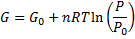
We get Gibbs free energy dependence on pressure:
CIaM1yh.png
(6)
Equation (6) is true strictly when:

l2JTh5i.png
, because of equation. (3).

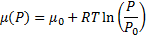
Later we derive chemical potential for ideal gas:

NUhjUKK.png
(7)
Here we assumed that
NZCsk75.png
is a function of n. (because it is an extensive property), therefore:
MBtbmLm.png


In the end we get pressure dependency of chemical potential for ideal gas:
uyXY4WV.png
(8)​

Note that in equation (7) we differentiate equation (6) by n and eq. 6 is derived only for condition when n = const and T = const.
In other words, we differentiate it with respect to variable which should stay constant.
Are we allowed to do this ?
 
Last edited:
Science news on Phys.org
The short answer is yes. Even though ##n## is constant in taking the derivative ##\left(\frac{\partial G}{\partial P} \right)_{n,T}##, the value of the derivative will depend on what value of ##n## you choose. For example if you had something like ##y=nx## then ##\left(\frac{\partial y}{\partial x} \right)_{n}=n##. So even though ##n## is constant in taking the derivative, it still depends on ##n## and you can take its derivative again with respect to ##n##.
 
  • Like
Likes   Reactions: alpha358
Thanks, now it seems so trivial :D
 
The original equation you wrote down applies only to a system in which the total number of moles of gas is varying, while the composition of the gas is constant. In such a situation,

##G=n\mu(T,P)##

For situations in which the composition of the gas can also vary, see Smith and Van Ness, Introduction to Chemical Engineering Thermodynamics.

Chet
 
  • Like
Likes   Reactions: alpha358
Chestermiller said:
The original equation you wrote down applies only to a system in which the total number of moles of gas is varying, while the composition of the gas is constant. In such a situation,

##G=n\mu(T,P)##

For situations in which the composition of the gas can also vary, see Smith and Van Ness, Introduction to Chemical Engineering Thermodynamics.

Chet
For an ideal gas, the variation of the composition can be taken into account by simply using the partial pressure throughout, as the different components of the gas don't interact, i.e. you don't have to consider the mixture effects at all in an ideal mixture.
 
Chestermiller said:
The original equation you wrote down applies only to a system in which the total number of moles of gas is varying, while the composition of the gas is constant. In such a situation,

##G=n\mu(T,P)##

For situations in which the composition of the gas can also vary, see Smith and Van Ness, Introduction to Chemical Engineering Thermodynamics.

Chet
For an ideal gas, the variation of the composition can be taken into account by simply using the partial pressure throughout, as the different components of the gas don't interact, i.e. you don't have to consider the mixture effects at all in an ideal mixture.
 
DrDu said:
For an ideal gas, the variation of the composition can be taken into account by simply using the partial pressure throughout, as the different components of the gas don't interact, i.e. you don't have to consider the mixture effects at all in an ideal mixture.
Yes. This is correct. The chemical potential of each species is as DrDu indicates. But, the derivation of why it works out this way requires some derivation, and Smith and Van Ness do a very nice job of providing this derivation (Chapter 10).

Chet
 

Similar threads

  • · Replies 16 ·
Replies
16
Views
3K
  • · Replies 6 ·
Replies
6
Views
2K
  • · Replies 35 ·
2
Replies
35
Views
5K
  • · Replies 7 ·
Replies
7
Views
725
  • · Replies 2 ·
Replies
2
Views
2K
  • · Replies 19 ·
Replies
19
Views
3K
  • · Replies 3 ·
Replies
3
Views
2K
  • · Replies 109 ·
4
Replies
109
Views
9K
  • · Replies 22 ·
Replies
22
Views
6K
  • · Replies 3 ·
Replies
3
Views
2K

