Thin Charged Isolated Rod -- Find the electric field at this point

Join the discussion
Ask a follow-up here, or get your own question answered by working scientists, mathematicians and engineers — people, not an autocomplete.
Real named experts · corrections over time · the nuance an AI answer skips
3 replies · 2K views
Ugnius
Messages
54
Reaction score
10
Homework Statement
Thin isolated rod , 1 meter in length , placed on Y axis , find rod's created electic field to point P(1,0.75) , rod's linear charge density lambda = 6.8 micro coulumbs per meter.
Relevant Equations
dQ=Q/Ldx
Hi , I've been trying to manage a solution in my head and i think I'm on the right path , i just need some approval and maybe some tips.
So it's obvious I can't solve this without integration because law's only apply to point charges , and i can't shrink this object to a point as i could do with sphere. I've looked everywhere and couldn't find a formula that would involve anything like this atleast in my native language. If the point was in the middle of the rod and all the other vectors would cancel out , i could just calculate Ex = E , but now it's offset and I'm confused
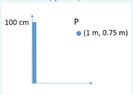
 

Attachments

  • grap.png
    grap.png
    3 KB · Views: 200
on Phys.org
Put the origin of coordinates at the midpoint of the rod. Consider an element ##dq= \lambda~dy'## on the rod at location ##y'## from the origin. Can you find the x and y components of the electric field due to this element alone at point P? Call them ##dE_x## and ##dE_y##. To find the net field, you need to do two separate integrals over ##y'##.

Start writing things down, post them and we will help you through. Please use symbols not numbers until the very end. Call the coordinates of P ##x_P## and ##y_P##.
 
kuruman said:
Put the origin of coordinates at the midpoint of the rod. Consider an element ##dq= \lambda~dy'## on the rod at location ##y'## from the origin. Can you find the x and y components of the electric field due to this element alone at point P? Call them ##dE_x## and ##dE_y##. To find the net field, you need to do two separate integrals over ##y'##.

Start writing things down, post them and we will help you through. Please use symbols not numbers until the very end. Call the coordinates of P ##x_P## and ##y_P##.
1632610131650.png

I don't know if I managed to understand what you meant , but is it something like this?
 
Yes, something like this. To avoid confusion:
1. Use y or y' for positions along the y-axis.
2. Define distances from the origin which you chose to be at the end of the rod. That's fine.
3. The length element should be labeled ##dy## and its position should be labeled ##y## from the end of the rod (point O).
4. Point C should be at {0, ##\frac{3}{4}L##} and point P should be at {{x, ##\frac{3}{4}L##}.
Got it? Please redraw the figure according to the above so that we can refer to it in the future. Thanks.

Now you need to find an expression first for the magnitude of ##dE## and then worry about the components. Use the expression ##dE= \dfrac{dQ}{4\pi\epsilon_0r^2}## for a point charge.

Look at the new drawing. Your point charge is the length element ##dy##. What is the charge ##dQ## on it? What is the magnitude of the field generated by it at point P in terms of the symbols in the drawing?