[Thin-Film Optics] Incident white light to color

Join the discussion
Ask a follow-up here, or get your own question answered by working scientists, mathematicians and engineers — people, not an autocomplete.
Real named experts · corrections over time · the nuance an AI answer skips
9 replies · 2K views
abstracted6
Messages
37
Reaction score
0
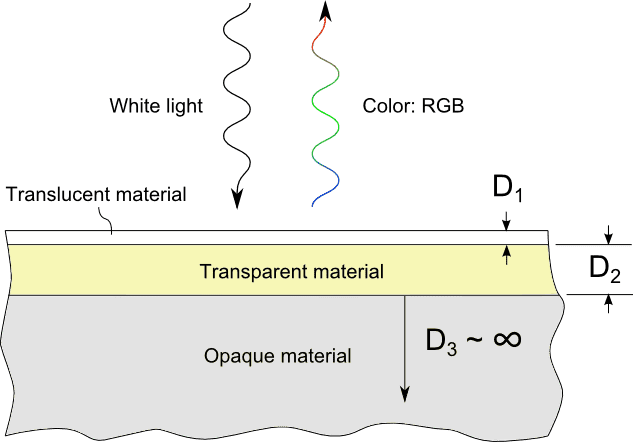
Hello, as you might have guessed, my question revolves around thin film optics. My intention is: Given a two thin-film system residing on top of a semi-infinite (bulk) layer, how can I estimate the reflecting color (RGB preferably) when illuminated by white light? (Illustrated below).

I obviously have omitted much of the specific information such as material, constants, etc (this isn't even my entire problem). I am not looking for an explicit answer, rather I'd like to be pointed in the right direction or some resource of where to start (Optics isn't really a strong suit of mine).
Ngqx68O.png
 
on Phys.org
I would imagine that in the end I want to get the reflectance as a function of wavelength which will essentially divulge the color information.

To get there I'm guessing I need to first use the fresnel equations to determine transmittance/reflectance for each layer. Then use the resulting reflectance functions to generate a the scattering/wave-transfer matrices which (I think) can yield the reflectance of the entire system? Then just iterate through my desired wavelength range.

Or would I be making it too complicated?
 
Bad word choice I suppose, the top layer is somewhere in-between transparent and opaque.
 
OK - so what you actually mean is two transparent materials with different refractive indexes suitable for thin-film interference. For a moment there I wondered if the solution was simpler.

But yeah - you have to work out the reflection and transmission at each boundary and find the phase difference.
Multi-layer thin films can get quite complicated. Usually they get rigged so the dominant refection is off the bottom so you don't worry about the reflection from the middle layers.
 
I found this: http://www.filmetrics.com/reflectance-calculator an online calculator that calculates the reflectance of a multi-layer system.

They mention they used the "complex matrix form" of the Fresnel equations. I'm guessing that means the scattering/wave-transfer matrices?
 
Yeah - the general problem can be nasty - so you'd normally look for simplifications.
The problem I have with this question right now is that I don't know how to take it.

At first I thought it was an exercize for students - now I don't know.

Looking at it as written it looked like 4 layers.
0. air
1. a very thin scattering medium "translucent"
2. a thin refractive medium n>1 "transparent"
3. an absorbing medium "opaque"

So you'd just tune the thickness of layer 2 to resonantly transmit the color you want to remove.

In the general case where all the layers are refracting, you will end up with three "reflected" rays coming out the top surface, each with a different phase (which depends on how much of which material was traveled through). You need to express the phases of each ray in terms of the thicknesses of the materials they pas through (don't forget the phase shift, if any, on reflection)... tune the thicknesses so the phases sum to zero for the wavelength you want to remove.