Three doubts in a paragraph on the equilibrium of Incompressible fluids

Click For Summary
SUMMARY

This discussion focuses on the equilibrium of incompressible fluids as presented in Sommerfeld’s Lectures on Theoretical Physics, specifically addressing three key doubts. The first doubt clarifies that external force per unit volume, such as gravity, acts on all six faces of a fluid volume element. The second doubt explains that dividing by ##\Delta \tau## helps derive a differential equation for pressure, with ##F_x## representing the x-component of the external force. The third doubt confirms that the equations ##grad~ p = \mathbf F## are necessary for equilibrium, as they arise from the force equilibrium on fluid elements.

PREREQUISITES
  • Understanding of fluid mechanics principles, particularly incompressible fluid behavior.
  • Familiarity with differential equations and their application in physics.
  • Knowledge of vector notation and components, especially in the context of forces.
  • Basic grasp of pressure concepts in fluid dynamics.
NEXT STEPS
  • Study the derivation of the Navier-Stokes equations for incompressible fluids.
  • Learn about the implications of pressure gradients in fluid dynamics.
  • Explore the concept of force balance in fluid elements and its applications.
  • Investigate the role of external forces, such as gravity, in fluid equilibrium.
USEFUL FOR

Students and professionals in physics, particularly those specializing in fluid mechanics, as well as engineers working with fluid systems and anyone seeking to deepen their understanding of fluid equilibrium concepts.

Adesh
Messages
735
Reaction score
191
Homework Statement
See the main body.
Relevant Equations
We don’t need them.
These are the images from Sommerfeld’s Lectures on Theoretical Physics, Vol 2 chapter 2, section 6, Equilibrium of Incompressible Fluids.
IMG_1062_1.jpg


Image 1

IMG_1063_1.jpg

Image 2

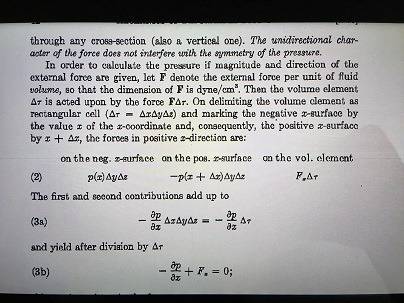
Doubt 1 : What does it mean for a force to act on a fluid volume? Force acts on a point, force may act on a surface but I’m unable to understand what it means “external force per unit of fluid volume”. Did Sommerfeld mean that ##\mathbf F## acts on all six faces of that fluid volume element ?

Doubt 2 : I really couldn’t understand what happened after equation 3a. Why we divided by ##\Delta \tau## and how ##F_x## came in equation 3b ?

Doubt 3 : How equation 3b and 4 “obviously” constitute a necessary condition for the equilibrium? I’m unable to understand how ##grad~ p = \mathbf F## is a necessary condition for the equilibrium.

Please explain the above said doubts to me, if my question is too broad please let me know.

Thank you.
 
Last edited by a moderator:
Physics news on Phys.org
Adesh said:
Homework Statement:: See the main body.
Relevant Equations:: We don’t need them.

These are the images from Sommerfeld’s Lectures on Theoretical Physics, Vol 2 chapter 2, section 6, Equilibrium of Incompressible Fluids.
Image 1
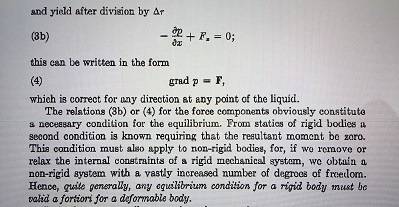
Image 2

Doubt 1 : What does it mean for a force to act on a fluid volume? Force acts on a point, force may act on a surface but I’m unable to understand what it means “external force per unit of fluid volume”. Did Sommerfeld mean that ##\mathbf F## acts on all six faces of that fluid volume element ?

No, he meant exactly what he said. It is external force per unit volume. For example, the force of gravity per unit volume would be ##\rho \vec g## where ##\rho## is the density and ##\vec g## the gravitational field.

Doubt 2 : I really couldn’t understand what happened after equation 3a. Why we divided by ##\Delta \tau## and how ##F_x## came in equation 3b ?

We divided in order to get rid of the volume element and obtain a differential equation for p. ##F_x## is the x-component of ##\vec F##. Equation 3b is based on equilibrium of the fluid.

Doubt 3 : How equation 3b and 4 “obviously” constitute a necessary condition for the equilibrium? I’m unable to understand how ##grad~ p = \mathbf F## is a necessary condition for the equilibrium.

That equation is a direct consequence of force equilibrium on each fluid element.
 
  • Like
Likes   Reactions: Adesh
Orodruin said:
We divided in order to get rid of the volume element and obtain a differential equation for p. ##F_x## is the x-component of ##\vec F## . Equation 3b is based on equilibrium of the fluid.
I thought that the pressure at the ##x##-faces of rectangular cell was caused due to the external force only. I mean to say that ##p(x)## at the negative ##x## surface was caused because we had a ##x## component of the force. So, for me invoking ##F_x## in the summation of pressures at opposite faces seems a quite hard thing to conceive. According to me, pressures at opposite faces should cancel each other by themselves.

Is there any way by which I can be helped in changing my perspective regarding the above situation? I mean can you help me?
 
How pressure can be there in the absence of any external force on fluid?
 
Adesh said:
I thought that the pressure at the xxx-faces of rectangular cell was caused due to the external force only
External force here means any force external to the cell in question...in particular from the cell adjacent. In limit of infinitesimal cells this gives the smooth pressure function.
 
  • Like
Likes   Reactions: Adesh
hutchphd said:
External force here means any force external to the cell in question...in particular from the cell adjacent. In limit of infinitesimal cells this gives the smooth pressure function.
What is the source of ##p(x) \Delta y \Delta z## and of ##F_x##?
 
I believe the Fx represents any external field (like say gravity) and p(x) the contact pressure from the adjacent fluid (in the infinitesimal limit ultimately).
 
  • Like
Likes   Reactions: Chestermiller and Adesh
hutchphd said:
I believe the Fx represents any external field (like say gravity) and p(x) the contact pressure from the adjacent fluid (in the infinitesimal limit ultimately).
Thank you.
 
  • Like
Likes   Reactions: hutchphd
Adesh said:
According to me, pressures at opposite faces should cancel each other by themselves.
This is only true if the pressure is the same on both sides. This is not necessarily the case and for small ##\Delta x##, the pressures will differ by approximately ##\Delta x\, \partial_x p##.
 
  • Like
Likes   Reactions: Adesh

Similar threads

Replies
1
Views
1K
  • · Replies 10 ·
Replies
10
Views
4K
  • · Replies 7 ·
Replies
7
Views
2K
  • · Replies 18 ·
Replies
18
Views
2K
  • · Replies 7 ·
Replies
7
Views
2K
Replies
0
Views
2K
Replies
2
Views
957
  • · Replies 10 ·
Replies
10
Views
2K
  • · Replies 48 ·
2
Replies
48
Views
5K
  • · Replies 73 ·
3
Replies
73
Views
16K