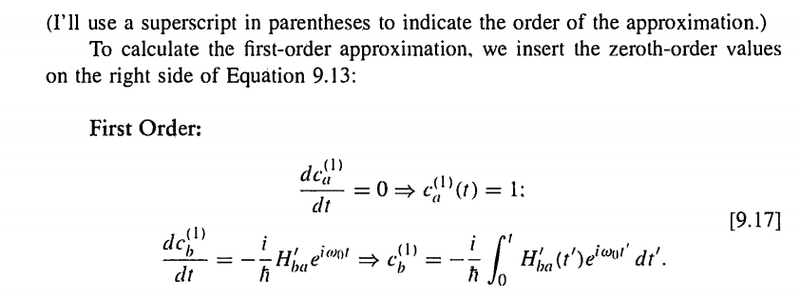
Initially I agreed with you, but the passage in your original post defines [itex]c^{(1)}[/itex] not as the "first order correction" but the "first order approximation".
To my mind, if we speak of perturbing a system [itex]y' = f(x,y)[/itex] subjec to [itex]y(0) = 1[/itex] then the perturbed system is [itex]y' = f(x,y) + \epsilon g(x,y)[/itex] for some small parameter [itex]\epsilon[/itex]. We would then pose an expansion of the form [itex]y(x) = y_0(x) + \epsilon y_1(x) + \dots[/itex], and we would then call [itex]y_1[/itex] the first order correction. And if we don't perturb the initial condition as well then indeed [itex]y_0(0) = 1[/itex] and [itex]y_1(0) = 0[/itex].
But here the text (at least the parts you've posted) doesn't mention a small parameter, and you have described the author's method as "successive approximation" rather than "asymptotic expansion". This would be like obtaining approximate solutions to our perturbed system by the iterative process [tex]
y_{n+1}(x) = 1 + \int_0^x f(x,y_n(x)) + \epsilon g(x,y_n(x))\,dx[/tex] for which [itex]y_n(0) = 1[/itex] always holds.