Timoshenko's Solution for Truss Problems

newbie1127
Messages
13
Reaction score
5
Homework Statement
Hello everyone,
i am new to the forum and this is my first message, please go easy on me if i break any rules/make mistakes

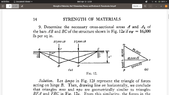
i recently started reading Strength of Material by Timoshenko and in the first chapter encountered a problem in one of the solved examples (attached screenshot)

The problem is of a truss with point load,
i dont understand the second figure(b) particularly how it was calculated, i tried using method of joints, but i am getting different results.
Relevant Equations
xyz
xyz
 

Attachments

  • Screenshot from 2022-04-13 12-20-51.png
    Screenshot from 2022-04-13 12-20-51.png
    27.8 KB · Views: 203
  • Screenshot from 2022-04-13 12-20-51.png
    Screenshot from 2022-04-13 12-20-51.png
    27.8 KB · Views: 233
Physics news on Phys.org
newbie1127 said:
Homework Statement:: Hello everyone,
i am new to the forum and this is my first message, please go easy on me if i break any rules/make mistakes

i recently started reading Strength of Material by Timoshenko and in the first chapter encountered a problem in one of the solved examples (attached screenshot)

The problem is of a truss with point load,
i don't understand the second figure(b) particularly how it was calculated, i tried using method of joints, but i am getting different results.
Relevant Equations:: xyz

xyz
Welcome to PF. :smile:

Can you show your work so far? It's best if you can post the math equations using the "LaTeX Guide" link in the footer. Thanks.
 
berkeman said:
Welcome to PF. :smile:

Can you show your work so far? It's best if you can post the math equations using the "LaTeX Guide" link in the footer. Thanks.
@berkeman thanks for replying,

i don't know where to begin, i skipped the question for now
i only have used method of joints where i did:

assumed equilibrium conditions and hence did,
1) sum of all horizontal forces = 0
2) sum of all vertical forces = 0
3) all moment about a point = 0 and calculated the force values

problem is i start the problem with another value
for example:
i take initial force of 27000 lb to calculate value of AB
whereas, the author starts with 18000 lb and hence, i get different result

my values for AB : 27000 lb - initial force ; and get 54000 lb - as tension force on AB
author's values for AB : 18000 lb - initial force ; and gets 36000 lb - as tension force for AB

i think i am missing some concept that has to be applied before appling the method of joint or some other method. i just don't know what it is
 
I got the answer, thanks to someone named NRG99

solution i found: using the triangle law of forces as suggested by NRP99

Now that i think on it, i was too concerned about why it was that 18000 and 9000 were written separately and if they had any physics significance turns out it was just a mathematical by-product of solving the problem and doesn't represent anything

also, i want to end this by giving credit to the author,
while calculating the solution i came across the number 1053
i wouldn't have thought anything of it if i didn't know the answer 9000√13
i wouldn't have thought 13 was a factor of 1053
i know he is a super smart guy, i just thought it was interesting to mention.
 
  • Like
Likes   Reactions: Lnewqban
Welcome!
I hope you bring more questions to us.
Timoshenko is an excellent book (I and II).
 
  • Like
Likes   Reactions: newbie1127

Similar threads

  • · Replies 4 ·
Replies
4
Views
2K
  • · Replies 1 ·
Replies
1
Views
2K
  • · Replies 4 ·
Replies
4
Views
3K
  • · Replies 1 ·
Replies
1
Views
3K
  • · Replies 7 ·
Replies
7
Views
4K
  • · Replies 2 ·
Replies
2
Views
3K
  • · Replies 1 ·
Replies
1
Views
2K
  • · Replies 4 ·
Replies
4
Views
2K
  • · Replies 8 ·
Replies
8
Views
2K
  • · Replies 4 ·
Replies
4
Views
2K