Discussion Overview
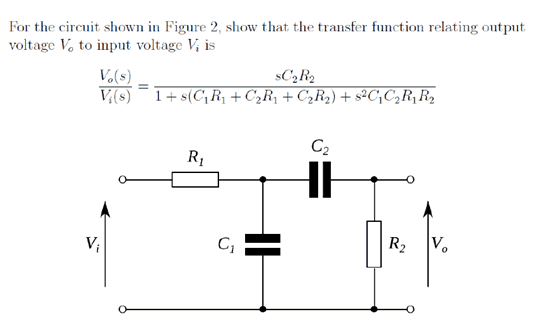
The discussion revolves around determining the transfer function of a second-order RC circuit. Participants explore the implications of circuit interactions, assumptions in circuit analysis, and the methodology for deriving the transfer function.
Discussion Character
- Technical explanation
- Debate/contested
- Mathematical reasoning
Main Points Raised
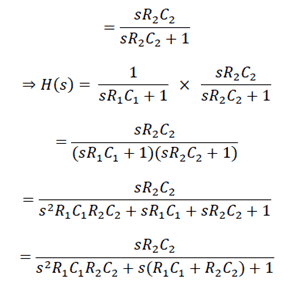
- One participant expresses difficulty in obtaining the correct transfer function and shares their attempt.
- Another participant suggests that the issue arises from incorrectly splitting the circuit into two parts, which neglects the interaction between sections.
- It is proposed that treating the circuit as a whole and applying KCL (Kirchhoff's Current Law) equations may yield better results.
- There is a discussion about the assumption that transfer functions can be multiplied when circuits are cascaded, with a clarification that this holds true only if loading effects are negligible.
- A participant mentions the importance of buffering stages to avoid loading effects when cascading circuits.
- One participant indicates they are still struggling with the problem after working out KCL and KVL (Kirchhoff's Voltage Law) equations, expressing uncertainty about the next steps.
- Another participant points out that the goal is to find the ratio of output voltage to input voltage (##V_o/V_i##).
Areas of Agreement / Disagreement
Participants express differing views on the validity of splitting the circuit for analysis. There is no consensus on the best approach to derive the transfer function, and multiple perspectives on circuit interactions and assumptions remain present.
Contextual Notes
Participants note the dependence on ideal assumptions regarding source and load impedances, which may not hold in practical scenarios. The discussion reflects various interpretations of circuit behavior and the implications for transfer function calculations.