Transfer function of third order filter

Click For Summary
The discussion revolves around solving a third-order filter problem involving KVL and KCL equations. The user initially struggles with substitutions to express V_c1 in terms of Vs and Vout, leading to unproductive results. After several attempts, they eventually find the correct answer but seek advice on how to choose effective substitutions more efficiently in a timed scenario. Additionally, they express frustration with the complexity of the algebra involved in deriving the transfer function H(ω). The conversation highlights the challenges of balancing circuit analysis with complex algebra skills.
gfd43tg
Gold Member
Messages
947
Reaction score
48
Hello, I am trying to do this example problem in my textbook
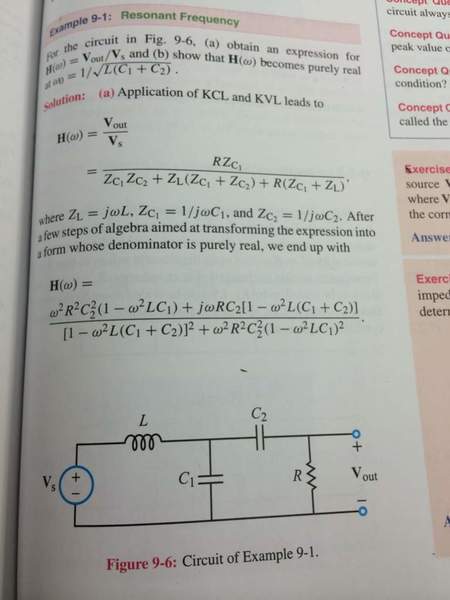
ImageUploadedByPhysics Forums1399350470.018469.jpg
I have my KVL and KCL equations written. I am trying to use substitutions to find V_c1 in terms of Vs and also in terms of Vout, so I can find Vout in terms of Vs. However, it seems like no matter what sequence of substitutions I do yield 0 = 0, and I am not making progress in finding the answer.
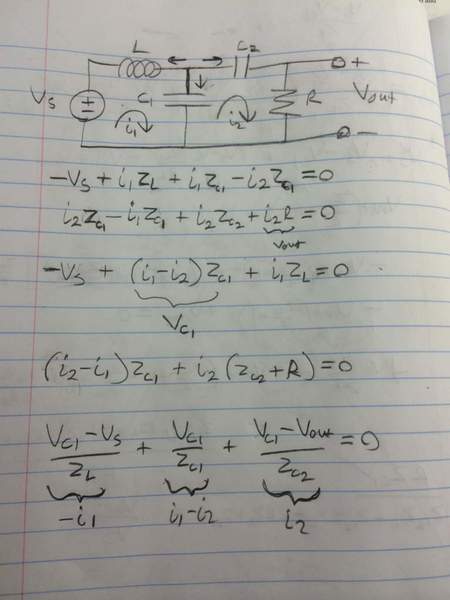
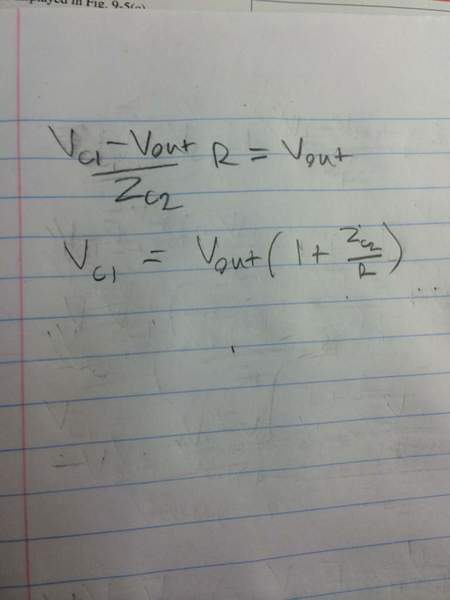
ImageUploadedByPhysics Forums1399350485.593870.jpg

ImageUploadedByPhysics Forums1399350498.917678.jpg
 
Physics news on Phys.org
Here is my closest attempt so far

ImageUploadedByPhysics Forums1399352222.306117.jpg


Edit: I followed through with the algebra and it turns out to give the correct answer. My question though is this: I sort of chose to do this substitution from exhaustion. Meaning, I tried many other substitutions that yielded nothing. In a timed situation, how do I know which substitution I should make so I don't waste time trying other ones that are dead ends?
 
Last edited:
Well, since I got the part with the impedances correct, I am having a hell of a time trying to get it in the form they have with the H(ω). Any tips for this? I am trying to multiply by the complex conjugate but the algebra here is way too much and its too easy to make a mistake.
 
You need to make use of this:

attachment.php?attachmentid=69476&stc=1&d=1399364247.png


Then you can proceed like this:

attachment.php?attachmentid=69477&stc=1&d=1399364247.png
 

Attachments

  • Show1.png
    Show1.png
    2.6 KB · Views: 653
  • Show2.png
    Show2.png
    7.4 KB · Views: 1,942
  • Like
Likes 1 person
Thanks for that. I will look carefully over these steps.
 
I'm having trouble getting from

''After we make these substitutions...we get these results''
 
I finally got it. That is such an annoying problem. Sometimes I wonder if this is a circuits class or a complex algebra class...
 
Maylis said:
Sometimes I wonder if this is a circuits class or a complex algebra class...

Count yourself lucky. If it hadn't been for Steinmetz:

http://en.wikipedia.org/wiki/Charles_Proteus_Steinmetz

you would be solving simultaneous differential equations instead of simple algebra with complex arithmetic! :smile:
 

Similar threads

  • · Replies 16 ·
Replies
16
Views
2K
  • · Replies 9 ·
Replies
9
Views
4K
  • · Replies 4 ·
Replies
4
Views
718
Replies
16
Views
3K
  • · Replies 1 ·
Replies
1
Views
2K
  • · Replies 2 ·
Replies
2
Views
2K
  • · Replies 14 ·
Replies
14
Views
2K
  • · Replies 3 ·
Replies
3
Views
2K
  • · Replies 4 ·
Replies
4
Views
5K
  • · Replies 1 ·
Replies
1
Views
2K