Discussion Overview
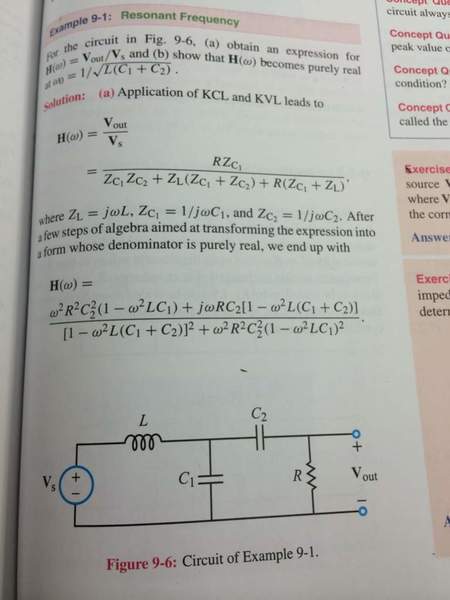
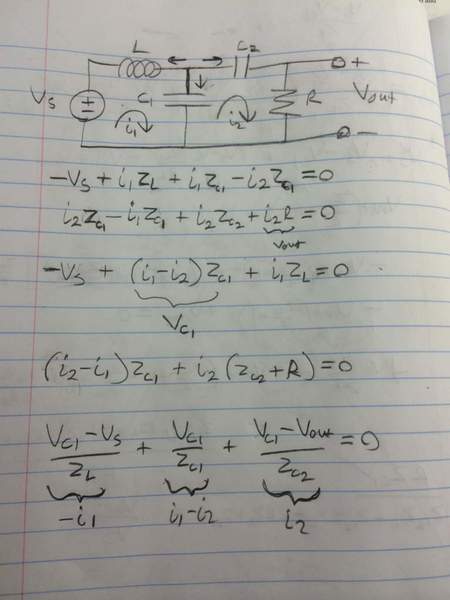
The discussion revolves around solving a problem related to the transfer function of a third-order filter, focusing on the application of Kirchhoff's Voltage Law (KVL) and Kirchhoff's Current Law (KCL) in circuit analysis. Participants share their experiences with substitutions and algebraic manipulations to derive the output voltage in terms of the input voltage.
Discussion Character
- Homework-related
- Mathematical reasoning
- Technical explanation
Main Points Raised
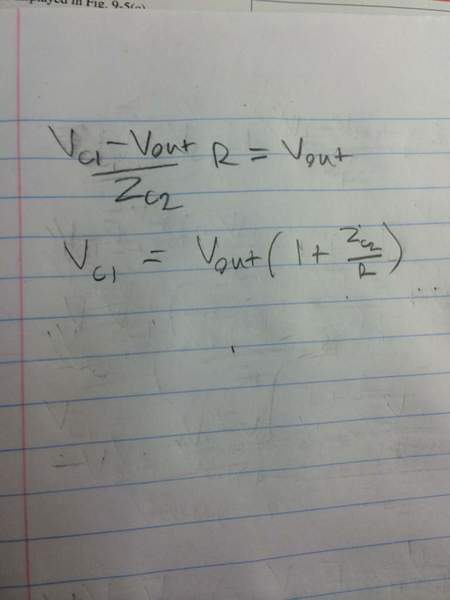
- One participant expresses difficulty in finding the voltage across a capacitor (V_c1) in terms of the source voltage (Vs) and output voltage (Vout), leading to a trivial equation (0 = 0).
- Another participant shares their experience of reaching a correct answer after multiple attempts and questions how to efficiently choose substitutions in a timed scenario.
- A participant mentions challenges in expressing the transfer function H(ω) and struggles with complex algebra, particularly when multiplying by the complex conjugate.
- One participant provides a suggestion to utilize a specific method or formula to aid in the problem-solving process.
- Another participant expresses relief at finally solving the problem while commenting on the complexity of the material.
- A humorous remark is made about the nature of the course material, comparing it to complex algebra rather than circuit analysis, with a historical reference to Charles Proteus Steinmetz.
Areas of Agreement / Disagreement
Participants do not appear to reach a consensus on the best approach to substitutions or the algebra involved, indicating that multiple competing views and methods remain in the discussion.
Contextual Notes
Participants mention various methods and substitutions without resolving which is the most effective, highlighting the potential for different approaches to yield different results. The discussion reflects a reliance on personal experience and trial-and-error in problem-solving.
Who May Find This Useful
This discussion may be useful for students and practitioners in electrical engineering or related fields who are grappling with circuit analysis and transfer functions, particularly those seeking strategies for problem-solving in complex algebraic contexts.