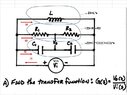
Transform question about this circuit

  • Context: Engineering 
  • Thread starter Thread starter Fuji
  • Start date Start date
  • Tags Tags
    Circuit Transform
Click For Summary
SUMMARY

This discussion focuses on analyzing a four-loop circuit using Kirchhoff's voltage law and the node voltage method. The user is attempting to derive the transfer function while dealing with the complexities introduced by the output voltage (Vo) embedded in the circuit. Key equations discussed include I1 = I2 + I3 + I4 and the conversion of circuit components into impedances for easier analysis in the s-domain. The conversation emphasizes the importance of voltage dividers and the relationship between the components to calculate Vo accurately.

PREREQUISITES
  • Understanding of Kirchhoff's voltage law
  • Familiarity with circuit analysis techniques, specifically node voltage method
  • Knowledge of impedance in the s-domain for inductors, capacitors, and resistors
  • Ability to apply voltage divider principles in circuit analysis
NEXT STEPS
  • Learn how to convert circuit components into impedances in the s-domain
  • Study the application of the node voltage method in complex circuits
  • Research voltage divider formulas and their applications in circuit analysis
  • Explore transfer function derivation techniques for multi-loop circuits
USEFUL FOR

Electrical engineering students, circuit designers, and anyone involved in advanced circuit analysis and design, particularly those working with multi-loop circuits and transfer functions.

Fuji
Messages
2
Reaction score
0
Homework Statement
Need to derive the transfer function
Relevant Equations
G(s)=Vo(s)/Vi(s)
F.JPG
I Normally can solve these but when Vo is embeded into the circuit, is throwing me for a loop (no pun is intended). My question is, if I apply Kirchoff's voltage law: VR+VC+VL-Vi=0, I'm not quite sure how this would be set up when Vo is between R1R2 & C1C2?
I believe this ia 4 Loop circuit:
I1 = I2 + I3 + I4
I2 = [(Vin-Vout) / C1] + (Vout / C2)
I3 = [(Vin-Vout) / R1] + (Vout / R2)
I4 = Vin / L
Would this be correct for the assumption?
 
Last edited:
Physics news on Phys.org
Could you label where the currents are with arrows in your diagram? So basically label where the currents "I1", "I2", "I3", etc.. are actually going. That way anyone can get an idea of the directions (i.e. In/Out) you're thinking about.

I was going to suggest using a node voltage method but it seems like you're on a good track for this problem.

The first thing I would suggest is you convert all of the components into "impedances". At least for me, it would be easier to analyze the circuit that way.

So think back to what the equation for an inductor, capacitor, and resistor is. That way, you can convert everything into the "s" domain (or omega format, whichever one you want to call it). Then, from there, you can start writing out equations/relationships. See if things might even cancel out when solving for Vout/Vin.

We're not allowed to give "direct" answers to problems on here. I'm just trying to give you tips/advice on what steps to take or approaches to use.
 
Thanks for the input. I'm not looking for the answer, but if you check my work to see if I'm evaluating the problem correctly so far. I ended up changing this to a 3 loop circuit. It's not finished since I haven't derived the transfer function yet but before I go any furthur, I was wonder what I have is correct. The attached pdf has six pages to it.
 

Attachments

Last edited:
If Z2(s)=C1*C2/(C1+C2)*s ;Z3=R1+R2 ;Z4=1/L/s

Then, in my opinion, since Vi/s=Z2(s)*I2(s)=Z3(s)*I3(s)=Z4(s)*I4(s)

I2(s)=Vi/s/(C1*C2)*(C1+C2)/s=Vi/s^2*(C1+C2)/(C1*C2)

I3(s)=Vi/s/(R1+R2)

I3(s)*R1+Vo-I2/C1/s=0

Vo=I2(s)/C1/s-I3(s)*R1
 

Attachments

  • Transfer Function Gs.jpg
    Transfer Function Gs.jpg
    48.9 KB · Views: 134
Fuji, the first thing to do is get rid of L. Since Vi is a voltage source, all L does is draw some current from Vi, but it has no effect on Vo.

R1 and R2 form a voltage divider across Vi, and C1 and C2 do the same thing.

Let the right hand terminal of Vi be ground (reference node), and calculate the voltage across R2 using the voltage divider formula; that will be the voltage at the top of Vo. Calculate the voltage across C2 using the voltage divider formula; that will be the voltage at the bottom of Vo. The value of Vo will be the difference of the voltage across R2 and the voltage across C2.
 
  • Like
Likes   Reactions: Babadag

Similar threads

  • · Replies 21 ·
Replies
21
Views
3K
  • · Replies 5 ·
Replies
5
Views
5K
  • · Replies 26 ·
Replies
26
Views
3K
Replies
4
Views
1K
  • · Replies 16 ·
Replies
16
Views
4K
  • · Replies 4 ·
Replies
4
Views
2K
  • · Replies 25 ·
Replies
25
Views
3K
  • · Replies 187 ·
7
Replies
187
Views
58K
  • · Replies 5 ·
Replies
5
Views
5K
  • · Replies 2 ·
Replies
2
Views
4K