Transforming Y-axis table values into a separate formula?

Click For Summary
SUMMARY

The discussion centers on calculating time dilation during a 100-second journey with constant acceleration using the formula √(1-v²/c²). The user has generated a velocity vs. time graph with acceleration set at 10^6 km/s² and seeks a method to integrate 100 velocity data points into the time dilation formula efficiently. The conversation highlights the necessity of using relativistic equations instead of Newtonian mechanics to accurately estimate time dilation, particularly as velocities approach the speed of light.

PREREQUISITES
  • Understanding of special relativity and the Lorentz transformation
  • Proficiency in calculus, specifically integration techniques
  • Familiarity with velocity-time graphs and their physical interpretations
  • Basic knowledge of Excel or programming for data manipulation
NEXT STEPS
  • Learn how to implement numerical integration techniques for time dilation calculations
  • Explore Excel functions for handling arrays and applying formulas to multiple data points
  • Study the implications of constant acceleration in relativistic physics
  • Investigate the relationship between kinetic energy and the Lorentz factor (γ)
USEFUL FOR

Physics students, researchers in relativistic mechanics, and anyone interested in applying calculus to real-world physics problems involving time dilation and acceleration.

Sabertooth
Messages
29
Reaction score
2
Homework Statement
Hoping to get some help with the details of Special Relativity in Accelerating frames of reference.
Relevant Equations
Integrals, Graphing, Velocity. Time dilation factor.
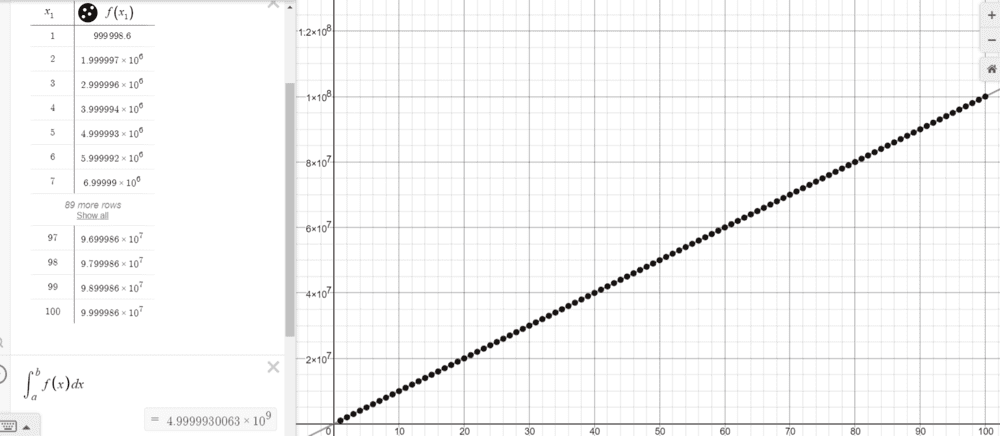
Hey everyone, I have generated a nice little velocity vs time graph that I would love if somebody could help me put to use.
I have marked data points on the x-axis for the Y-value for every second on the function.

Just to be clear: X-axis = time in seconds & Y-axis = velocity in meters/second. We have a constant acceleration.
phys.png


I have also made an integral of the function, calculating the total area under the curve to be exactly 4.999993*10^9

However, since the 100 data points on the table would be quite tedious to manually apply the time dilation to √1-v^2/c^2 for every seconds at the different velocities. I have wondered whether there is a way to insert the values in my table directly into a calculus such that I retrieve the accumulated amount of time dilation over the 100 second journey depicted on the graph. I think there should be a way integrate these values with the Time dilation factor, even if we have to assume that we travel in constant motion, that increase every second.
Thanks in advance:)
 
Physics news on Phys.org
You draw the graph
v=at
where a = 10^6 km/s^2, right?
and you get the value of
x=1/2 \ at^2.
These are Newtonian mechanics.

Then I do not understand your scenario to relate this with \sqrt{1-v^2/c^2} of relativity? What situation you are thinking ?
 
Last edited:
anuttarasammyak said:
You draw the graph
v=at
where a = 10^6 km/s^2, right?
and you get the value of
x=1/2 \ at^2.
These are Newtonian mechanics.

Then I do not understand your scenario to relate this with \sqrt{1-v^2/c^2} of relativity? What situation you are thinking ?

I want to transform every velocity in the table, into the formula: \sqrt{1-v^2/c^2}for 1 second each, then sum them all up to get a good approximation of the total amount of time dilation during this 100 second acceleration. You cannot use Newtonian mechanics, since the Lorentz transformation gets exponentially larger at higher velocities according to special relativity.

There must be somehow, in excel, word or otherwise. To take all these y(velocity) values and plug them all into the formula simultaneously. Or a calculus trick to sum the total amount of time dilation occurring over all these t-intervals.
 
So for example, at second 1, my velocity is 1 000 000 m/s, at second 2 my velocity is 2 000 000 etc.

For every single time interval I want to plug in my y-values into the formula: \sqrt{1-v^2/c^2} where we insert our 100 different y-values as the v^2 component.
 
So correspondence
time:speed:time dilation rate is
t : at : ##\sqrt{1-\frac{a^2t^2}{c^2}}##

The y-t graph y= ##\sqrt{1-\frac{a^2t^2}{c^2}}## would be what you want. Area under the graph

\int_0^T \sqrt{1-\frac{a^2t^2}{c^2}} dt < T

is the time reading of the moving clock when time T in the Earth frame of reference.
 
Last edited:
anuttarasammyak said:
So correspondence
time:speed:time dilation rate is
t : at : ##\sqrt{1-\frac{a^2t^2}{c^2}}##

The graph y= ##\sqrt{1-\frac{a^2t^2}{c^2}}## would be what you want. Area under the graph

\int_0^T \sqrt{1-\frac{a^2t^2}{c^2}} dt

is the time reading of the moving clock when time T in the Earth frame of reference.

The graph shows t in stationary observer time, so that when we plug in the velocities into the formula we should get a lower value t' for the spaceship.
 
anuttarasammyak said:
So correspondence
time:speed:time dilation rate is
t : at : ##\sqrt{1-\frac{a^2t^2}{c^2}}##

The y-t graph y= ##\sqrt{1-\frac{a^2t^2}{c^2}}## would be what you want. Area under the graph

\int_0^T \sqrt{1-\frac{a^2t^2}{c^2}} dt < T

is the time reading of the moving clock when time T in the Earth frame of reference.

Wow, seems like it worked perfectly. Thanks! I'm getting two different values, depending on whether I square a & x separately. Not sure which one of these is correct and why - however it would be easy to estimate which approach is correct. That's awesome, been spending a bunch of hours on this and you were the saving grace.
calc1.png

calc2.png
 
Take a look at dimension of the form
\sqrt{1-X^2}
1 is dimensionless. As well X = Z/c should be dimensionless.
 
anuttarasammyak said:
Take a look at dimension of the form
\sqrt{1-X^2}
1 is dimensionless. As well X = Z/c should be dimensionless.

Just found something amazing with this approach, assuming a constant increase in velocity like depicted above, which goes directly to C over 100 seconds. (impossible scenario admittedly) This equation dictates that the minimum t value is equal to exactly t````````'= ((π/4)*100) seconds
 
  • #10
anuttarasammyak said:
Take a look at dimension of the form
\sqrt{1-X^2}
1 is dimensionless. As well X = Z/c should be dimensionless.

Am I correct in assuming that acceleration and kinetic energy values under the circumstances given in the graph above would transform to the inverse gamma(γ) formula ?
 
Last edited:

Similar threads

Replies
11
Views
2K
  • · Replies 18 ·
Replies
18
Views
2K
Replies
4
Views
760
  • · Replies 22 ·
Replies
22
Views
4K
  • · Replies 20 ·
Replies
20
Views
2K
  • · Replies 10 ·
Replies
10
Views
3K
  • · Replies 5 ·
Replies
5
Views
2K
  • · Replies 24 ·
Replies
24
Views
2K
  • · Replies 3 ·
Replies
3
Views
2K
  • · Replies 20 ·
Replies
20
Views
3K