Transverse shear stress calculation in non-slender built up members

Click For Summary

Discussion Overview

The discussion revolves around the calculation of transverse shear stress in non-slender built-up members, focusing on the applicability of the shear formula under specific conditions. Participants explore the implications of aspect ratios on shear stress distribution and the role of fasteners in maintaining structural integrity under bending loads.

Discussion Character

  • Technical explanation
  • Debate/contested
  • Mathematical reasoning

Main Points Raised

  • One participant questions the legality of using the shear formula due to the assumption of uniform shear distribution, noting that for flat cross sections with a high aspect ratio, actual transverse stresses deviate significantly from predicted values.
  • Another participant suggests that bolts, rather than nails, should be used to clamp the aluminum pieces, emphasizing the role of friction in preventing sliding under bending loads.
  • A participant asserts that the shear formula applies to the cross-sections of bolts or rivets, but questions whether transverse shear stress remains uniformly distributed in slender members.
  • Another participant argues that rivets or bolts resist the cutting effect of the plates sliding against each other, regardless of the slenderness of the plates.
  • One participant clarifies that shear stress varies across the width of the cross section, being maximum at the edges and minimum at the center, and that the shear formula calculates an average shear stress that may not accurately reflect the maximum stress endured by the member.

Areas of Agreement / Disagreement

Participants express differing views on the applicability of the shear formula and the distribution of shear stress, indicating that multiple competing perspectives remain unresolved.

Contextual Notes

Participants highlight limitations related to the aspect ratio of cross sections and the assumptions made in deriving the shear formula, which may affect the accuracy of calculations in practical applications.

greg_rack
Gold Member
Messages
361
Reaction score
79
Homework Statement
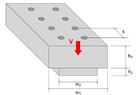
Plates are made up of Aluminum(given max shear strength), nails are of given maximum shear force. Dimensions and load intensity are given. What will fail first, among the two plates and the nails?
DIAGRAM SHOWN BELOW
Relevant Equations
Shear formula
1646730683383.png
Hi guys, this is an exercise I have been tasked to solve for an assignment. First of explaining you what I have done to solve it using the shear equation, in order to find the maximum shear stress and the shear flow in the juncture, one big question:
how is it legal to utilize the shear formula in this case? One big limitation of it is given by the "aspect ratio" of the cross section; since to derive it the assumption of uniform shear distribution along the width has to be made, actual transverse stresses for flat cross sections(for this specific case, w1/h1 is approx. 4, whilst the threshold should be approx. 0.5) deviate significantly from the values predicted by the equation, since stress is not uniform along the width.
Thus, does the problem I've been given with even make sense? I'm quite confused
 
Physics news on Phys.org
The description of nails is confusing.
In real applications, those should be bolts that clamp both pieces of aluminum in such a way that friction helps them to keeps both pieces from sliding respect to each other in case of bending loads.
 
Lnewqban said:
The description of nails is confusing.
In real applications, those should be bolts that clamp both pieces of aluminum in such a way that friction helps them to keeps both pieces from sliding respect to each other in case of bending loads.
True. But nails apart(e.g. let's say the same cross section was welded or extruded), would the shear formula apply? For the aspect ratio argument I reported above
 
Last edited:
The shear formula applies to the cross-sections of the bolts or rivets.
The problem is to calculate the shear value caused by bending of the built-up beam at the intersection plane between both plates.
That value depends on the location of that plane respect to the neutral axis of the cross-section and the shear load distribution.

Please, see example problems here:
https://mathalino.com/reviewer/mech.../spacing-of-rivets-or-bolts-in-built-up-beams
 
  • Like
Likes   Reactions: greg_rack
Lnewqban said:
The shear formula applies to the cross-sections of the bolts or rivets.
And why? isn't the transverse shear stress not uniformly distributed anymore, beeing the member(s) slender?
 
greg_rack said:
And why? isn't the transverse shear stress not uniformly distributed anymore, beeing the member(s) slender?
Sorry, I don’t see why.
The rivets or bolts are only resisting the cutting effect of the “scissor” formed by both plates, which are trying to tightly slide respect to each other.
The bolts are keeping zero gap between the plates and the edges of the holes are the ones in charge of the cutting, regardless of the slenderness of each plate.

Nd9GcTSwgYAl6xYQrDKnTJgpD6GiP3Gu-bBykp9mA&usqp=CAU.png
 
Lnewqban said:
Sorry, I don’t see why.
The rivets or bolts are only resisting the cutting effect of the “scissor” formed by both plates, which are trying to tightly slide respect to each other.
The bolts are keeping zero gap between the plates and the edges of the holes are the ones in charge of the cutting, regardless of the slenderness of each plate.

View attachment 298141
Hey, sorry for responding just now.
What I meant is that, along the width of the cross section the shear stress will take up on different values... it's not going to be constant as maths in this case tells us. Always with respect to the distribution along the width, trans. shear stress value will be maximum at the edges and minimum at the center point; I think what answers my question is that with the shear formula we're just calculating the average shear stress along the width of the section. For an aspect ratio of the cross section of 2, the offset of this average stress to the actual maximum endured by the member is as high as of 40%, whilst for more slender members it can be very close to both the maxima and minima!
 

Similar threads

  • · Replies 2 ·
Replies
2
Views
3K
  • · Replies 4 ·
Replies
4
Views
2K
  • · Replies 1 ·
Replies
1
Views
2K
Replies
1
Views
2K
Replies
4
Views
13K
  • · Replies 4 ·
Replies
4
Views
4K
  • · Replies 2 ·
Replies
2
Views
3K
Replies
4
Views
4K
  • · Replies 3 ·
Replies
3
Views
3K
  • · Replies 1 ·
Replies
1
Views
4K