Troubleshooting an Op Amp Circuit: Iterative Problem-Solving Methods

Click For Summary

Discussion Overview

The discussion revolves around troubleshooting an operational amplifier (op amp) circuit, focusing on iterative problem-solving methods. Participants share their attempts at solutions, question the validity of their equations, and explore the implications of their findings.

Discussion Character

  • Homework-related
  • Debate/contested
  • Exploratory
  • Mathematical reasoning

Main Points Raised

  • Participants express confusion over arriving at the equation 0=0, questioning the implications of different formulations of the output voltage (Vo).
  • Some participants propose that the relationship between resistors R1 and R2 should be determined based on the coefficient of V1.
  • There is a suggestion to write the equation in a different form to simplify the circuit solution.
  • One participant highlights that combining equations could lead to an impossible scenario of negative resistance, raising questions about the validity of the mathematical approach.
  • Another participant emphasizes the importance of an iterative method for solving the circuit problem, outlining steps to clarify the relationships between components.

Areas of Agreement / Disagreement

Participants do not reach a consensus on the correct formulation of the output voltage or the implications of their findings. Multiple competing views on the equations and methods remain present throughout the discussion.

Contextual Notes

Some participants note that the arrangement of equations may lead to no solution, indicating potential limitations in their approach. There is also mention of the need to adjust coefficients to explore different outcomes.

Who May Find This Useful

This discussion may be useful for students and practitioners working on op amp circuits, particularly those interested in problem-solving strategies and iterative methods in circuit analysis.

Vishera
Messages
72
Reaction score
1

Homework Statement


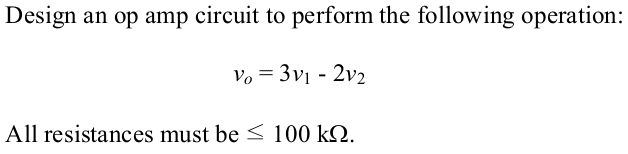
af4mhjJ.png


Homework Equations


The Attempt at a Solution


Here is my attempt: http://i.imgur.com/oKjwI8O.png

The problem is at the end, I get 0=0. What did I do wrong?
 
Physics news on Phys.org
Vishera said:

Homework Statement


af4mhjJ.png


Homework Equations


The Attempt at a Solution


Here is my attempt: http://i.imgur.com/oKjwI8O.png

The problem is at the end, I get 0=0. What did I do wrong?

Can you post a drawing of your opamp circuit, with the resistor names labeled? Thanks. :smile:
 
berkeman said:
Can you post a drawing of your opamp circuit, with the resistor names labeled? Thanks. :smile:

Sure, here is the drawing of the general circuit that I am aiming to design:
HRH4KpA.png


For that general circuit, the following equation applies:
ArKSEgn.png


Here is an example in the textbook:

TLjrkqx.png

fBCqinw.png
 
You sure it isn't Vo = 3V2 - 2V1?
 
rude man said:
You sure it isn't Vo = 3V2 - 2V1?

I agree with rude man.

In all cases an input to the negative side of an single op-amp circuit will be inverted, while an input to the positive side will not be inverted.
 
rude man said:
You sure it isn't Vo = 3V2 - 2V1?

Is there any specific reason why you can't the following equation to:
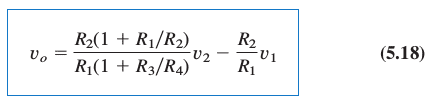
ArKSEgn.png


to:

vo=3v1-2v2?

I understand that I get 0=0 but why do I get 0=0? Algebraically speaking, why would it matter if it were vo = 3v2 - 2v1 or vo=3v1-2v2?
 
It might be helpful to write:

##3 v_1 - 2 v_2 = v_1 + 2(v_1 - v_2)##

Then a really simple circuit solution might come to mind.
 
Vishera said:
Is there any specific reason why you can't the following equation to:

ArKSEgn.png


to:

vo=3v1-2v2?

I understand that I get 0=0 but why do I get 0=0? Algebraically speaking, why would it matter if it were vo = 3v2 - 2v1 or vo=3v1-2v2?

combing your two equations the way you initially had them -R2/R1 would have to equal three.

that would imply that you have a negative resistance, which is impossible
 
I would solve this problem through an iterative method.

1. determine the relationship between R2 and R1 based on the V1 coefficient (hint R2/R1 = ?)
2. choose resistor values such that the relationship is true
4. determine R3 and R4 values based on the V2 coefficient and R1 and R2.
5. If needed go back to step 1
 
  • #10
donpacino said:
combing your two equations the way you initially had them -R2/R1 would have to equal three.

that would imply that you have a negative resistance, which is impossible

I understand that negative resistance is impossible in the real world, but shouldn't I at least get an answer with negative resistances in the math? I didn't even get an answer in the algebra which is confusing me.
 
  • #11
you got unlucky with the numbers. for that particular (wrong) arrangement of equations there is no solution. why don't you try it again with the correct number orientation. If you don't believe you got unlucky, change coefficients in the equation to some random combination and see what happens.

I do want to point out that the best way to solve these problems is an iterative process.
I recommend following the process I gave you above.
 

Similar threads

Replies
15
Views
3K
Replies
21
Views
3K
  • · Replies 8 ·
Replies
8
Views
3K
Replies
34
Views
4K
  • · Replies 8 ·
Replies
8
Views
2K
  • · Replies 13 ·
Replies
13
Views
3K
  • · Replies 0 ·
Replies
0
Views
2K
  • · Replies 4 ·
Replies
4
Views
3K
  • · Replies 4 ·
Replies
4
Views
2K
  • · Replies 13 ·
Replies
13
Views
3K