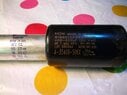
Discussion Overview
The discussion centers on the feasibility of using an old TV capacitor as a replacement for a failed motor capacitor in a 1 hp farm motor running on 220 AC. Participants explore the differences between motor capacitors and TV capacitors, particularly in terms of their electrical characteristics and safety implications.
Discussion Character
- Debate/contested
- Technical explanation
Main Points Raised
- Some participants assert that motor capacitors are bi-polar AC components, while TV capacitors are typically DC, suggesting that using a TV capacitor could be inappropriate.
- One participant emphasizes the importance of using the correct replacement part to avoid future failures and additional costs.
- Another participant questions the motivation behind seeking a shortcut, implying concerns about the motor's condition and the willingness to invest in the correct part.
- Some participants highlight the potential dangers of using a DC capacitor in an AC application, noting that it could lead to catastrophic failure.
- A later reply provides a technical explanation regarding the construction of electrolytic capacitors and the risks associated with incorrect usage.
Areas of Agreement / Disagreement
Participants generally disagree on the appropriateness of using a TV capacitor as a replacement for a motor capacitor, with some strongly advising against it due to safety concerns, while others express uncertainty about the differences and potential outcomes.
Contextual Notes
There are unresolved questions about the specific requirements for the motor capacitor, such as its voltage rating and whether it is a start or run capacitor. The discussion also reflects varying levels of understanding regarding capacitor types and their applications.