vcsharp2003
- 915
- 179
ThEmptyTree said:If you are interested, I have a very good resource of problems and explanations from an MIT OCW.
Yes, I am interested.
ThEmptyTree said:If you are interested, I have a very good resource of problems and explanations from an MIT OCW.
I understand your intuitive logic, but here's the thing.vcsharp2003 said:I think that the equation (5) is ok because we have the system of pulley and the hanging masses in black box move up with acceleration ##a_1## relative to ground. Is that correct? The acceleration of internal parts of this system is not needed but just the acceleration of whole system.
vcsharp2003 said:Yes, I am interested.
ThEmptyTree said:
ThEmptyTree said:Whenever you have objects that are considered massless (pulleys / strings), avoid grouping them into systems of objects, because you risk getting such contradictions
I know perfectly what you're talking about, but here it simply doesn't work and I kinda told you why.vcsharp2003 said:I was comparing it to a plane that is moving on the runway. Passengers inside could be walking relative to the plane, but Newton's second law could be applied to the plane using the total mass of passengers and plane as the m term in F=ma equation.
ThEmptyTree said:I know perfectly what you're talking about, but here it simply doesn't work and I kinda told you why.
The problem wouldn't be called challenging if it were that easy.
Yes I think you are right here, I didn't think of the center of mass thing. Personally I avoid grouping objects because I think it's safer to take care of each object in particular.vcsharp2003 said:I think if we take a system of multiple parts then the a in F = ma needs to be the acceleration of the center of mass. In the application I did, I took the acceleration of the pulley P when it should have been the acceleration of the center of mass of P and moving masses 2 and 3. That's why my application of Newton's second law to the system was incorrect. Right?
ThEmptyTree said:Yes I think you are right here, I didn't think of the center of mass thing. Personally I avoid grouping objects because I think it's safer to take care of each object in particular.
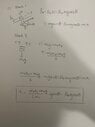
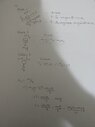
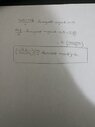
Another way of solving this challenging problem could be to convert the non-inertial frame of reference to an inertial frame of reference.ThEmptyTree said:I have attached a PDF with the full solution.
Draw a FBD for m2. What are the forces on it? What equation does that give for its acceleration?AzimD said:should use T = ((m_2*g- m_2*a_2)/2 )... Why?
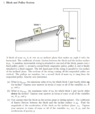
Look at the FBDs below for part (c) where ##m_1## is moving up the incline and ##m_2## is descending.AzimD said:I get that if I were to go the F=ma route and set the Forces to find the T I'd get F=ma such that m_2*g-2T=ma_2 so that T=((ma_2-m_2*g)/2).
I guess better worded my question would be: why am I setting 2T equal to m_2*g in parts A and B whereas I'm tying in the component of acceleration to the equation in Part C?
Because in parts A and B the acceleration was zero, maybe?AzimD said:I get that if I were to go the F=ma route and set the Forces to find the T I'd get F=ma such that m_2*g-2T=ma_2 so that T=((ma_2-m_2*g)/2).
I guess better worded my question would be: why am I setting 2T equal to m_2*g in parts A and B whereas I'm tying in the component of acceleration to the equation in Part C?
"barely slides", i.e. negligible acceleration.AzimD said:There is no mention of acceleration being 0
Got it, so technically what we did with parts A and B is a F=ma analysis where 2T-m_2*g=m_2*a_2=0 and thus 2T=m_2*g?haruspex said:"barely slides", i.e. negligible acceleration.
Yes.AzimD said:Got it, so technically what we did with parts A and B is a F=ma analysis where 2T-m_2*g=m_2*a_2=0 and thus 2T=m_2*g?
No, you do not ALWAYS have to do a F = ma analysis. You can get the answer by energy considerations.AzimD said:So just to confirm: Conceptually, we ALWAYS have to do a F=ma analysis.
I've attached the new solution that I've come to. Does it look correct?
Never mind, I answered my own question. It does matter. I think I got it right this time, still not entirely sure though. Seems that the answer is a difficult answer to come across. I may have done something wrong.AzimD said:I'm redoing this problem, and I have another question revolving around the Tensions... Would the tension provided by m2 on Pulley 2 be different than the two Tensions provided by the rope on Pulley 2? If so would that be 2T=T_2?
Is this even relevant?
Why the minus sign in ##a_2=-a_1/2##?AzimD said:Never mind, I answered my own question. It does matter. I think I got it right this time, still not entirely sure though. Seems that the answer is a difficult answer to come across. I may have done something wrong.
You have a sign error in the equation for the hanging mass that is descending. The equation for ##m_1## is correctly written asAzimD said:Never mind, I answered my own question. It does matter. I think I got it right this time, still not entirely sure though. Seems that the answer is a difficult answer to come across. I may have done something wrong.
For the length of the rope, I get:kuruman said:So far so good. Now we know that the magnitude of ##a_2##, a positive number, is half that of ##a_1## also a positive number. So we write $$a_2=\frac{1}{2}a_1.$$ There is no minus sign. It looks like you have to do the algebra one more time.
The way you chose your coordinate for the bodies is not consistent with the equations you wrote.AzimD said:For the length of the rope, I get:
L=2y_2+y_1+constants so that d^2L = 0 = 2a_2+a_1 which means that a_2=(-a_1)/2
Oh okay, so basically the way I should conceptualize it is if Y_2 increases, then Y_1 has to decrease and thus in that regard, I must make it -Y_1 in my equation. Understood. This would also fix the acceleration issue!erobz said:The way you chose your coordinate for the bodies is not consistent with the equations you wrote.
For Block 1 ( on the incline ) you chose ##\nearrow^+##, and for block 2(hanging mass) you chose ##\downarrow^+## ( presumably referenced at the pulley at the top of the incline), thus:
$$ L = - y_1 + 2y_2 - \rm{const.} $$
You can imagine if the pulley is accelerating up the incline (positive acceleration by the convention you chose), the hanging mass is acceleration downward ( also positive acceleration by the convention you chose), and visa-versa.
Your result is telling you that if block 2 (hanging mass) is accelerating up ( negative acceleration ), then block 1 is also acceleration up the incline. Your spider senses better be tingling at that notion.
I'm glad you sorted that out. If you post your solution with your answer, I will post mine that shows how you can do this using the work-energy theorem as an alternate method.AzimD said:Oh okay, so basically the way I should conceptualize it is if Y_2 increases, then Y_1 has to decrease and thus in that regard, I must make it -Y_1 in my equation. Understood. This would also fix the acceleration issue!
I don't know If there is a clear conceptualization to be had without some mathematical funny business. The idea is that you have to fix a coordinate system, and lengths are measured relative to it in the typical fashion ( i.e. positions on one side of it are positive and positions on the other side negative).AzimD said:Oh okay, so basically the way I should conceptualize it is if Y_2 increases, then Y_1 has to decrease and thus in that regard, I must make it -Y_1 in my equation.