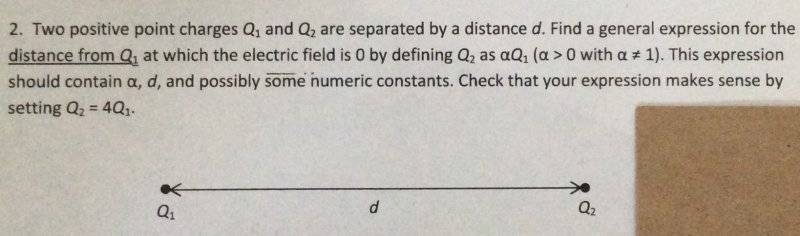
Two positive point charges q1 and q2 are separated by a distance d.

Click For Summary

Homework Help Overview

The discussion revolves around finding a general expression for the distance from one positive charge to the point where the electric field is zero, given two positive point charges Q1 and Q2 separated by a distance d. The second charge is defined as a multiple of the first (alphaQ1), where alpha is greater than zero and not equal to one.

Discussion Character

  • Exploratory, Conceptual clarification, Mathematical reasoning

Approaches and Questions Raised

  • Participants discuss the setup of the problem, including the direction of electric fields and the significance of the signs in the equations. There are attempts to clarify the reasoning behind the expressions used and the conditions under which the electric field becomes zero.

Discussion Status

The discussion is ongoing, with participants providing feedback on each other's mathematical expressions and reasoning. Some guidance has been offered regarding the interpretation of signs in the equations and the physical meaning of the setup. There appears to be a productive exchange of ideas, with participants questioning and clarifying assumptions.

Contextual Notes

Participants express confusion regarding the physics concepts involved and the instructional approach taken by their instructor, indicating a desire for deeper understanding rather than rote application of examples.
Joa Boaz
Messages
14
Reaction score
1
Two positive charges Q1 and Q2 are separated by a distance d. Find a general expression for the distance from Q1 at which the electric field is 0 by defining Q2 as alphaQ1 (alpha > 0 with alpha not equal to 1). This expression should contain alpha, d, and possible some numeric constants. Check that your expression makes sense by setting Q2 = 4Q1

I have attached the problem and what I have worked out.
IMG_0117.jpg
This is what I have, but unsure about it
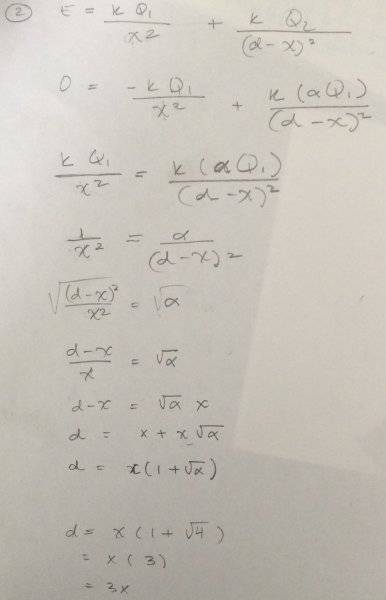
IMG_0118.jpg
 
Physics news on Phys.org
In your first expression for the field, you have only added the magnitude of the fields from the different charges. Then in the second line you have changed the sign of one of the charges (which is what it should be - between the charges the fields act in different directions).

Finally you should solve for x (which should be trivial given you have ##d = x(1+\sqrt\alpha)##. Apart from that, I am not sure what you are really asking. You should also argue why your result for the check is reasonable.
 
Thank you.

I am just trying to see whether I am going about solving the above problem correctly. Am I taking the right path? I find physics confusion, I guess, it doesn't help that most of the time my instructor is merely doing the same exactly example that the author provides step by step in the textbook. I am just trying to understand physics 2.

IMG_0119.jpg
 
The mathematics of your first post were correct apart from the first row. Since you should be in between the charges, x shoud be between 0 and d - so your result from there was correct. The only thing I was critisising was the first row which looked strange and did not explain the minus sign you introduced in the second.
 
Oh, I see, I am sorry, I didn't understand your comment. I thought you said that my whole equation was wrong. The reason I have a negative it is because Q1 and Q2 are both positive and if I have up and right as my positive. This seems to suggest that Q1 electric field are moving away or to the left which means it is negative. At least, that was my take of this problem. But, I wouldn't be surprise to see that I am complete wrong.
 
No, your reasoning is the correct one. However, this should have showed up as a a minus sign already in the first line.
 
I see. Thank you.
 

Similar threads

Replies
9
Views
5K
Replies
2
Views
2K
Replies
9
Views
3K
  • · Replies 1 ·
Replies
1
Views
3K
  • · Replies 2 ·
Replies
2
Views
5K
  • · Replies 3 ·
Replies
3
Views
5K
  • · Replies 5 ·
Replies
5
Views
4K
  • · Replies 36 ·
2
Replies
36
Views
2K
  • · Replies 3 ·
Replies
3
Views
4K
  • · Replies 2 ·
Replies
2
Views
8K