Unconscious
- 77
- 12
I'm studying the proof of this theorem (Zorich, Mathematical Analysis II, 1st ed., pag.136):
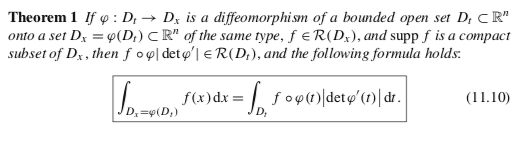
which as the main idea uses the fact that a diffeomorphism between two open sets can always be locally decomposed in a composition of elementary ones.
As a remark, an elementary diffeomorphism ##\varphi## is a diffeomorphism under which only a single variable is modified (in the following example, the last one):
##\left\{\begin{matrix}
x^1=\varphi^1(t^1,...,t^n)=t^1\\
x^2=\varphi^2(t^1,...,t^n)=t^2\\
...\\
x^{n-1}=\varphi^{n-1}(t^1,...,t^n)=t^{n-1}\\
x^{n}=\varphi^{n}(t^1,...,t^n)
\end{matrix}\right.##
The proposed proof (pag.142) starts in this way:
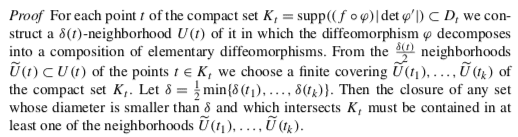
I can't understand the last sentence, because as an intuitively counterexample I'm imagining out this situation:
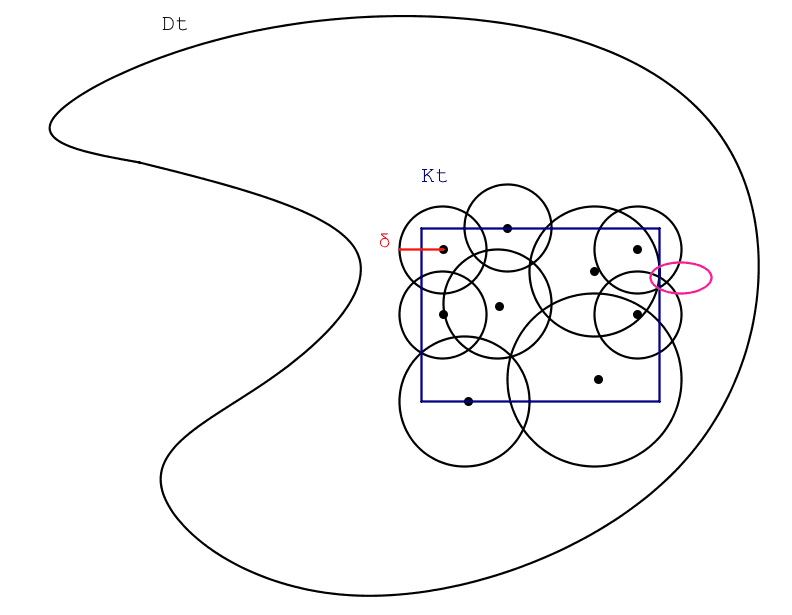
where the pink set is a set with a diameter less than ##\delta##, that intersect ##K_t##, but that is not contained in any neighborhoods of the finite family covering ##K_t##.
Am I missing something?
which as the main idea uses the fact that a diffeomorphism between two open sets can always be locally decomposed in a composition of elementary ones.
As a remark, an elementary diffeomorphism ##\varphi## is a diffeomorphism under which only a single variable is modified (in the following example, the last one):
##\left\{\begin{matrix}
x^1=\varphi^1(t^1,...,t^n)=t^1\\
x^2=\varphi^2(t^1,...,t^n)=t^2\\
...\\
x^{n-1}=\varphi^{n-1}(t^1,...,t^n)=t^{n-1}\\
x^{n}=\varphi^{n}(t^1,...,t^n)
\end{matrix}\right.##
The proposed proof (pag.142) starts in this way:
I can't understand the last sentence, because as an intuitively counterexample I'm imagining out this situation:
where the pink set is a set with a diameter less than ##\delta##, that intersect ##K_t##, but that is not contained in any neighborhoods of the finite family covering ##K_t##.
Am I missing something?