Understanding Active High Circuits and Digital Logic: A Beginner's Guide

Click For Summary
The discussion focuses on understanding active high circuits and the role of switches and resistors in digital logic. It clarifies that a closed switch allows current to flow, while an open switch does not, which is contrary to common analogies with physical gates. The use of pull-up and pull-down resistors is explained as essential for defining logic levels when switches are open, preventing floating states. Resistors limit current to avoid short circuits and ensure safe operation of logic gates. Overall, the conversation emphasizes the importance of proper terminology and circuit design in digital electronics.
whoareyou
Messages
162
Reaction score
2
I've recently started a digital electronics course with a lab component (so far not at all related to the lectures). Unfortunately, there are no prerequisites for the course and I guess they somehow expect us to know a whole lot about circuits, but I'm completely confused.

I"ll just ask two questions now and maybe if I don't understand some other things we can clear those up as well.

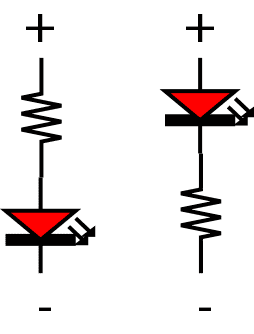
1. How do circuits like these make sense? I thought you needed a closed loop to have current flow ...
WVD4QJ8.png


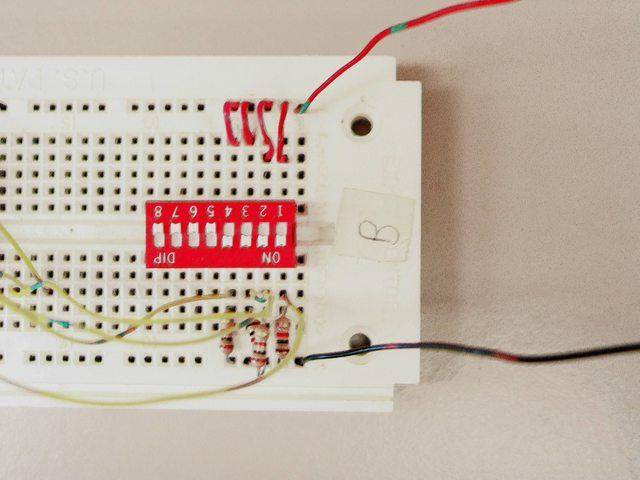
2. This is an example of an "active high" circuit. "When a switch is closed, the signal will be connected to power. When a switch is open, the signal will be connected to ground through the resistor." Does this mean that when the switch is open, there is actually current flowing through the wires?
rso6q2ml.jpg


I feel really stupid :(.
 
  • Like
Likes 1 person
Physics news on Phys.org
-1- The + and - symbols imply that there is a voltage source connected to those ends. The power supply (or battery) is what completes the circuit to allow current to flow.

-2- Usually such a switch is used to drive the input of logic gates high and low. That takes a small current to drive those inputs low or high, so yes, that current is either supplied by the power supply when the switch is closed, or by the pulldown resistor when the switch is open. When the switch is closed, the power supply provides both the pullup current for the logic gate, and drives a current through the pulldown resistor.

If that's not clear, post some follow-up questions. :smile:
 
Ooops, wrong circuit! This one (there aren't any closed loops):

WpCd8r6.png


Also, "current is either supplied by the power supply [...] or by the pulldown resistor" --> I though resistors limited current. They also provide a current? I tried searching around the web and there are a lot of sources that say something about being in a floated state so that the input pin is sometimes how and sometimes low and that the resistor is in place to ensure it is low.
 
whoareyou said:
Ooops, wrong circuit! This one (there aren't any closed loops):

WpCd8r6.png


Also, "current is either supplied by the power supply [...] or by the pulldown resistor" --> I though resistors limited current. They also provide a current? I tried searching around the web and there are a lot of sources that say something about being in a floated state so that the input pin is sometimes how and sometimes low and that the resistor is in place to ensure it is low.

-1- Sure there are. Draw the Vcc voltage supply and its ground connection.

-2- The input to logic gates has a small leakage current that needs to be sourced or sinked to pull the input high or low. That leakage current can be supplied by a "hard" power supply voltage (like 5V or ground), or by a pullup/pulldown resistor. If the input leakage current for a CMOS gate is 10uA, and you use a 1 kOhm pullup/pulldown resistor, what will the input voltage be to the gate for a high and low input?
 
I'm still not understanding the pull-up/pull-down resistor stuff. Why use resistors anyways? Why can't I just attach a wire in place of the resistor?
 
Some circuit symbols (like Vcc and Gnd) are shorthand. If you replace them with a voltage source you will see the circuit loops.

Resistors are used to pull the inputs to a defined logic level (0V/Gnd in your circuit) when there is nothing else connected to them. For example when the switches are open (off).

You can't use a wire instead because when the switches are made (on) the wire would connect VCC directly to 0V/Gnd via the switch. Very large current would flow because the resistance of the wire is very low.
 
whoareyou said:
"When a switch is closed, the signal will be connected to power. When a switch is open, the signal will be connected to ground through the resistor." Does this mean that when the switch is open, there is actually current flowing through the wires?
Hi whoareyou. :smile:

There is a frequent confusion with terminology here, among people new to electronics. If you have a farming background, then you are accustomed to associating an open door or gate with free passage of animals, and a closed gate as allowing no passage through it. However, electrical switches are not farm gates. When an electrical switch allows current to flow through it, we say that switch is closed. Yes, really! And when the switch prevents the passage of current, we say the switch is open.

The origin of this lies with switch internals. When it is required to block electron flow, the circuit between the switch's terminals needs to be an open circuit, i.e., not be a continuous path of copper conductor within that switch. When flow of current is to be allowed, the switch's two terminals need to be joined as by a continuous path of copper conductor so as to close or complete the circuit.

All perfectly logical! :smile:

Now, having deftly cleared away the confusion between farm gates and electrical switches, we can turn our spotlight onto the topic of logic gates, and ask "should we draw a comparison between farm gates and logic gates?" :wink: :wink:
 
Not to tread on anyone's toes or anything. But in digital logic, a 1 is on and a 0 is off.

In the case of this circuit, the 1 would be the full voltage from the power supply. The 0 would be a decrease in voltage by way of a resistor. This results in constant flow of electricity, but at varying voltages to represent the 1, or 0.
 

Similar threads

  • · Replies 1 ·
Replies
1
Views
1K
Replies
15
Views
2K
  • · Replies 3 ·
Replies
3
Views
2K
  • · Replies 4 ·
Replies
4
Views
1K
  • · Replies 3 ·
Replies
3
Views
3K
  • · Replies 2 ·
Replies
2
Views
2K
  • · Replies 7 ·
Replies
7
Views
5K
  • · Replies 2 ·
Replies
2
Views
2K
Replies
1
Views
2K
  • · Replies 1 ·
Replies
1
Views
1K