hodor
- 7
- 0
Hi,
I've run into a snag trying to read a textbook problem. Here is the original example, it's pretty straightforward. The problem I have is when I get to the exercise and it asks me to place a restriction on this example. This restriction seems to break the independence of two variables and renders all the probabilities in the original example useless to me. For example:
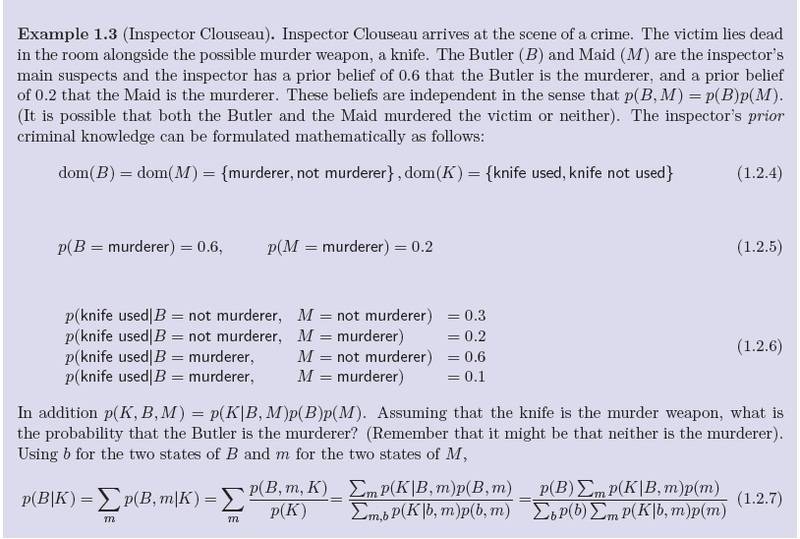

So, ignoring that it's asking for a code update here, I seem to have P(Butler = murderer, Maid = murderer) = 0 and so on. But it appears I can't recalculate P(K) (knife used) since B and M are no longer independent. So I really don't understand how to proceed. This leads me to believe I'm misinterpreting things so I thought I'd ask here. Thanks.
I've run into a snag trying to read a textbook problem. Here is the original example, it's pretty straightforward. The problem I have is when I get to the exercise and it asks me to place a restriction on this example. This restriction seems to break the independence of two variables and renders all the probabilities in the original example useless to me. For example:
So, ignoring that it's asking for a code update here, I seem to have P(Butler = murderer, Maid = murderer) = 0 and so on. But it appears I can't recalculate P(K) (knife used) since B and M are no longer independent. So I really don't understand how to proceed. This leads me to believe I'm misinterpreting things so I thought I'd ask here. Thanks.