Understanding Current in Series Circuits: Explaining 6A with 12V and 2 Ohms

  • Context: High School 
  • Thread starter Thread starter Lim Y K
  • Start date Start date
  • Tags Tags
    Current Series
Click For Summary

Discussion Overview

The discussion revolves around the calculation of current in a series circuit, specifically addressing a scenario where a voltage of 12V and a resistance of 2 Ohms lead to a current of 6A. Participants explore the implications of circuit design, the role of total resistance, and the effects of real-world conditions on theoretical calculations.

Discussion Character

  • Exploratory
  • Technical explanation
  • Debate/contested

Main Points Raised

  • One participant notes that the current should be calculated as 12V divided by the total resistance in the series circuit, which includes the resistance of both the bulb and resistor X.
  • Another participant argues that since the voltage across resistor X is 12V, the other components of the circuit should not affect the current calculation.
  • A different viewpoint suggests that the example used may illustrate a fundamental wiring mistake, questioning the validity of the current calculation without considering the total resistance.
  • Concerns are raised about the real-world behavior of components, particularly incandescent light bulbs, which have resistance that changes as they heat up, potentially affecting current calculations.
  • One participant expresses uncertainty about the correctness of the textbook answer due to the lack of clarity in the original question's wording.
  • Another participant emphasizes the need to inform students that theoretical calculations may not hold true in practical scenarios, particularly with incorrectly drawn circuits.

Areas of Agreement / Disagreement

Participants express differing views on the relevance of total resistance in the circuit and the impact of real-world conditions on the theoretical calculations. There is no consensus on the correctness of the current calculation or the appropriateness of the example used.

Contextual Notes

Participants highlight limitations in the example provided, including missing information about the resistance of the light bulb and the potential confusion caused by circuit diagrams. The discussion reflects uncertainty regarding the assumptions made in the problem statement.

Lim Y K
Messages
26
Reaction score
0
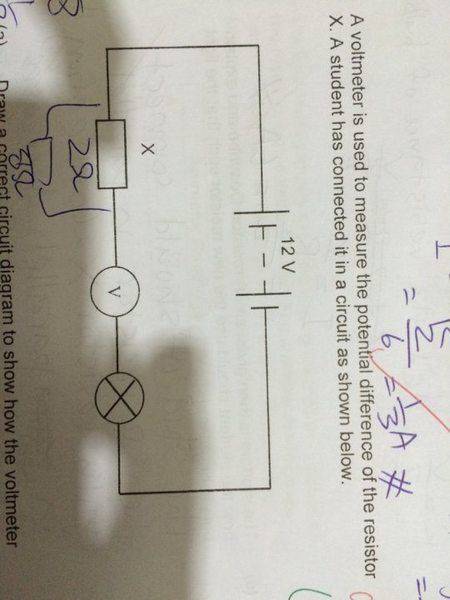
Take this question as an example
ImageUploadedByPhysics Forums1440066974.082733.jpg

They asked for the current flowing through the bulb and the answer is 6A
I know that it's 12V divided by 2 ohms(2 ohm is the resistance of resistor X) , but why? I thought the current is supposed to be 12V divided by the resistance of bulb and resistor X(total resistance of resistors) since its arranged in series?
 
Physics news on Phys.org
As stated, the voltage across the resistor X is measured at 12 V, so the other parts of the circuit shouldn't matter.
 
Yes, current would be 12/(rtotal), where rtotal is the sum of the series resistances.

I'm not able to agree or disagree with you on the correctness of the textbook's answer, because you haven't disclosed the exact wording of the question. The figure you selected to use as an example is not a particularly good choice---because it examplifies a fundamental wiring "mistake".
 
  • Like
Likes   Reactions: CWatters and davenn
olivermsun said:
As stated, the voltage across the resistor X is measured at 12 V, so the other parts of the circuit shouldn't matter.

for a idea circuit, yes you could say that. But if it was a real world circuit, that is no longer true. The light globe will have significant resistance
which will change as it heats up

NascentOxygen said:
The figure you selected to use as an example is not a particularly good choice---because it examplifies a fundamental wiring "mistake".

indeed

@Lim Y K, can you recognise the problem ?Dave
 
davenn said:
for a idea circuit, yes you could say that. But if it was a real world circuit, that is no longer true. The light globe will have significant resistance
which will change as it heats up
I realize that is the case for a real incandescent lightbulb, but since the heated filament resistance, wasn't given in the problem, I'm assuming that the student isn't expected to incorporate that information in the solution.
 
maybe but they need to be informed that it isn't like that in the real world and you didn't give that clarification :smile:

the poor guy is already getting confused enough with incorrectly drawn circuits ...
 
olivermsun said:
As stated, the voltage across the resistor X is measured at 12 V, so the other parts of the circuit shouldn't matter.
This is not the case in the figure I'm seeing.
 

Similar threads

  • · Replies 57 ·
2
Replies
57
Views
14K
  • · Replies 6 ·
Replies
6
Views
5K
  • · Replies 3 ·
Replies
3
Views
2K
  • · Replies 28 ·
Replies
28
Views
4K
  • · Replies 6 ·
Replies
6
Views
19K
  • · Replies 16 ·
Replies
16
Views
4K
  • · Replies 4 ·
Replies
4
Views
2K
Replies
4
Views
2K
  • · Replies 25 ·
Replies
25
Views
2K
  • · Replies 1 ·
Replies
1
Views
2K