Understanding Diffraction Condition in Kittle's Intro to Solid State Physics

Join the discussion
Ask a follow-up here, or get your own question answered by working scientists, mathematicians and engineers — people, not an autocomplete.
Real named experts · corrections over time · the nuance an AI answer skips
1 reply · 3K views
Mart1234
Messages
6
Reaction score
0
TL;DR
Diffraction Condition derivation in Kittle's Introduction to Solid State Physics
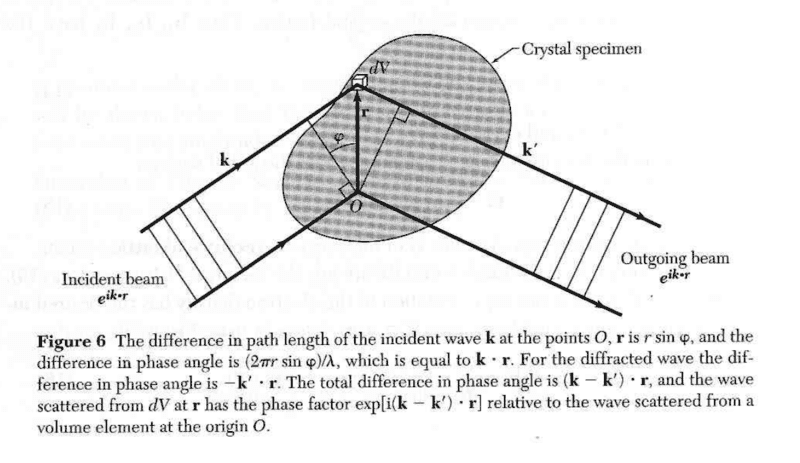
I am going over the diffraction condition section in Kittle's Introduction to Solid State Physics physics and I am having a hard time understanding why the phase difference angle for the incident wave is positive while the phase angle difference for the diffracted wave is negative. Thank you for the help.
1676492080257.png
 
Last edited by a moderator:
Physics news on Phys.org
Mart1234 said:
TL;DR Summary: Diffraction Condition derivation in Kittle's Introduction to Solid State Physics

I am having a hard time understanding why the phase difference angle for the incident wave is positive while the phase angle difference for the diffracted wave is negativeiy
I see in the figure attached that
[tex]\mathbf{k}\cdot \mathbf{r}>0.....(1)[/tex]
The phase of upside or outside wave advances until reflection.
[tex]\mathbf{k'}\cdot \mathbf{r}<0.....(2)[/tex]
The phase of upside or outside wave advance after reflection also so sign must be inverted for addition to (1) to give the full phase difference by reflection.
 
Last edited: