Understanding Mean Force in Tandem Steam Engines

Click For Summary

Homework Help Overview

The discussion revolves around understanding the mean force in a tandem steam engine's piston rod, specifically focusing on the relationship between force, pressure, and the geometry of the pistons and rods involved. Participants express confusion regarding the question's wording and the concept of "mean force," as well as the implications of missing information about the diameter of one of the piston rods.

Discussion Character

  • Exploratory, Conceptual clarification, Assumption checking

Approaches and Questions Raised

  • Participants discuss the relationship between force and pressure, questioning the meaning of "mean force" and how it applies to the system. There are attempts to clarify the calculations involving the diameters of the pistons and rods, and some participants suggest alternative values for the unknown diameter. Others explore the implications of the forces acting on the pistons and how they interact.

Discussion Status

The discussion is active, with participants providing insights and attempting to clarify each other's understanding. Some guidance has been offered regarding the regrouping of forces and the physical interpretation of the forces acting on the pistons. However, there is no explicit consensus on the interpretation of the problem or the calculations involved.

Contextual Notes

There is a noted ambiguity in the problem statement, particularly regarding the missing diameter of the piston rod and the definition of "mean force." Participants are also navigating the complexities of the forces involved and how they relate to the overall system dynamics.

cwill53
Messages
220
Reaction score
40
Homework Statement
Determine the mean force in a piston rod connecting pistons in two tandem cylinders of a steam engine if the diameters of the pistons are $$D_{1}$$=12.5 in., $$D_{2}$$=24in., the diameters of the piston rods are $$d_{1}$$=2.5in, $$d_{3}$$=4 in., and the mean steam pressures $$p_{1}$$= 135$$lb/in^{2}$$, $$p_{2}$$= 35.5$$lb/in^{2}$$, and $$p_{3}$$= 1.5$$lb/in^{2}$$.
Relevant Equations
$$p=\frac{\vec{F}}{A}$$
I found the correct solution using the equation that relates force and pressure, but I don't REALLY understand what the question is asking and what is actually going on in the machine. I want a better understanding of everything that's going on, not just an answer. Below is a clear diagram and a clear sheet of my work.
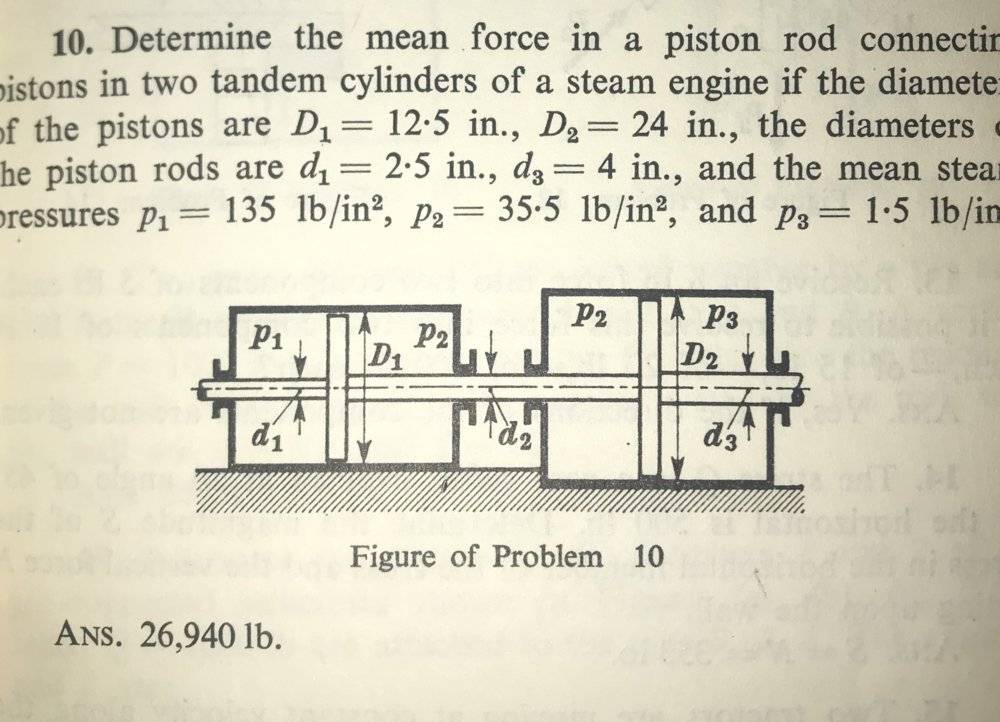
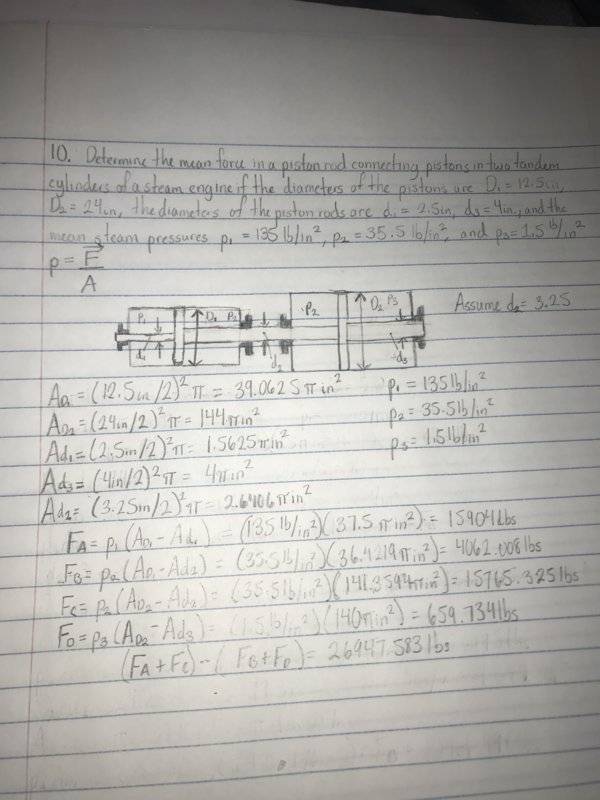
IMG_6852.jpg
IMG_6851.jpg


One issue I had was that the diameter of the piston rod d2 is not given. Maybe it was a typo? I don't know. But I made a guess and assumed that it was the average between d1 and d3. Another thing I don't get is what is meant by "mean force," and what exactly is happening in each section of the piston.
 
Physics news on Phys.org
cwill53 said:
Homework Statement:: Determine the mean force in a piston rod connecting pistons in two tandem cylinders of a steam engine if the diameters of the pistons are ##D_{1}=12.5 ##in., and ##D_{2}=24##in.,
the diameters of the piston rods are ##d_{1}=2.5##in, ##d_{3}=4 ##in.,
and the mean steam pressures ##p_{1}= 135 ##lb/in2, ##p_{2}= 35.5##lb/in2, and ##p_{3}= 1.5##lb/in2.
Relevant Equations:: ##p=\frac{\vec{F}}{A}##

I found the correct solution using the equation that relates force and pressure, but I don't REALLY understand what the question is asking and what is actually going on in the machine. I want a better understanding of everything that's going on, not just an answer. Below is a clear diagram and a clear sheet of my work.

View attachment 261424View attachment 261425

One issue I had was that the diameter of the piston rod d2 is not given. Maybe it was a typo? I don't know. But I made a guess and assumed that it was the average between d1 and d3. Another thing I don't get is what is meant by "mean force," and what exactly is happening in each section of the piston.
You mention that for ##d_2## you used the average of ##d_1## and ##d_3##, but in your solution (by the way: It's very hard to read.) you used 3.25 in. for ##d_2##, which is not the average.
(Added in Edit: Of course you were right. 3.25 in. is the average of 2.50 in. and 4.00 in. )

Did you try using some different value for ##d_2## ?

For the mean force, you used ##(F_A+F_C)-(F_B+F_D)##.
Which of these terms depend on ##d_2##, or what you call ##A_{d_2}##?
Can you see what happens to any dependence on ##d_2##?
 
Last edited:
SammyS said:
You mention that for ##d_2## you used the average of ##d_1## and ##d_3##, but in your solution (by the way: It's very hard to read.) you used 3.25 in. for ##d_2##, which is not the average.

Did you try using some different value for ##d_2## ?

For the mean force, you used ##(F_A+F_C)-(F_B+F_D)##.
Which of these terms depend on ##d_2##, or what you call ##A_{d_2}##?
Can you see what happens to any dependence on ##d_2##?
3.25 is (2.5in+4in)/2. The higher d2 is the lower the total areas would be for the calculations for Force B and Force D.
D8257EA3-120A-4078-A8E6-7AA06FAEA386.png
 
cwill53 said:
3.25 is (2.5in+4in)/2.
Oh yes! So it is. I need a new calculator.

As for ##(F_A+F_C)-(F_B+F_D)## :

Write that as ##F_A+ (-F_B)+F_C + (-F_D)##. Then write out ##F_B## and ##F_C ## in terms of the A's and p's .
 
  • Like
Likes   Reactions: cwill53
This is not really important to the question, but in your relevant equations you gave ##p = \frac{\vec{F}}{A}##. This can't be right, since the LHS is a scalar and the RHS is a vector! A better relationship would be ##\vec{F} = p\vec{A}##, where ##\vec{A}## is the area vector of the surface (magnitude equals the area, direction is along the normal of the surface, i.e. ##\vec{A} = A\hat{n}##). Of course, the form we're first introduced to is just obtained by taking the magnitudes ##F = pA##.

Just thought you might find this interesting! It doesn't have any bearing on your working :cool:
 
  • Like
Likes   Reactions: cwill53
etotheipi said:
This is not really important to the question, but in your relevant equations you gave ##p = \frac{\vec{F}}{A}##. This can't be right, since the LHS is a scalar and the RHS is a vector! A better relationship would be ##\vec{F} = p\vec{A}##, where ##\vec{A}## is the area vector of the surface (magnitude equals the area, direction is along the normal of the surface, i.e. ##\vec{A} = A\hat{n}##). Of course, the form we're first introduced to is just obtained by taking the magnitudes ##F = pA##.

Just thought you might find this interesting! It doesn't have any bearing on your working :cool:
I like the attention to detail, thanks for sharing that, I see it AS relevant as it’s always good to practice good habits!
Thanks for explaining area as a vector too, I was about to ask that as I was reading.
 
  • Like
Likes   Reactions: etotheipi
SammyS said:
Oh yes! So it is. I need a new calculator.

As for ##(F_A+F_C)-(F_B+F_D)## :

Write that as ##F_A+ (-F_B)+F_C + (-F_D)##. Then write out ##F_B## and ##F_C ## in terms of the A's and p's .
Alright.
Can you help me understand what’s going on in the picture? I see what the object is, but I don’t have an intuitive understanding of what’s happening.
 
cwill53 said:
Alright.
Can you help me understand what’s going on in the picture? I see what the object is, but I don’t have an intuitive understanding of what’s happening.
I can try. However, if you actually do the regrouping I suggested, symbolically rather than after plugging in numbers, this all might be clear. I can't tell whether or not you did this.

An attempt at a little bit more physical explanation:
The issue here deals with:
FB , the force exerted (to the left, thus negative) on the right side of Piston #1 by steam at a pressure of p2
and
FC , the force exerted (to the right, thus positive) on the left side of Piston #2 by steam also at a pressure of p2.

As the figure and the given dimensions suggest, the the net effect of these two forces is that pressure, p2 acting on the right side area of Piston #1 exerts a force, FB, which cancels the force generated by p2 on an equivalent portion of area on the left side of Piston #2. The amount of force not canceled is just the force generated by a pressure of p2 acting on the remaining area of the left side of Piston #2. That area is ##\dfrac{\pi}{4}\left({D_2}^2 - {D_1}^2 \right) ##. This is independent of the area of the connecting rod, diameter d2.

In conclusion: The connecting rod subtracts the same area from each piston face discussed here and both of those faces are subjected to the same pressure.
 
  • Like
Likes   Reactions: cwill53 and etotheipi
The question is worded in a way that's slightly bizarre to me. It appears a much clearer way of stating the problem is just "find the resultant force on the rigid body consisting of the pistons and the rod". All that remains to do is to compute the total force on this body, like you said \begin{align*} F_x &= F_{ax} - F_{bx} + F_{cx} - F_{dx} \\
&= P_1 A_1 - P_2 A_2 + P_2 A_3 - P_3 A _4\\
&= P_1 \frac{\pi}{4}({D_1}^2 - {d_1}^2) - P_2 \frac{\pi}{4}({D_1}^2 - {d_2}^2) + P_2 \frac{\pi}{4}({D_2}^2 - {d_2}^2) - P_3 \frac{\pi}{4}({D_2}^2 - {d_3}^2)\\
\end{align*} And then as @SammyS pointed out you get cancellation of the ##\frac{\pi}{4} P_2 {d_2}^{2}## terms.

This resultant force is going to cause the body to accelerate inside the cylinders, which will evidently change the pressures and result in a new resultant force. Hence our result holds only for this particular instant.

I might be missing something here but that is what I interpreted the question as!
 
  • Like
Likes   Reactions: cwill53
  • #10
SammyS said:
I can try. However, if you actually do the regrouping I suggested, symbolically rather than after plugging in numbers, this all might be clear. I can't tell whether or not you did this.

An attempt at a little bit more physical explanation:
The issue here deals with:
FB , the force exerted (to the left, thus negative) on the right side of Piston #1 by steam at a pressure of p2
and
FC , the force exerted (to the right, thus positive) on the left side of Piston #2 by steam also at a pressure of p2.

As the figure and the given dimensions suggest, the the net effect of these two forces is that pressure, p2 acting on the right side area of Piston #1 exerts a force, FB, which cancels the force generated by p2 on an equivalent portion of area on the left side of Piston #2. The amount of force not canceled is just the force generated by a pressure of p2 acting on the remaining area of the left side of Piston #2. That area is ##\dfrac{\pi}{4}\left({D_2}^2 - {D_1}^2 \right) ##. This is independent of the area of the connecting rod, diameter d2.

In conclusion: The connecting rod subtracts the same area from each piston face discussed here and both of those faces are subjected to the same pressure.
I think it was more so the wording of the question that got me a bit confused. When the book says “mean force”. That just sounds weird. Thanks for the thorough explanation. After actually thinking about what the regrouping means and looking at the diagram it makes sense.
 
  • #11
etotheipi said:
This resultant force is going to cause the body to accelerate inside the cylinders, which will evidently change the pressures and result in a new resultant force. Hence our result holds only for this particular instant.

I might be missing something here but that is what I interpreted the question as!
I interpreted this as having an external connection between the the two center chambers, keeping both at the same pressure, p2. Otherwise, as you point out, "our result holds only for this particular instant." In addition to that, knowing the diameter of the connecting rod would be crucial.
 
  • Like
Likes   Reactions: cwill53
  • #12
etotheipi said:
The question is worded in a way that's slightly bizarre to me. It appears a much clearer way of stating the problem is just "find the resultant force on the rigid body consisting of the pistons and the rod". All that remains to do is to compute the total force on this body, like you said \begin{align*} F_x &= F_{ax} - F_{bx} + F_{cx} - F_{dx} \\
&= P_1 A_1 - P_2 A_2 + P_2 A_3 - P_3 A _4\\
&= P_1 \frac{\pi}{4}({D_1}^2 - {d_1}^2) - P_2 \frac{\pi}{4}({D_1}^2 - {d_2}^2) + P_2 \frac{\pi}{4}({D_2}^2 - {d_2}^2) - P_3 \frac{\pi}{4}({D_2}^2 - {d_3}^2)\\
\end{align*} And then as @SammyS pointed out you get cancellation of the ##\frac{\pi}{4} P_2 {d_2}^{2}## terms.

This resultant force is going to cause the body to accelerate inside the cylinders, which will evidently change the pressures and result in a new resultant force. Hence our result holds only for this particular instant.

I might be missing something here but that is what I interpreted the question as!
Yea I see now. This diagram looks like a simplified version of something that could happen in an engine. I screenshotted these pics from www.vintagemachinery.org and it looks just like the problem from the book

728FE7CE-49D4-475B-8FA6-66313DA1B0DC.png
 
  • Informative
Likes   Reactions: etotheipi
  • #13
SammyS said:
I interpreted this as having an external connection between the the two center chambers, keeping both at the same pressure, p2. Otherwise, as you point out, "our result holds only for this particular instant." In addition to that, knowing the diameter of the connecting rod would be crucial.
That’s another thing that was weird. I assumed it might have been a typo that the diameter of the connecting rod was not given. Is there a mathematical way to determine the diameter of that rod assuming it didn’t happen to be the average of the two other rods?
 
  • #14
cwill53 said:
That’s another thing that was weird. I assumed it might have been a typo that the diameter of the connecting rod was not given. Is there a mathematical way to determine the diameter of that rod assuming it didn’t happen to be the average of the two other rods?
Did you not understand after all?
If both of those portions of the cylinders are maintained at the same pressure as each other, then the diameter of the connecting rod does not matter. You get the same answer whether d2 is 0.01 in. or even the maximum possible, 12.5 in.
 
  • Like
Likes   Reactions: cwill53
  • #15
SammyS said:
Did you not understand after all?
If both of those portions of the cylinders are maintained at the same pressure as each other, then the diameter of the connecting rod does not matter. You get the same answer whether d2 is 0.01 in. or even the maximum possible, 12.5 in.
I see now, I took another look at the diagram and read what you said while looking at the diagram. The right side of the piston on the left and the left side of the piston on the right are both subject to the same pressure, but the forces caused by said pressure are acting in the opposite direction, I can just subtract the area D1 from D2, which will be in the positive direction because D2 has a larger area. Then just multiply that by P2 and add the positive and negative forces coming from Fa and Fd, respectively. Thanks for that. I know you literally said it several times.
 
  • #16
I'd also like to emphasise that it makes no sense to talk of the force "in" a rod, only the force "on" a rod. The closest thing you'd get to a force in a rod is an internal force pair between two interacting mass elements, though that sort of thing is not at all relevant in this problem.

Sloppiness on the book's part!
 
  • Like
Likes   Reactions: cwill53
  • #17
etotheipi said:
I'd also like to emphasise that it makes no sense to talk of the force "in" a rod, only the force "on" a rod. The closest thing you'd get to a force in a rod is an internal force pair between two interacting mass elements, though that sort of thing is not at all relevant in this problem.

Sloppiness on the book's part!
I assume it’s because it was translated poorly. It was originally a Russian book, this was translated in the 60’s if I’m not mistaken.
 
  • Informative
Likes   Reactions: etotheipi
  • #18
cwill53 said:
I see now, I took another look at the diagram and read what you said while looking at the diagram. The right side of the piston on the left and the left side of the piston on the right are both subject to the same pressure, but the forces caused by said pressure are acting in the opposite direction, ...
I did a search for tandem steam engines, then tandem compound steam engines. Learned some interesting things. Here's an image from the same site where you took your screen-shot, showing only tandem cylinder arrangement along with the steam flow and valving.
SteamEngineIMG_6852-4023-B.jpg

(http://vintagemachinery.org/MfgIndex/Images/4023-B.jpg)

In this position, the pistons are just beginning their motion to the right. So that as in the figure from your textbook the two central cylindrical cavities are held at approximately the same pressure. I found other aspects of these engines to be of interest, but I'll end this post here.
 
  • Like
Likes   Reactions: cwill53

Similar threads

Replies
4
Views
2K
  • · Replies 12 ·
Replies
12
Views
2K
  • · Replies 7 ·
Replies
7
Views
2K
  • · Replies 17 ·
Replies
17
Views
2K
  • · Replies 1 ·
Replies
1
Views
3K
  • · Replies 8 ·
Replies
8
Views
3K
  • · Replies 5 ·
Replies
5
Views
2K
  • · Replies 9 ·
Replies
9
Views
5K
  • · Replies 2 ·
Replies
2
Views
1K
  • · Replies 45 ·
2
Replies
45
Views
7K