Understanding Power Signals and Non-Periodic Functions

Click For Summary

Discussion Overview

The discussion revolves around the nature of power signals and non-periodic functions, specifically examining the periodicity of given mathematical functions and their graphical representations. Participants explore definitions and properties related to periodicity in the context of discrete and continuous signals.

Discussion Character

  • Exploratory
  • Debate/contested
  • Mathematical reasoning

Main Points Raised

  • One participant presents a piecewise function and questions its correctness and periodicity, seeking confirmation.
  • Another participant agrees with the first and confirms the function's representation.
  • A different participant introduces a discrete cosine function and questions its periodicity over different ranges, suggesting it may be periodic from 0 to infinity but not from negative to positive infinity.
  • A subsequent reply challenges the definition of periodicity, referencing a source that implies periodicity must hold for all values, not just a subset.
  • One participant clarifies a misunderstanding regarding their textbook, stating it refers to the function as a power signal rather than periodic, leading to further questioning about the periodicity of the function.

Areas of Agreement / Disagreement

Participants generally express uncertainty regarding the periodicity of the functions discussed. There are competing views on the definitions and properties of periodic functions, particularly in relation to the context of power signals.

Contextual Notes

The discussion highlights the dependence on definitions of periodicity and the context in which signals are analyzed. There is ambiguity regarding the classification of the cosine function as periodic based on different interpretations of the range.

Angello90
Messages
65
Reaction score
0
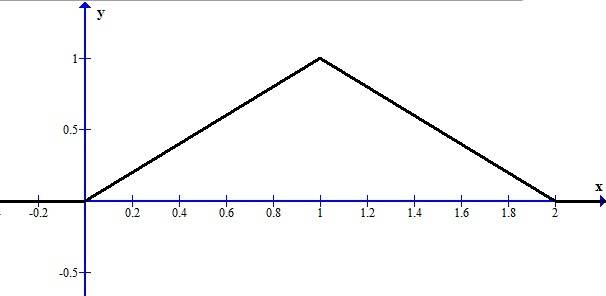
x(t) = t, [tex]0 \leq t \leq 1[/tex];
x(t) = 2-t, [tex]1 \leq t \leq 2[/tex];
x(t) = 0 ,otherwise.

I want to draw this signal, and I have something similar to this
attachment.php?attachmentid=29446&d=1288200219.jpg


Is that correct? Also this is not periodic right? I just want to be sure 100%

Thanks!
 

Attachments

  • Untitled-1.jpg
    Untitled-1.jpg
    10.2 KB · Views: 544
Physics news on Phys.org
Angello90 said:
x(t) = t, [tex]0 \leq t \leq 1[/tex];
x(t) = 2-t, [tex]1 \leq t \leq 2[/tex];
x(t) = 0 ,otherwise.

I want to draw this signal, and I have something similar to this
attachment.php?attachmentid=29446&d=1288200219.jpg


Is that correct? Also this is not periodic right? I just want to be sure 100%

Thanks!

Looks good to me.
 
Ok thanks a lot;)

Also if:
[tex]x[n] = Cos(\pi n), n\geq 0[/tex]
[tex]x[n] = 0, otherwise[/tex],

Than graph will be periodic from [tex]0 \rightarrow \infty[/tex], but from [tex]- \infty \rightarrow \infty[/tex] it is not periodic right? So overall is it periodic or not? My books says that it is periodic.
 
Angello90 said:
Ok thanks a lot;)

Also if:
[tex]x[n] = Cos(\pi n), n\geq 0[/tex]
[tex]x[n] = 0, otherwise[/tex],

Than graph will be periodic from [tex]0 \rightarrow \infty[/tex], but from [tex]- \infty \rightarrow \infty[/tex] it is not periodic right? So overall is it periodic or not? My books says that it is periodic.

What is your book's definition of a periodic function? Usually it has to hold for all x, not just a range:

http://en.wikipedia.org/wiki/Periodic_function

.
 
Sorry I shouldn't write that it says it's periodic. It says that it is power signal, but power signal is periodic hence my statement.

So the function x[n] is not periodic?
 

Similar threads

  • · Replies 4 ·
Replies
4
Views
3K
  • · Replies 2 ·
Replies
2
Views
3K
  • · Replies 6 ·
Replies
6
Views
5K
  • · Replies 4 ·
Replies
4
Views
2K
  • · Replies 1 ·
Replies
1
Views
3K
  • · Replies 2 ·
Replies
2
Views
2K
  • · Replies 1 ·
Replies
1
Views
2K
  • · Replies 7 ·
Replies
7
Views
3K
  • · Replies 1 ·
Replies
1
Views
2K
  • · Replies 5 ·
Replies
5
Views
2K