Understanding ray diagrams for concave lenses

Click For Summary

Discussion Overview

The discussion revolves around understanding ray diagrams for concave lenses, specifically focusing on the behavior of rays as they pass through the lens. Participants explore the implications of ray interactions and the underlying physics principles involved in ray tracing.

Discussion Character

  • Exploratory
  • Technical explanation
  • Conceptual clarification
  • Debate/contested

Main Points Raised

  • One participant expresses frustration over the lack of resources explaining the transformation of rays through concave lenses, particularly the transition of Ray Y.
  • Another participant suggests that to understand Ray Y's transformation, one should extrapolate it to where it would intersect the axis if the lens were absent, indicating a method for determining the virtual object associated with Ray Y.
  • A different participant introduces concepts from linear optics, discussing how rays can be characterized using two parameters (height and slope) and how these parameters relate through a matrix. They mention that for thin lenses, certain properties remain unchanged across the lens.
  • This participant also notes that the coefficients in the matrix are influenced by the concavity of the lens and the refractive indices of the lens and surrounding medium, suggesting a more formal approach to understanding ray behavior.
  • Another participant points out that for a concave lens, the incident ray diverges, and discusses how Ray Y's path can be inferred based on its position relative to Ray X.

Areas of Agreement / Disagreement

Participants do not reach a consensus on the specific transformation of Ray Y, and multiple approaches to understanding the ray behavior are presented. The discussion remains unresolved regarding the exact answer to the original question posed.

Contextual Notes

There are limitations in the discussion regarding the assumptions made about the rays and the lens properties, as well as the dependence on specific definitions of ray behavior in optics. The mathematical steps involved in the linear optics approach are not fully resolved.

Kyle91
Messages
34
Reaction score
0
Hey guys,

So some friends and I are studying for a test and we came across this question. I've absolutely no idea what the answer is simply because every website I've found only shows parallel rays and a ray going through the centre of the lens. It's incredibly aggravating.

Anyway here's the question -
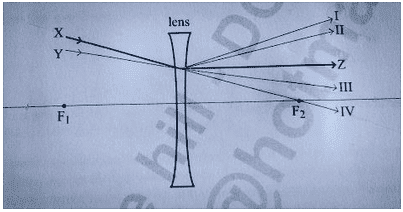
rYpSVs0.png


Ray X became Ray Z when passing through the lens. Which does Ray Y become?

As I said, every website/textbook/youtube video skips this info so I don't have a guess. Can you please not make me work for the answer. I'll understand it if you just tell me. I don't want to hate studying - I just want to know.

Thank you
 
Science news on Phys.org
Sorry, our philosophy here is not to simply give answers to questions like this. :wink:

You might start by extrapolating ray Y to the point where it would intersect the axis if the lens were not there. That tells you the location of the (virtual) object associated with that ray.
 
I don't know much about the physics here, but I read about this in a book on symplectic methods in physics. Apparently, if you take any plane perpendicular to the F1F2 axis, then you can characterize a ray passing through that plane with two numbers:

q = height of intersection.
p = (slope of the ray) *(index of refraction)

The values of q and p depend on the plane you choose. But if you choose two different planes, then the corresponding q and p values are related by a matrix whose determinant equals 1.

q' = aq + bp
p' = cq + dp,

ad - bc = 1.

This is called linear optics and is an approximation of proper geometric optics.

So anyway, if you take the two planes just on either side of a thin lens, then (because the lens is very thin), the height remains unchanged from one side to the other. So a=1, b=0.
And if the incoming height is 0 (i.e. the ray intersects the lens along the central axis), then the slopes are unchanged because the lens is flat there. So d=1. (But you could also deduce this from ad-bc=1)

Anyway, the coefficient c is related to the concavity of the interface and the difference in index of refraction of the lens and the index of refraction of the ambient space (air?).

Presumably the index of refraction to the left of the lens is equal to the index to the right, so p and p' are proportional to the ingoing and outgoing slopes with the same proportionality constant. You can take this further to find the answer to your question.

Anyway, I thought I would put this down because your question reminded me of this stuff I read about a long time ago. And because I am guessing the linear approach is different from the one in your class. It has the benefit of being a powerful method that is easy to employ. However, it is limited to things like thin lenses in which a linearization of the true optics problem is valid. Also, since it is fairly formal, it does not necessarily add to your understanding of the physics.
 
Last edited:
for a concave lens, the incident ray diverges outward from its actual path... here the ray X becomes parallel after refraction... and ray Y is coming from below X... so that narrows down the possibilities of the final path of Y.
 

Similar threads

  • · Replies 17 ·
Replies
17
Views
3K
  • · Replies 4 ·
Replies
4
Views
2K
  • · Replies 6 ·
Replies
6
Views
4K
  • · Replies 3 ·
Replies
3
Views
2K
  • · Replies 10 ·
Replies
10
Views
3K
  • · Replies 2 ·
Replies
2
Views
4K
  • · Replies 8 ·
Replies
8
Views
3K
  • · Replies 5 ·
Replies
5
Views
3K
  • · Replies 12 ·
Replies
12
Views
22K
  • · Replies 9 ·
Replies
9
Views
4K