Comp Sci Understanding Residue 3 Automata to Moore Machines | Zulfi

  • Thread starter Thread starter zak100
  • Start date Start date
  • Tags Tags
    Machine Residue
Click For Summary
SUMMARY

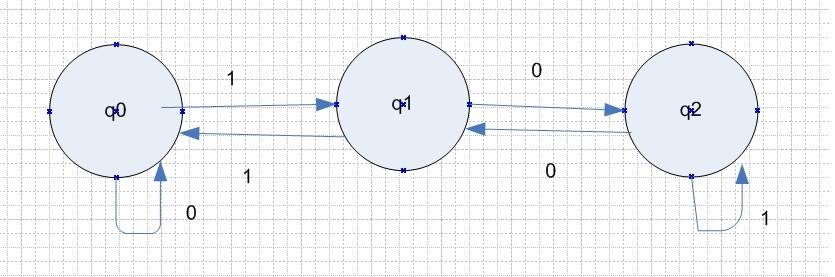
This discussion focuses on the transition rules of residue 3 automata implemented as Moore machines. The initial state is defined as q0, where an input of 0 keeps the machine in q0, while an input of 1 transitions it to q1. The discussion further clarifies that when in state q1, an input of 0 transitions the machine to state q2, based on the modulus operation of the input values. The analysis emphasizes understanding the state transitions through binary input strings and their corresponding modulus values.

PREREQUISITES
  • Understanding of Moore machines and their state transition diagrams.
  • Familiarity with residue number systems, specifically residue 3.
  • Basic knowledge of binary number representation.
  • Concept of modulus operations and their application in state transitions.
NEXT STEPS
  • Study the principles of state machines and their classifications, focusing on Moore and Mealy machines.
  • Explore residue number systems in depth, particularly residue 3 arithmetic.
  • Learn about state transition diagrams and how to construct them for different automata.
  • Investigate binary arithmetic and its implications for state transitions in finite automata.
USEFUL FOR

Students and professionals in computer science, particularly those studying automata theory, state machine design, and digital logic design.

zak100
Messages
462
Reaction score
11
Homework Statement
Create a residue Moore Machine using FA
Relevant Equations
No equations
Hi,
I am trying to create residue 3 automata using Moore. I can't understand why we go to state q1 when we have input 0 in q0 and similalry why we go to q2 when we have input zero in q1.

I have attached an image of FA.

Some body please guide me.

Zulfi.
residue three.jpg
 
Physics news on Phys.org
To analyze this, make sure to start simple.

By definition, the initial state of the state machine is q0. Let's start there.

So what if your input string is the simplest possible input string, "0". One can't get much simpler than that. So now ask yourself, what is 0 mod 3? That should tell you something about how q0 must transition when the input is 0.

Now let's change the input to the next most simple string, "1". What is 1 mod 3? This should tell you something about the transition from q0 when the input is a 1.

Continuing on, what if the input string was "10 (binary; i.e., '2' decimal.)" Ask yourself, "well, what is 2 mod 3?" Do you see now why the state must transition from q1 to q2 when the input is a 0?

Continue with the following strings:
11 (binary): What is 3 mod 3?
100 (binary): What is 4 mod 3?
101 (binary): What is 5 mod 3?
 
zak100 said:
I can't understand why we go to state q1 when we have input 0 in q0

And for clarity, that's not right. When in state q0, with input 0, the state machine stays in state q0.
 

Similar threads

  • · Replies 7 ·
Replies
7
Views
3K
  • · Replies 8 ·
Replies
8
Views
4K
  • · Replies 10 ·
Replies
10
Views
4K
Replies
1
Views
3K
  • · Replies 19 ·
Replies
19
Views
4K
  • · Replies 5 ·
Replies
5
Views
1K
  • · Replies 2 ·
Replies
2
Views
2K
  • · Replies 4 ·
Replies
4
Views
2K
  • · Replies 4 ·
Replies
4
Views
2K
Replies
29
Views
3K